
Texas ban on gender-affirming health care for minors blocked, Missouri ban allowed to take effect
Advertisement
Read this article for free:
or
Already have an account? Log in here »
We need your support!
Local journalism needs your support!
As we navigate through unprecedented times, our journalists are working harder than ever to bring you the latest local updates to keep you safe and informed.
Now, more than ever, we need your support.
Starting at $15.99 plus taxes every four weeks you can access your Brandon Sun online and full access to all content as it appears on our website.
Subscribe Nowor call circulation directly at (204) 727-0527.
Your pledge helps to ensure we provide the news that matters most to your community!
To continue reading, please subscribe:
Add Brandon Sun access to your Free Press subscription for only an additional
$1 for the first 4 weeks*
- Enjoy unlimited reading on brandonsun.com
- Read the Brandon Sun E-Edition, our digital replica newspaper
*Your next Free Press subscription payment will increase by $1.00 and you will be charged $20.95 plus GST for four weeks. After four weeks, your payment will increase to $24.95 plus GST every four weeks.
Read unlimited articles for free today:
or
Already have an account? Log in here »
Hey there, time traveller!
This article was published 25/08/2023 (1126 days ago), so information in it may no longer be current.
COLUMBIA, Mo. (AP) — A judge on Friday blocked Texas’ ban on gender-affirming health care for minors while a separate judge in Missouri allowed a similar ban to take effect, underscoring the mixed verdict in courtrooms across the U.S. this year over a historic wave of restrictions aimed at transgender youth.
More than 20 states have adopted laws to ban some gender-affirming care for minors, although some are not yet in effect or have been put on hold by courts. Many of them prevent transgender minors from accessing hormone therapies, puberty blockers and transition surgeries, even though medical experts say such surgical procedures are rarely performed on children.
Texas would be the most populous state to enforce such a ban. But state District Judge Maria Cantu Hexsel sided with a group of families who argued it would violate parents’ rights and have devastating consequences for transgender children and teenagers who would be denied treatment recommended by their physicians.
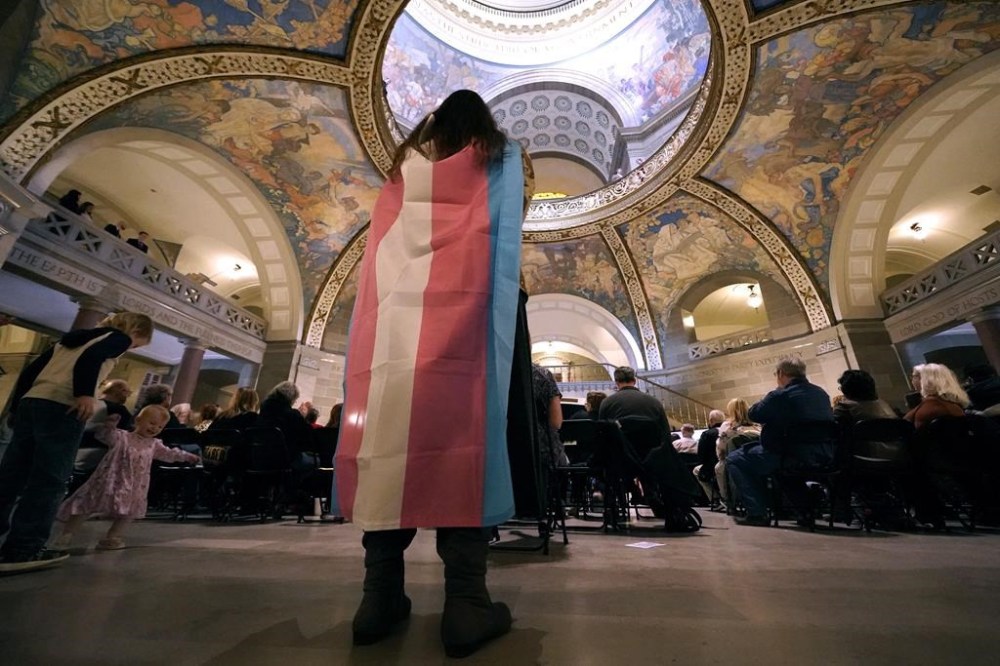
The Missouri ruling by St. Louis Circuit Judge Steven Ohmer means that beginning on Monday, health care providers are prohibited from providing gender-affirming surgeries to children. Minors who began puberty blockers or hormones before Monday will be allowed to continue on those medications, but other minors won’t have access to those drugs.
Some adults will also lose access to gender-affirming care. Medicaid no longer will cover treatments for adults, and the state will not provide those surgeries to prisoners.
Physicians who violate the law face having their licenses revoked and being sued by patients. The law makes it easier for former patients to sue, giving them 15 years to go to court and promising at least $500,000 in damages if they succeed.
The Texas ruling landed just ahead of the Sept. 1 start date for the ban. The Texas Attorney General’s office was expected to quickly file an appeal to let the law take effect.
The ACLU of Missouri, Lambda Legal, and Bryan Cave Leighton Paisner last month sued to overturn the Missouri law on behalf of doctors, LGBTQ+ organizations, and three families of transgender minors, arguing that it is discriminatory. They asked that the law be temporarily blocked as the court challenge against it plays out. The next hearing in the case is scheduled for Sept. 22.
But Ohmer wrote that the plaintiffs’ arguments were “unpersuasive and not likely to succeed.”
“The science and medical evidence is conflicting and unclear. Accordingly, the evidence raises more questions than answers,” Ohmer wrote in his ruling. “As a result, it has not clearly been shown with sufficient possibility of success on the merits to justify the grant of a preliminary injunction.”
One plaintiff, a 10-year-old transgender boy, has not yet started puberty and consequently has not yet started taking puberty blockers. His family is worried he will begin puberty after the law takes effect, meaning he will not be grandfathered in and will not have access to puberty blockers for the next four years until the law sunsets.
The law expires in August 2027.
Proponents of the law argued gender-affirming medical treatments are unsafe and untested.
Republican Attorney General Andrew Bailey’s office wrote in a court brief that blocking the law “would open the gate to interventions that a growing international consensus has said may be extraordinarily damaging.”
The office cited restrictions on gender-affirming treatments for minors in countries including England and Norway, although those nations have not enacted outright bans.
An Associated Press email requesting comment from the Attorney General’s Office was not immediately returned Friday.
Every major medical organization in the U.S., including the American Medical Association, has opposed bans on gender-affirming care for minors and supported the medical care for youth when administered appropriately. Lawsuits have been filed in several states where bans have been enacted this year.
“We will work with patients to get the care they need in Missouri, or, in Illinois, where gender-affirming care is protected under state law,” Yamelsie Rodríguez, president and CEO, Planned Parenthood of the St. Louis Region and Southwest Missouri, said in a statement after the ruling.
The Food and Drug Administration approved puberty blockers 30 years ago to treat children with precocious puberty — a condition that causes sexual development to begin much earlier than usual. Sex hormones — synthetic forms of estrogen and testosterone — were approved decades ago to treat hormone disorders and for birth control.
The FDA has not approved the medications specifically to treat gender-questioning youth. But they have been used for many years for that purpose “off label,” a common and accepted practice for many medical conditions. Doctors who treat trans patients say those decades of use are proof the treatments are not experimental.
____
Vertuno reported from Austin, Texas.