
New Keystone mural has story to tell
Advertisement
Read this article for free:
or
Already have an account? Log in here »
We need your support!
Local journalism needs your support!
As we navigate through unprecedented times, our journalists are working harder than ever to bring you the latest local updates to keep you safe and informed.
Now, more than ever, we need your support.
Starting at $15.99 plus taxes every four weeks you can access your Brandon Sun online and full access to all content as it appears on our website.
Subscribe Nowor call circulation directly at (204) 727-0527.
Your pledge helps to ensure we provide the news that matters most to your community!
To continue reading, please subscribe:
Add Brandon Sun access to your Free Press subscription for only an additional
$1 for the first 4 weeks*
- Enjoy unlimited reading on brandonsun.com
- Read the Brandon Sun E-Edition, our digital replica newspaper
*Your next Free Press subscription payment will increase by $1.00 and you will be charged $20.95 plus GST for four weeks. After four weeks, your payment will increase to $24.95 plus GST every four weeks.
Read unlimited articles for free today:
or
Already have an account? Log in here »
Hey there, time traveller!
This article was published 29/08/2023 (1126 days ago), so information in it may no longer be current.
Connection between the Indigenous and non-Indigenous people of Canada is depicted in strokes of brilliant colour and imagery above a main door at the Keystone Centre.
The mural — the Keystone’s first Indigenous one — is the work of artist Jeannie Whitebird, who lives in Selkirk and is a member of Rolling River First Nation, and international muralist Charlie Johnston, who collaborated on the project.
Revealed in the large-scale mural is not only the story of creation from Anishinaabe tradition, but the ways in which nature works together and the ways people can work together as well, regardless of where they are from.
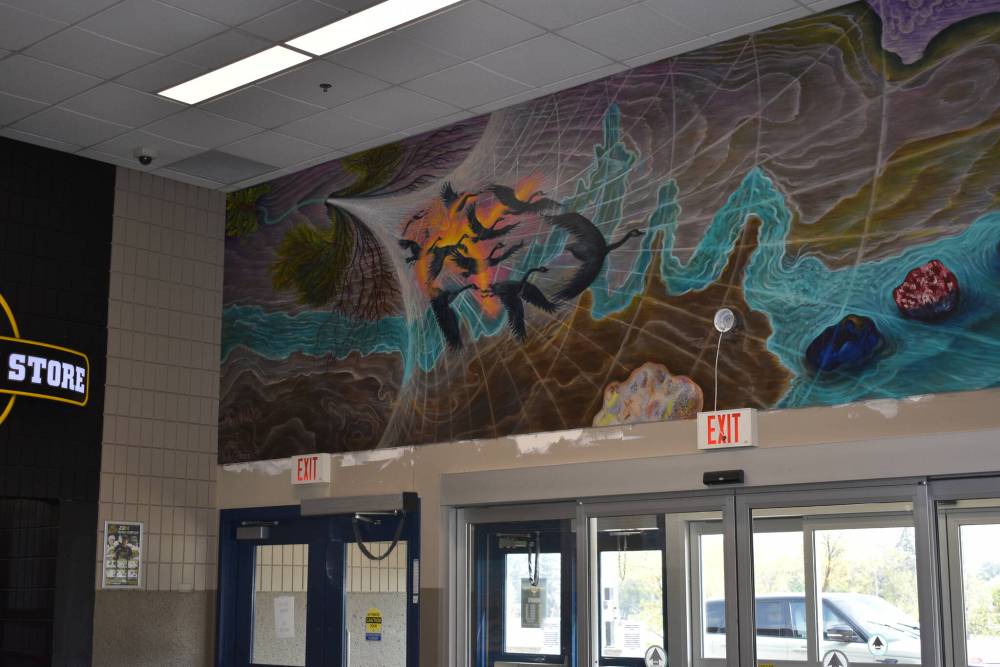
A mural entitled "Bimaadiziwin," the Anishinaabemowin term for The Journey, was painted last week above the main doorway at the Keystone Centre. (Geena Mortfield/The Brandon Sun)
“We’re in a time of reconciliation all across Canada, and each community, whether we are on reserve or off, is feeling the intensity of the emotions,” Whitebird told the Sun. “It affects how we are comprehending truth, how we are sharing the truth and moving forward.”
Many Indigenous people are still healing from the intergenerational effects of colonialism, Whitebird said. She is a third-generation survivor of the residential school system, and she was adopted out of her home community of Rolling River First Nation under Canada’s ’60s Scoop policy, which saw Indigenous children taken from their families and communities and placed in the care of non-Indigenous people, some who lived outside of Canada. The journey she has been on to heal from that trauma has been very difficult, but has also been intensely rewarding, she said.
“Through a complete immersion in cultural teachings, by way of ceremonies and culture, facilitated and directed by elders … I’ve come to have a constant connection with people in my community,” Whitebird said. “That has been a beautiful journey.”
Whitebird has previously painted a mural in Selkirk honouring missing and murdered Indigenous women and girls in 2021. When the Keystone Centre reached out to her to paint a mural in Brandon, she knew the theme she wanted to go with — one that reflected how far society has come, even though there remains a lot of work still to be done.
The title of the piece is “Bimaadiziwin,” the Anishinaabemowin term for The Journey. Her cousin, First Treaty Commissioner Dennis Whitebird, a knowledge keeper from Rolling River First Nation, spoke with her about the significance of Bimaadiziwin, the Anishinaabe creation story.
“There’s so much beauty in this creation story,” Whitebird. “There’s so much symbolism, and stories with story. There’s so much in there.”
Working with Johnston, who Whitebird met when he mentored her in a mural program, has been an enriching experience for her, she said.
“My artistic creation is flourishing with his help and expertise in technical, practical things, because I am learning everything about murals — from the inception of the design all the way through to the final installation of a large-scope mural piece.”
Johnston has also been able to learn Indigenous culture from Whitebird, who says he has always been respectful and passionate about letting the culture speak for itself.
“He stepped back and allowed the Indigenous voice to be amplified,” Whitebird said. “At the same time, he continues to make sure he is doing what he can to foster reconciliation.”
Whitebird was touched when the Keystone Centre reached out to her to ask her to paint the mural, saying it points to the fact that, while there is still a lot of work to be done for truth and reconciliation, steps are being taken in the right direction.
“Good on the Keystone for wanting to take this journey, by challenging themselves, by having awareness that they are in a community…with a population of Indigenous people,” she said.
A mural has been something that the Keystone Centre has been looking at for a while, director of marketing and ticketing Jared McKenzie told the Sun.
He said that previously getting a mural was complicated by multiple factors, like finding an artist, getting the funding and being able to have the artist complete the mural in between events at the Keystone.
“[The mural] happening now is kind of a happy coincidence of a bunch of things kind of coming together all at once,” McKenzie said.
The director said that the Keystone looked at a number of Manitoba muralists, but Whitebird was referred to them and the facility was impressed with the work that she has done with Johnston.
He said that the spot for the mural — above the main entrance of the Keystone — was chosen because the facility wanted the piece to be as visible as possible.
“Our goal with the piece was to increase the Indigenous visibility within the building,” McKenzie said, adding that the Keystone sees a diverse population walk through its doors. “It’s important that representation is visible when they come here, so that when we say that we are a community centre, [that] it speaks to the entire community.”
McKenzie said that a plaque will soon accompany the mural and that the Keystone hopes to add more murals throughout the facility.
“We spoke [with Whitebird] about the potential for adding to the story throughout the building,” he said.
When people look at the mural, Whitebird hopes that they will see not just a creation story but a story of how all people and all creatures are connected. She also hopes that everyone, whether Indigenous, non-Indigenous, settler descendants or new Canadians, will be prompted to learn more about Indigenous teachings and culture.
“A great place to start is to understand that, as First Nations people, we are directly connected to the land, and that the voice of the land has to be heard,” she said. “And we have a direct connection. We invite our relatives who form other parts of the world to come and share spaces.”
» mleybourne@brandonsun.com
» X: @miraleybourne
» gmortfield@brandonsun.com
» X: @geena_mortfield