
Walking for suicide prevention
Advertisement
Read this article for free:
or
Already have an account? Log in here »
We need your support!
Local journalism needs your support!
As we navigate through unprecedented times, our journalists are working harder than ever to bring you the latest local updates to keep you safe and informed.
Now, more than ever, we need your support.
Starting at $15.99 plus taxes every four weeks you can access your Brandon Sun online and full access to all content as it appears on our website.
Subscribe Nowor call circulation directly at (204) 727-0527.
Your pledge helps to ensure we provide the news that matters most to your community!
To continue reading, please subscribe:
Add Brandon Sun access to your Free Press subscription for only an additional
$1 for the first 4 weeks*
- Enjoy unlimited reading on brandonsun.com
- Read the Brandon Sun E-Edition, our digital replica newspaper
*Your next Free Press subscription payment will increase by $1.00 and you will be charged $20.95 plus GST for four weeks. After four weeks, your payment will increase to $24.95 plus GST every four weeks.
Read unlimited articles for free today:
or
Already have an account? Log in here »
Hey there, time traveller!
This article was published 12/09/2023 (1150 days ago), so information in it may no longer be current.
SIOUX VALLEY DAKOTA NATION — There is no word in the Dakota language for suicide, says Koda Tacan, a member of Sioux Valley Dakota Nation.
Despite this, Manitoba’s rate of suicide leads the nation at 13.5 per 100,000 people versus the Canadian average of 11.5 per 100,000, according to a report by the Manitoba Centre for Health Policy. And Statistics Canada says that suicide rates among First Nations people, Métis and Inuit were significantly higher than the rate among non-Indigenous people. Among First Nations people living on reserves, the rate was about twice as high as that among those living off reserve.
In the face of this, the community of Sioux Valley Dakota Nation, located 50 kilometres northwest of Brandon, is sharing a message of hope and education with its young people.
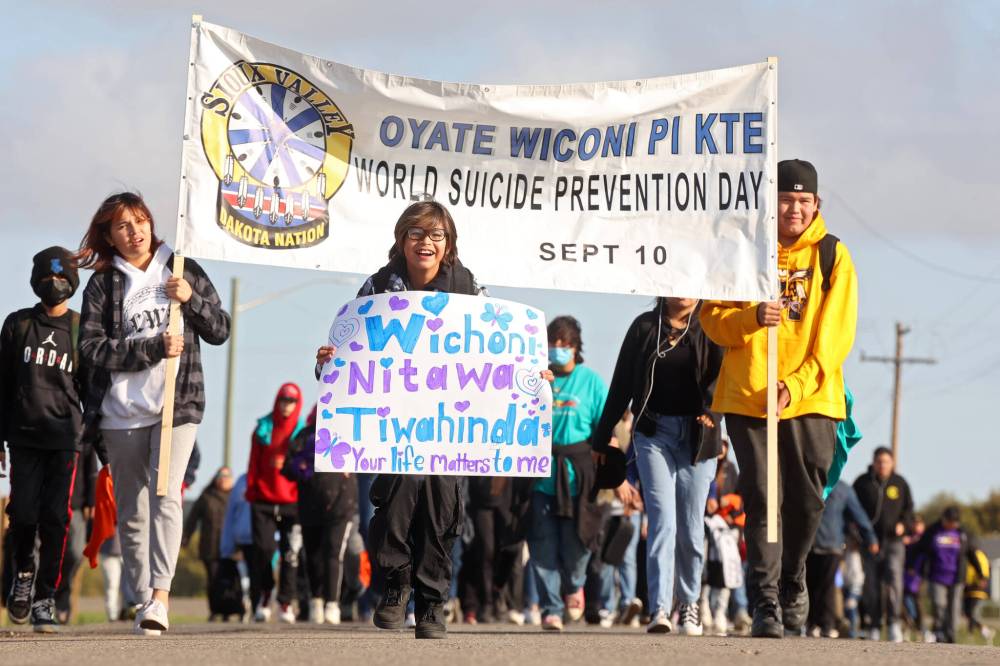
Students and community members take part in a walk on Monday to mark World Suicide Prevention Day at Sioux Valley Dakota Nation. (Tim Smith/The Brandon Sun)
Students, teachers and staff from Sioux Valley High School, staff from the Sioux Valley Health Centre, elders and community members gathered at the health centre on Monday morning to walk to the powwow grounds beneath a banner raising awareness for World Suicide Prevention Day, which had taken place the day before.
Suicide has a devastating effect on entire communities, said Tacan, who shared his experiences working at the Sioux Valley Fire Department.
“When something like that occurs, it leaves everyone wondering, ‘what could I have done,’ and ‘what could I do that’s going to be different in the future?’”
Having lost a close friend to suicide, and having responded to suicide calls in his role as a firefighter, the former firefighter said it’s something he still finds difficult to talk about.
Despite this, he chose to share his words with the youth of his First Nation in hopes that it will motivate them to reach out when they need help or when they think their friends and peers might — and to not be afraid to discuss mental health challenges.
“Don’t hesitate. Don’t hold back. Talk to each other,” Tacan said. “Please reach out.”
If someone notices a change in behaviour in a loved one or friend, it doesn’t make them a bad person to alert someone else who could help them, Tacan stressed. He also reminded the youth in attendance of the places that are safe to reach out if they’re feeling suicidal or suspect someone they know is, from the school to the health centre, to Dakota Tiwahe Services, the child and family services organization on the First Nation.
“We have a lot of different resources that can help us in these battles. We don’t have to fight them by ourselves,” he said. “If you guys need somebody, please go and find the help you need.”
There’s also no shame in receiving therapy, Tacan said, sharing that it’s something he did for many years while he was grappling with the things he experienced in his career that helped him get to a healthier place.
Statistics back up Tacan’s own personal experiences. The Psychiatric Times published an article in 2018 that said that in randomized trials, cognitive behavioural therapy-based interventions demonstrated effectiveness in reducing suicidal behaviour. Other therapies such as dialectical behavioural therapy and mentalization-based therapy led to a reduction in self-harm in adolescents.
A counselling office and a new mental health worker is now available at Sioux Valley High School, said the school’s guidance councillor, Corrine Harper. Suicide is something that both adults and students have to recognize, she said.
Suicide can affect even people that others might not expect to have mental health struggles, Harper said.
“Lots of times we hear and see people around who are always looking happy, and all of a sudden something happens in their life that they can’t handle. So, when something like that happens, find someone,” she said. “Your aunties or uncles, or your older siblings, your parents — it is so important to find someone. There’s always a friendly face around. You need to find someone.”
Guidance councillors at the high school will be going around to each class and talking about the resources that are available to students and their families.
The bottom line, Harper said, is that people would rather hear about people’s problems and help them with them — or point them in the right direction to find help — than attend the funeral of a loved one lost to suicide.
“It’s the family that’s left behind that suffers the most. For years and years later, and there’s always the question of why — why did they do this?”
Harper told the students not to be afraid to call 911 or other emergency numbers if they feel they are making a plan to commit suicide or if they believe a friend of theirs is planning to do so.
“It’s very easy to call 911 and tell them what’s going on. Everybody should just say, ‘I’m going to do this, because I’d rather them be mad at me than go to their funeral,’” she said. “I’ve had a few kids come to me and say, ‘how come you called 911 on me?’ Well, hello, you’re here at school, we’re not coming to your funeral.’ I would much rather say that.”
Higher rates of suicide among First Nation, Métis and Inuit people has been suggested to be the result of historical and intergenerational trauma experienced as a result of colonization and ongoing marginalization, according to a report by the Aboriginal Healing Foundation.
In an interview given to the Sun at the beginning of September, Sioux Valley Dakota Nation Chief Jennifer Bone said healing efforts made by First Nations must be supported by all levels of government.
“There’s healing that has to happen amongst our people, and that goes back to the government and what they’re doing to support us, to ensure that our people are healthy and that they can lead healthy lives and heal from that intergenerational trauma,” she said.
» mleybourne@brandonsun.com
» X: @miraleybourne