
Council revisits genocide motion
Advertisement
Read this article for free:
or
Already have an account? Log in here »
We need your support!
Local journalism needs your support!
As we navigate through unprecedented times, our journalists are working harder than ever to bring you the latest local updates to keep you safe and informed.
Now, more than ever, we need your support.
Starting at $15.99 plus taxes every four weeks you can access your Brandon Sun online and full access to all content as it appears on our website.
Subscribe Nowor call circulation directly at (204) 727-0527.
Your pledge helps to ensure we provide the news that matters most to your community!
To continue reading, please subscribe:
Add Brandon Sun access to your Free Press subscription for only an additional
$1 for the first 4 weeks*
- Enjoy unlimited reading on brandonsun.com
- Read the Brandon Sun E-Edition, our digital replica newspaper
*Your next Free Press subscription payment will increase by $1.00 and you will be charged $20.95 plus GST for four weeks. After four weeks, your payment will increase to $24.95 plus GST every four weeks.
Read unlimited articles for free today:
or
Already have an account? Log in here »
Hey there, time traveller!
This article was published 15/09/2023 (1094 days ago), so information in it may no longer be current.
A new draft of a motion that would have the City of Brandon acknowledge the residential school system as genocide has been created ahead of a vote on the matter later this year.
In May, the Brandon Urban Aboriginal Peoples’ Council recommended to Brandon City Council that it pass a motion making the acknowledgment as an act of reconciliation.
The motion as proposed by BUAPC earlier this year would have the city state that in its opinion, the Government of Canada must acknowledge the residential school system as genocide as recognized by Pope Francis during a visit to Canada last year, through the House of Commons passing a motion with unanimous consent last year and in accordance with the United Nations Convention on the Prevention and Punishment of the Crime of Genocide.
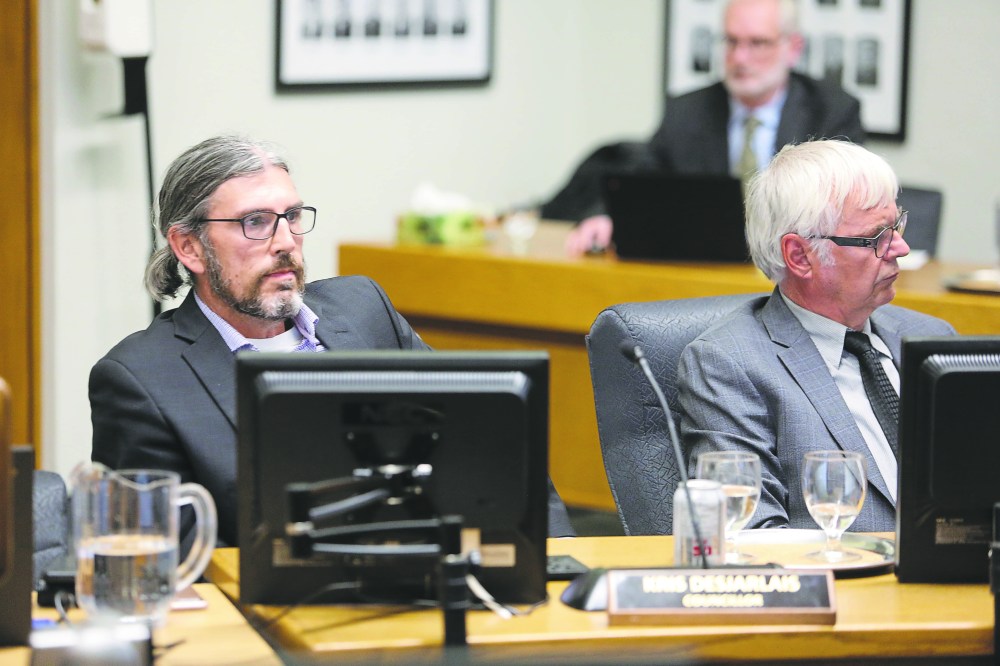
At the time of the original BUSU recommendation, no council members disputed the harms of residential schools. However, Coun. Shawn Berry (Ward 7) expressed concerns about the potential legal ramifications of such a declaration. Mayor Jeff Fawcett wondered why the notice mentions the federal government, since it would be a local declaration.
The new proposed motion, presented at a special meeting held Monday evening, was more Brandon-centric:
“The City of Brandon Council recognizes that what happened in Canada’s Indian Residential School system, including Brandon Indian Residential School, describes genocide. This had the effect of creating long-lasting, traumatic repercussions for the Indigenous peoples of southwestern Manitoba, including Brandon urban Indigenous people who call Brandon home.”
In talking about the revised motion, director of legislative services Renee Sigurdson talked about the United Nations’ definitions of genocide and how there is a difference between the legal and descriptive uses of that term.
This motion, she said, uses the descriptive use of genocide. Sigurdson added it’s unlikely Canada will be prosecuted for genocide, but that could change in the future, and distinctions like this could be a small factor in that change.
The mayor said the new motion made him more comfortable because it is a strong gesture of reconciliation to the people in the region that council represents.
“It falls in line with things we’ve been doing … we have not been doing political actions and the initial statement is very political.”
Coun. Barry Cullen (Ward 3) also expressed that he was more comfortable with the new motion, saying the term genocide scares him immensely.
“Because what it is that I’m being asked to accept in some definitions is mass murder, extermination, mass graves in comparison to Rwanda, in comparison to the Holocaust,” Cullen said.
“I understand and totally agree that this was forced assimilation. As a colonial society, we removed children from their homes. We took them to educational facilities, and in some cases we abused those people and they passed away at those facilities.”
In listening to local elders like the late Doris Pratt and Gladys Cook as well as going to see Truth and Reconciliation Commission chair Murray Sinclair speak at Brandon University in the past, Cullen said he never heard the term genocide be used.
He said he was scared that he was being asked to say on behalf of his constituents that residential schools were something akin to the extermination of entire peoples.
Arguing in favour of the city recognizing residential schools as genocide, Coun. Kris Desjarlais (Ward 2) said two of the UN’s definitions of the act — imposing measures to prevent births of a group and transferring children out of a group to another — took place in Canada.
In 2022, a report by the Senate of Canada acknowledged the country had engaged in the forced and coerced sterilization of First Nations, Métis, Inuit, Black and disabled people. The sterilization of Indigenous women, the report said, started in the 1920s.
Though he was in favour of localizing the motion, changing the language to say it describes genocide rather than calling it genocide directly was something Desjarlais said he was worried was watering down its impact.
At one point, Coun. Glen Parker (Ward 9) said he was worried about the impact of the motion on people in the area who worked at the local residential school, didn’t participate in abuse and did their best for the children there, though he acknowledged that doesn’t change what happened at the schools.
Desjarlais’ rebuttal was that for a long time the only history taught about the schools was that they were good and necessary. That there were good people working at the schools doesn’t change the fact that genocide occurred at them.
Coun. Shaun Cameron (Ward 4) noted that the Truth and Reconciliation Commission discussed the act of cultural genocide — not necessarily the destruction of people, but their culture.
When that commission was preparing its final report, Maeengan Linklater of Dakota Ojibway Tribal Council said it wasn’t within its mandate to discuss the UN’s definitions of genocide. The next best alternative was to adopt the definition of cultural genocide.
Linklater was the person who first proposed the motion to city council in May on behalf of the BUAPC.
At the time, he said Brandon’s acknowledgment would not only be a chance to advance reconciliation and educate Canadians about the impact of colonization, but also help progress the issue at the federal level. He gave the example that the Criminal Code of Canada only recognizes two of the five definitions of genocide listed by the United Nations.
On Monday, he said there had been elements about cultural genocide in early drafts of the UN’s work but that Canadian diplomats had worked to remove them.
The city’s revised motion, he said, acknowledges what happened in the past and takes into consideration what happened within Brandon in a genuine manner.
Whether council approves of the use of the word genocide or not is beside the point because it’s their duty as leaders to educate residents, Coun. Heather Karrouze (Ward 1) said.
“We know serious bodily and mental harm did occur,” she said. “We know there was a deliberate intent to destroy a culture and a language … I don’t want us to water down or minimize the trauma that was inflicted by the school system because we don’t like the word genocide.”
The chair of BUAPC, Sioux Valley Dakota Nation Chief Jennifer Bone, said genocide is an accurate term to describe what happened at residential schools.
“The children were forcibly removed from the community, forcibly removed by the RCMP,” she said.
“They were enforcers of the federal policy that wanted our Indigenous children to be assimilated into the mainstream society, to kill the Indian in them, to take away their language, their way of life, their culture. Not only that, but there was the abuse, the starvation that was inflicted on these children.”
In present day, Bone said she is still dealing with the legacy of residential schools by advocating for the unmarked graves of those who never came home and listening to the stories of survivors.
The chief spoke about how experiences at residential schools dissuaded members of her family from wanting to pass on the Dakota language and culture to future generations.
“I grew up in Sioux Valley, but my dad had that mentality that he didn’t want me to learn the language because that’s what was brought to them at residential school,” Bone said. “They weren’t proud of who they were. When we were younger, they wanted us to be assimilated into the culture, to be colonized.”
Having Dakota taught at her community’s school and to the nation’s employees — whether they are Indigenous or not — is something she said is a key part of reconciliation to her. Without the language and culture, Bone said they are not Dakota people.
She noted the irony in the federal government, which once tried to suppress Indigenous languages, now providing funding to help promote them.
“We’re in a critical time right now in Sioux Valley, and I’m sure it’s the same way in any other community because we’re losing our language speakers, our fluent language speakers, those knowledge keepers that have retained their language through all of this history and legacy of the residential schools.”
The vice-chair of BUAPC, Jeanine Pelletier, told city council her wish before she leaves this Earth is that something like the residential schools never happens again.
“I worry about my children, I worry about my grandchildren,” Pelletier said.
“I worry about those things, what’s going to happen to them should this ever come across again. We want to prevent that from happening, and you guys are in a position to stop that, to make history with that. That’s what we’re asking, that’s what we mean when we talk about reconciliation and we hear the word that we’re so scared of. That’s ‘genocide.’ I don’t even like using it, I’m uncomfortable with it … but at the same time, I feel for what happened for my mom, my dad, my grandparents, my uncles.
“I lost it all. I don’t even have my culture. Apparently, I spoke Cree. I can sing you a song in Cree, but I don’t know what it means. You hear these stories all over our communities when you hear our elders speaking, our knowledge keepers speaking. These things really did happen, and I know you guys believe us. All I’m thinking is about the future.”
Council has sent the motion to its Oct. 3 meeting for discussion and a vote.
» cslark@brandonsun.com
» X: @ColinSlark