
Kinew eager to work with city
Advertisement
Read this article for free:
or
Already have an account? Log in here »
We need your support!
Local journalism needs your support!
As we navigate through unprecedented times, our journalists are working harder than ever to bring you the latest local updates to keep you safe and informed.
Now, more than ever, we need your support.
Starting at $15.99 plus taxes every four weeks you can access your Brandon Sun online and full access to all content as it appears on our website.
Subscribe Nowor call circulation directly at (204) 727-0527.
Your pledge helps to ensure we provide the news that matters most to your community!
To continue reading, please subscribe:
Add Brandon Sun access to your Free Press subscription for only an additional
$1 for the first 4 weeks*
- Enjoy unlimited reading on brandonsun.com
- Read the Brandon Sun E-Edition, our digital replica newspaper
*Your next Free Press subscription payment will increase by $1.00 and you will be charged $20.95 plus GST for four weeks. After four weeks, your payment will increase to $24.95 plus GST every four weeks.
Read unlimited articles for free today:
or
Already have an account? Log in here »
Hey there, time traveller!
This article was published 27/09/2023 (1110 days ago), so information in it may no longer be current.
Following the Brandon Chamber of Commerce debate on Tuesday morning, NDP Leader Wab Kinew joined the Brandon Sun editorial board for a brief discussion about the ongoing election campaign. What follows below is part of his conversation with editor Matt Goerzen. The interview has been edited for length and clarity.
MG — The PCs have been promising tax cuts. They brought forward legislation to try to whittle down even further the education tax on property. You’ve agreed to keep that, at least a portion of it, as it is, and trying to further make living more equitable for Manitobans. How do you all at once, promise to do that? Keep taxes, lower, not increase hydro rates, and in fact, lower them. And still promised to pay for things like that need solid investments, such as health care, education being another one infrastructure. How do you do that and then balance the budget at the same time in what you said would be your first term?
WK — Yep. So it is our commitment to invest in health care, and then helping people with affordability measures while moving towards a balanced budget. And the short answer is we have the money in the budget right now. So under the PCs, and they started this during the pandemic, there’s basically half a billion dollars in unallocated money in the budget each year $520 million. If we just tell you right now that instead of keeping half a billion in unallocated money, that we’re going to spend this much of that on health care that much of it on affordability measures, and this much on investments in the future of our economy. And if you sum everything up that we’ve rolled out over the course of the campaign, it’s less than that amount of unallocated money in the budget. And then basically just moving forward over the next four years, we maintain those investments in health care, well, improving the overall fiscal situation.
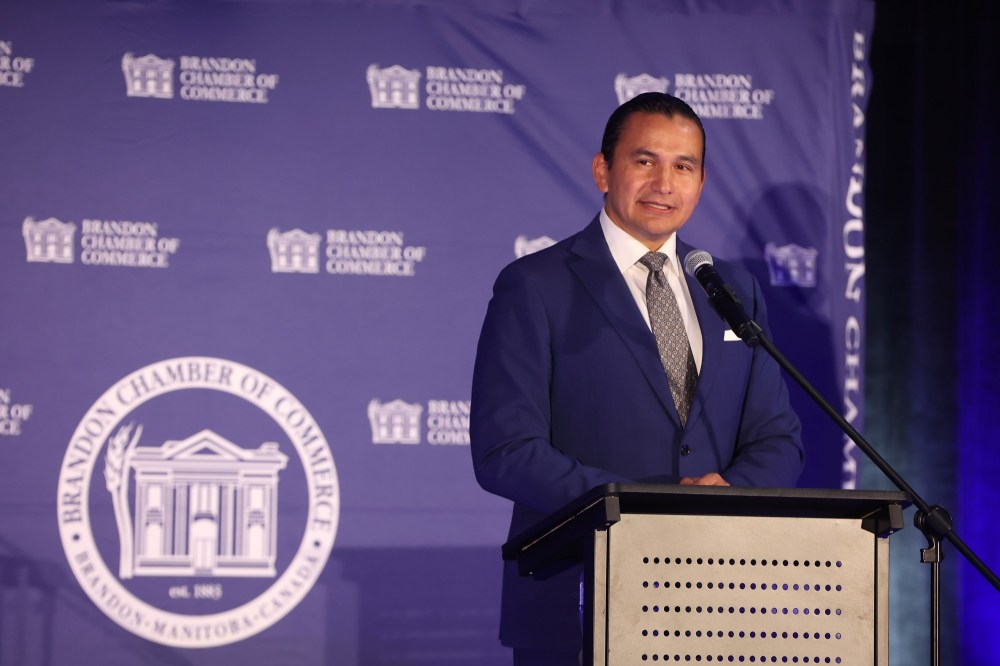
NDP Leader Wab Kinew speaks during the Brandon Chamber of Commerce debate at the Keystone Centre’s UCT Pavilion on Tuesday morning. (Tim Smith/The Brandon Sun)
MG — That’s health care. I mean, there are good investments. Tories have promised four new schools across the province. That’s not cheap. If you were to maintain those promises, and keep building those schools, which in Brandon it’s still necessary. I’m assuming that you wouldn’t be using the P3 model.
WK — No, actually, Brandon was the community that I think stopped the P3 thing from being implemented under (Brian) Pallister. We saw the canvassing and community townhall meetings, and I attended some of them. And so I took that very seriously. And that’s the reason why the you know, Maryland Park was built quickly. The concerns around P3s are around quality, but also them being more expensive and less opportunity for local people to work on a job site.
MG — So is that one of the ways in which you can trim costs?
WK — Yeah, we’d certainly be open to it. I mean, we’re going to have to see what we’re left with, you know. If we do earn the right to form government in Manitoba, my preference is to build schools using the public approach because it creates good jobs and you get higher quality buildings for the students.
MG — Back to the original point. You can see when the Tories came to power, and they promised a balanced budget. That meant to municipalities that they were put into a grant freeze. It was only this year, earlier this year that the freeze was lifted to a certain extent. When you have two major parties talking a balanced budget approach, do you think that there is a concern among municipalities and municipal leaders that we’re going to return right back to where we were with a grant freeze?
WK — Well, I hope not …
MG — Is there anything that you could say … I don’t know if guarantee is the right word …
WK — There won’t be a freeze under us. I can guarantee that. And the PC should clarify if their 2023 budget means a freeze for municipal operating funding going forward. We’re counting on predictable increases, and we’ve made the commitment to not only have no freeze, but also that we would provide a funding picture over the term of government. So municipal leaders would know what to expect in subsequent years, should we earn the right to form government.
MG — Let’s move on to the City of Brandon for a moment. OK. We have watched successive councils struggle with having to pay for increases and changes and growth, first from the to lift stations that we’ve got to wastewater treatment. We’ve got now unexpected costs that maybe were unexpected 10 years ago like fixing the Sportsplex, the ice rink the renovations there. How much of that is on the council? And how much can the province step into help?
WK — Well, I certainly like to help. And I’d like to work with the municipal leaders here in Brandon to ensure that we, we are a good partner. We certainly have been following a lot of issues closely. And like when the lift stations were projected to result in a big hit for the ratepayer here in Brandon, that was a big concern. And so to see the council has maybe moderated that forecast and things look like they’re going to be more affordable is a relief. But certainly, we know that the City of Brandon is going to continue to grow both in terms of residential, but also commercial and industrial development. The North Hill hosting the prairie Innovation Centre is significant. And we just want to make sure that these investments happen in a way that’s conducive to growing the local economy because that benefits everyone in Manitoba.
MG — (The City of Brandon) has a real problem going forward because they’re getting very close to what Deveryn Ross and myself have talked about, the debt ceiling. How do we avoid that as a city? Is there anything that the province can do to help us kind of lower those costs?
WK — Well, I think going back to that operating funding is a significant piece and especially in a city like Brandon, where you not only have infrastructure and community services, but you also have a police department. We need to make sure that the operating funding is adequate. And then when it comes to specific initiatives, then I think that that’s something we should work on together — a partnership. We’re happy to be collaborative and open and, you know, Mayor Fawcett just started to lay some of these issues out and one of our previous conversations is, here’s my cellphone. Let’s talk about this anytime. And I’m committed that there’ll be an open line of communication. For him as a leader and other members of council, but also to the community of Brandon. We want to ensure that there’s good representation geographically.
MG — I’ll harken back for a moment to the last municipal election. And Fawcett saying that he wanted Brandon to fulfil its role as Manitoba second-largest city. There is a feeling and it’s been pervasive for as long as I’ve been here, that Brandon gets short shrift when it comes to attention from the province and projects … and aid to bring larger businesses here. Do you see it that way?
WK — Yeah, I think if I could generalize, I think folks in the Westman too often feel ignored or under appreciated. And I think nowhere is that more apparent than in health care. I mean, I take a province wide view of health care, I’m passionate about health care for everyone in Manitoba. And while regions like the Interlake, and the city and the north have had no shortage of health-care challenges, I think everyone would agree that Prairie Mountain Health has had so many closures, so many issues with agency nurse use skyrocketing, that it really just seems like the health-care situation in Prairie Mountain is particularly acute in terms of the need to fix the situation here. We were talking about hydro hookups at the debate and the need for increased electrical capacity here in Brandon, and on through from health care and economic issues, just to the broader questions of investments to grow the region. One of the things that I’ve been talking about is an infrastructure panel, to ensure that when we’re talking about making investments to build the provinces economy in the future, that we have representation from the region, we have voices of community, voices of industry, from this part of the province, fighting to make sure that the Westman region and Brandon in particular, gets its fair share.
MG — I assume that would also pertain to post secondary education.
WK — Yeah.
MG — That came up in the debate this morning. We have also a what would you call it a grand design for ACC, a master plan that was a 15-year master plan that included renovations to the Parkland building, which has been for seven years sitting there festering. The Tories say they put $10 million into figuring out what’s going to go there. What do you see as a potential investment for ACC to complete the work done at the North Hill Campus?
WK — Well, I think in addition to the 10, that’s already been allocated, there’s a need for an additional 60. In terms of a capital commitment to ensure that that project of the Prairie Innovation Centre and the more general future of ACC, proceeds in a good way. And so we’re committed to that. And here, I don’t think any of us as elected officials can take credit. It’s the leadership of ACC, it’s the leadership of the fundraising committee, spearheaded by ag industry leaders in the region, and other members of the community that have clearly said, this is a priority. This is good for Brandon, this is good for AG, this is good for the West man. And so I think when the voice of the community speaks that clearly and people put their money where their mouth is to the extent that they have, the province has a responsibility to ensure that the resources are there. And so we’ve accounted for this in our in our fiscal plan, and we would ensure that the provincial share is covered not just for the planning, but also for the construction and development.
MG — The liberal platform includes the creation of a medical school, a satellite office of the University of Manitoba, here at BU. I know it would be stealing from another party’s platform. But is that something that would be considered under a new NDP administration? Because it was considered under previous NDP.
WK — Yeah, no, we’ve committed to it when we did our health-care announcement at the Brandon East campaign office. We made that commitment along with the primary care teams and minor injury and illness clinic model. And I think what I would say though, is I would want it to be a partnership with Brandon University. Like in order to deliver medical training, the University of Manitoba has to have a role. And so part of our Bannatyne campus expansion, we’ll see those seats expand. But I think there should also be a partnership with Brandon University to ensure that we’re maximizing the local know how and local opportunity for the university here in town to continue to flourish and to keep pace with investments in the health-care system. I think our commitment would be for 10 doctor training seats, but to ensure that BU has a place in delivering it.
MG — The PCs are currently using the phrase — and they use this often — “Our government will always defend, not defund, the police.” It’s been used by the premier. It’s used by Minister Goertzen and Len Isleifson. It implies that the NDP would like nothing better than to slash police budgets and cut police numbers at a time when Manitobans are feeling less secure. What do you say to the accusation that the NDP are not going to be strong on crime because … you … are at the helm?
WK — I will never defund the police. And we’ll work with law enforcement to do something the PCs never did, which is to crack down on drug trafficking. The PCs have been hard on people with addictions, and they’ve been soft on drug traffickers. And so we know that we can do far better on the situation with drugs in our communities. And I think that we should give law enforcement strong tools to build cases against people who are bringing toxic drugs into our community.
MG — With all due respect, what proof do you have they’re not tough on drug dealers?
WK — Well, look out your window or walk through downtown Brandon. Go anywhere in the province and tell me if drugs are worse than when the PCs took office. I think everyone would agree that they are. What specific measures have they brought in place to crack down on drug trafficking?
MG — I would argue that and I only say this because I watched the police reports come in and read them every every day. At least once a week, they’re talking about someone that they’ve arrested where how many kilograms of this or that kind of drug has been seized. I mean, it’s not like it’s not happening.
WK — No, but that’s law enforcement. Right? What have the PCs done by way of new initiatives?
MG — Are you expecting the, you know, justice minister to go out there with a tactical uniform?
WK — Well he could give tools to law enforcement to help them build cases. Right now, the PCs claim they’ve taken a step in this direction, but it’s only after the fact. It’s about proceeds of crime. And you know, if somebody’s in the court system, being able to go after them after they’ve been charged. But what I’m saying is, we should have an unexplained wealth act here in Manitoba that says, listen, if you’re a gangster driving $100,000 car, we’re going to ask, how did you get that? And if you can’t explain it, then we’re going to hold you accountable.
MG — Is that before or after they’re in the system?
WK — Before. This would help build a case.
MG — So how do you tell whose a gangster?
WK — Well, people who are under surveillance by law enforcement. This is an additional tool that a law enforcement officer who may be building a case against somebody could use to bring charges and to hold people accountable, who are bringing toxic drugs into our community. And so I would just encourage, you know, your readers to reflect on the following. The PCs are making a series of increasingly desperate claims. And why are they doing that? Why are they saying things that are untrue? It’s because they know that when it comes to safety, things feel worse now. And it’s happening under their watch. And so I think the cause of their desperation on this topic is the fact that they’ve been at the helm. And they’ve been very ineffective at keeping you safe. We’ll do better.
MG — Your party and yourself, members of your team have been under a great deal of spotlight from the Tories. They’re … trying to highlight histories of people who are on your team, as if these people are somehow bad, or you’re going to do that because you were charged with something once. And this is not just yourself. How do you react to things like this? And how do you push back?
WK — What I’ve done, the entirety of the campaign is to have a message of bringing Manitobans together to do the big things that need attention, like fixing health care, and making life more affordable. And the reason why the PCs resort to the American style attacks is because they know they can’t win an election talking about health care, they can’t win an election on tackling inflation, because under their watch, those things have gotten worse. And so our tactic is going to be to respond as appropriate, you know, when issues arise, but to focus on the big issues that matter to Manitobans, which is health care, which is lowering cost of living for the average family.
MG — So I guess my point is that they’re making character attacks.
WK — Yeah. And we’re making policy commitments, and we’re running on a vision for the future of Manitoba.
MG — During the televised debate back on the 21st, you said something that caught my attention. You said: “There’s no need to wait for other levels of government to take action on bail reform.” And then you promised to implement bail reform at the provincial level, and direct the Ministry of Justice to implement stronger conditions on bail, to keep (people) safe in the community.
WK — What I’m talking about is the policies that exist at the provincial level, which are not always legislative. There’s policies around what a Crown seeks, in terms of him being in court. There are policies in terms of general guidelines around bail, which exists in the Justice Department. Those are areas where the provincial government can influence things, can take action. The reason why I framed things the way that I did on the TV debate is we also have to be mindful the separation between elected officials and the administration of the justice system in our province. So a politician can’t direct: Hey, you go seek higher bail conditions in this one specific instance. But elected officials could say, Ministry of Justice, we think bail is a major issue that needs attending to, in order to keep people safe in Manitoba. Now, using your expertise, please develop a new set of approaches that will help guarantee that bail serves the public good in our province.
MG — Would you also pursue the federal aspect of this?
WK — Yeah. You know, I would note that there’s been passage through the Senate have some changes. But I do think there’s a need to continue to advocate at the federal level. And coming from the national level, the National Police Federation also brought in a suite of recommendations around bail, some of which I think the province could implement as well. These are things like ensuring that bail monitoring can be properly implemented at the provincial level. Ankle bracelets, for instance. Well, if you live in an area that doesn’t have cell coverage, ie, some parts of rural Manitoba, then that bail monitoring is not viable. So what can we do at the provincial level to ensure that there’s the right technology, the right ability to keep people safe in the community by ensuring that bail is being administered directly in the province?
MG — I’ve watched over a number of years as issue of hunting rights has been an issue. Night hunting has been an issue. This Tory government has put in place and has been trying to put in place stronger measures to curb night hunting. This is an issue that cuts across cultural lines, across rural communities and their day-to-day lives as well. But it’s not an easy situation to deal with. How do you see this issue playing out under your administration, if you’re elected?
WK — Well, I’ll start on the personal level, which is, you know, my wallets in the car. But I got my gun card in my wallet out in the vehicle. So I’m a hunter, and I’m teaching my kids to hunt safely. And I do not want them to be in the bush at night when people are firing high-powered rifles. And when it comes to respect for animals, that is part of the First Nations way of life, whether you’re Dakota or Anishinaabe, or whether you’re a Metis person. I don’t think any self-respecting Indigenous hunter would take the backstraps off of an animal and then leave the rest of the animal to rot. That is not respectful. And that is inconsistent with indigenous culture.
MG — So how do you battle that?
WK — I think that there’s outreach, there’s education that needs to happen. But here again, I would say this is an example where it can bring people together. Some of my best friends in southwestern Manitoba, I met over this issue. There are non-Indigenous people in the region who were very upset about night hunting, and reached out to see how can we engage. How can we talk across community lines to advance this issue? And so we started talking, you know, some six or seven years ago. And over the years, while we’ve maintained that line of communication, and we’ve, you know, tried to ensure that there is going to be safety out on the land. We’ve also had a lot of good conversations about health care, and a lot of good conversations about infrastructure and building the future of Manitoba. And these are folks that come from a region of the province where I’m not going to be super successful in asking people for votes, at least not this time around. And yet, if you have within your approach to leadership, that desire to bring people together, even on the tough issues, where there isn’t always agreement, you can still find a way to bring Manitobans together. But if you choose on the other hand to divide people, I think that’s only going to move us backwards as a province.
» mgoerzen@brandonsun.com