
A Danish artist who submitted empty frames as artwork is appealing court ruling to repay the cash
Advertisement
Read this article for free:
or
Already have an account? Log in here »
We need your support!
Local journalism needs your support!
As we navigate through unprecedented times, our journalists are working harder than ever to bring you the latest local updates to keep you safe and informed.
Now, more than ever, we need your support.
Starting at $15.99 plus taxes every four weeks you can access your Brandon Sun online and full access to all content as it appears on our website.
Subscribe Nowor call circulation directly at (204) 727-0527.
Your pledge helps to ensure we provide the news that matters most to your community!
To continue reading, please subscribe:
Add Brandon Sun access to your Free Press subscription for only an additional
$1 for the first 4 weeks*
- Enjoy unlimited reading on brandonsun.com
- Read the Brandon Sun E-Edition, our digital replica newspaper
*Your next Free Press subscription payment will increase by $1.00 and you will be charged $20.95 plus GST for four weeks. After four weeks, your payment will increase to $24.95 plus GST every four weeks.
Read unlimited articles for free today:
or
Already have an account? Log in here »
Hey there, time traveller!
This article was published 27/09/2023 (1087 days ago), so information in it may no longer be current.
COPENHAGEN, Denmark (AP) — A Danish artist who was given a pile of cash by a museum in northern Denmark to create a piece for its exhibition on labor conditions two years ago submitted two empty canvases — titled “Take the Money and Run.” The exhibit caused a stir.
A Danish court ruled last week that Jens Haaning has to repay 492,549 kroner ($69,894 ) to Kunsten Museum in Aalborg for having violated his contract. His lawyer, Peter Schønning, said Wednesday that the contemporary artist is appealing the ruling and declined further comment.
The museum had commissioned Haaning in 2021 to recreate two of his earlier pieces featuring bank notes attached to canvases representing the average annual wage in Denmark and Austria.
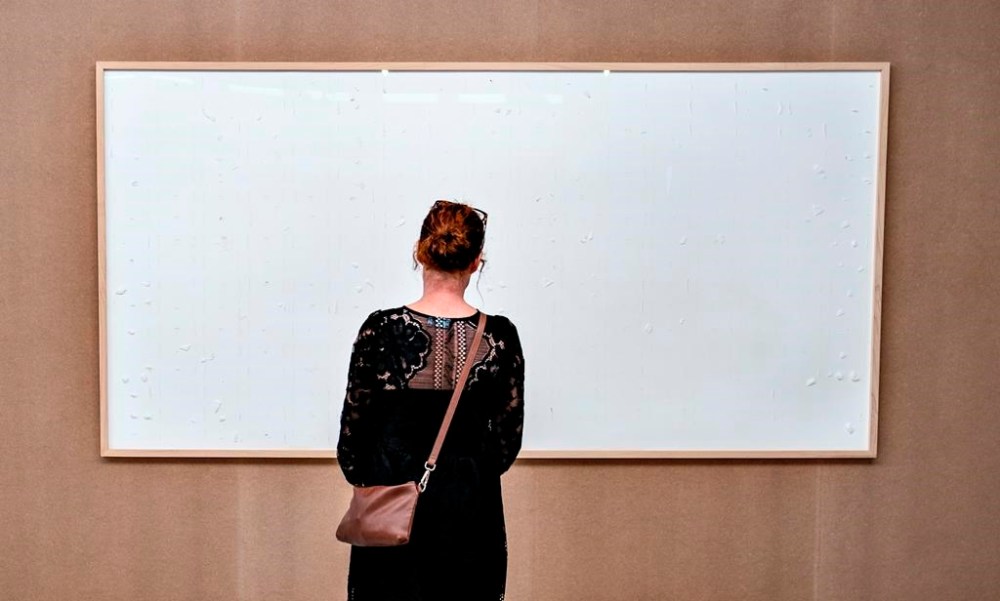
Instead, he submitted two empty canvases for the exhibition, entitled “Work It Out,” said the artwork represented his current work situation and kept the money.
Along with giving him the money in euro and kroner banknotes for the art pieces, the museum also paid him 25,000 kroner ($3,900) for his labor in creating the artwork.
In its Sept. 18 ruling, the District Court of Copenhagen also decided that Haaning can keep 40,000 kroner ($5,676) from the original amount given to him by the museum, which should constitute an artist’s fee because the exhibition, held from Sept. 24, 2021 to Jan. 16, 2022, went ahead with the empty frames.
The court said that the contract between the museum and Haaning had stated that the cash — the banknotes given to Haaning — would be available during the temporary display of the works, and that it was to be returned afterward.
When Haaning refused to return the cash after the exhibition ended, the museum took legal action.
Haaning has denied having committed a crime and insists he did produce a work of art.