
Long-necked marine reptile from 80 million years ago to become B.C.’s fossil emblem
Advertisement
Read this article for free:
or
Already have an account? Log in here »
We need your support!
Local journalism needs your support!
As we navigate through unprecedented times, our journalists are working harder than ever to bring you the latest local updates to keep you safe and informed.
Now, more than ever, we need your support.
Starting at $15.99 plus taxes every four weeks you can access your Brandon Sun online and full access to all content as it appears on our website.
Subscribe Nowor call circulation directly at (204) 727-0527.
Your pledge helps to ensure we provide the news that matters most to your community!
To continue reading, please subscribe:
Add Brandon Sun access to your Free Press subscription for only an additional
$1 for the first 4 weeks*
- Enjoy unlimited reading on brandonsun.com
- Read the Brandon Sun E-Edition, our digital replica newspaper
*Your next Free Press subscription payment will increase by $1.00 and you will be charged $20.95 plus GST for four weeks. After four weeks, your payment will increase to $24.95 plus GST every four weeks.
Read unlimited articles for free today:
or
Already have an account? Log in here »
Hey there, time traveller!
This article was published 04/10/2023 (1145 days ago), so information in it may no longer be current.
VICTORIA – A large, fierce-looking marine reptile with a mouthful of pointy teeth that made its home about 80 million years ago in Vancouver Island waters could soon become British Columbia’s official fossil emblem.
Tourism Minister Lana Popham introduced legislation Wednesday that, if passed, will see the 12-metre Puntledge River elasmosaur added to B.C.’s list of provincial symbols after a five-year recognition effort by local paleontology enthusiasts.
The first elasmosaur fossils in B.C. were found in 1988 along the Puntledge River in the Comox Valley, and are now on display at the Courtenay and District Museum and Palaeontology Centre.
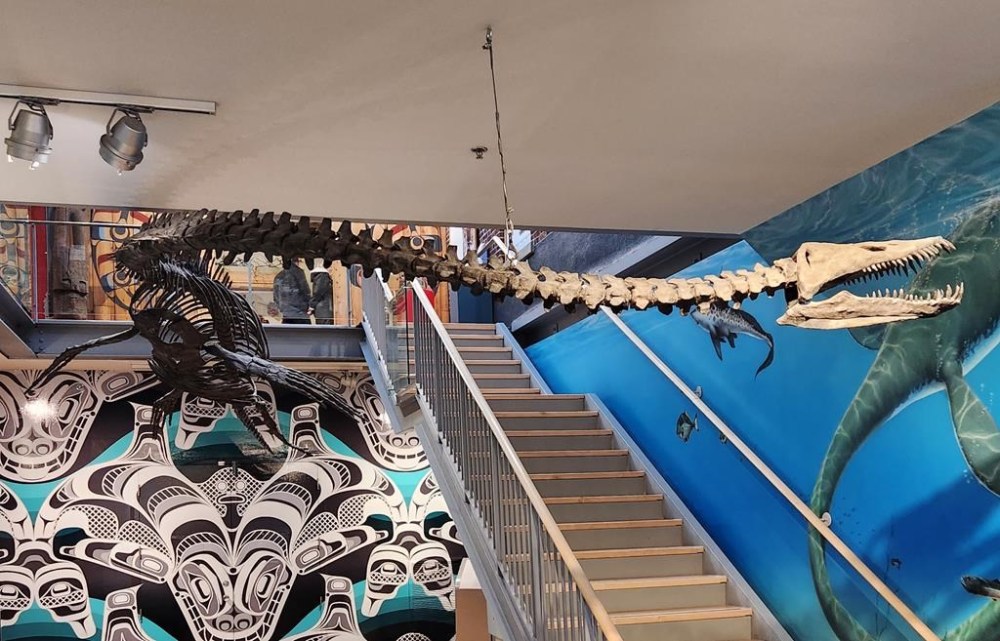
In 2018, the elasmosaur won a provincewide contest seeking additions to B.C.’s list of official symbols.
“B.C. has a rich and diverse variety of fossils and fossil deposits, resulting from the complex geological processes that formed our province,” Popham said. “Adding a fossil emblem to our official provincial symbol is a great way to increase awareness about our natural, physical, geologic provincial history.”
The legislation will add a section to B.C.’s Provincial Symbols and Honours Act to recognize the long-necked predator as a symbol of the province, she said.
Popham said the legislation is based largely on a private member’s bill introduced in February by Courtenay-Comox New Democrat MLA Ronna-Rae Leonard.
Leonard said she and the community staged a “relentless” effort to have the elasmosaur recognized as the provincial fossil.
Comox-area paleontology enthusiast Mike Trask and his daughter, Heather, found the first elasmosaur fossil in November 1988, she said.
Its discovery marked the first fossil of its kind found west of the Canadian Rockies, Leonard said.
“The story is inspiring of the family, the discovery in our community, the opportunities that present themselves for our whole province that is fossil-rich but nobody knows it,” she said. “It’s a point of pride in our community and an opportunity for the whole province.”
This report by The Canadian Press was first published Oct. 4, 2023.