
Carbon tax exemption misguided
Advertisement
Read this article for free:
or
Already have an account? Log in here »
We need your support!
Local journalism needs your support!
As we navigate through unprecedented times, our journalists are working harder than ever to bring you the latest local updates to keep you safe and informed.
Now, more than ever, we need your support.
Starting at $15.99 plus taxes every four weeks you can access your Brandon Sun online and full access to all content as it appears on our website.
Subscribe Nowor call circulation directly at (204) 727-0527.
Your pledge helps to ensure we provide the news that matters most to your community!
To continue reading, please subscribe:
Add Brandon Sun access to your Free Press subscription for only an additional
$1 for the first 4 weeks*
- Enjoy unlimited reading on brandonsun.com
- Read the Brandon Sun E-Edition, our digital replica newspaper
*Your next Free Press subscription payment will increase by $1.00 and you will be charged $20.95 plus GST for four weeks. After four weeks, your payment will increase to $24.95 plus GST every four weeks.
Read unlimited articles for free today:
or
Already have an account? Log in here »
Hey there, time traveller!
This article was published 13/11/2023 (1068 days ago), so information in it may no longer be current.
SINCE the federal Liberal announcement at the end of October to exempt home heating oil from the carbon tax for a three-year period, the issue has become front-and-centre across the country.
The hue-and-cry has been multiplicitous — and at times, bordering on incomprehensible — ranging from charges of regional unfairness to opposition of carbon taxation in general.
Here in Manitoba, the newly elected self-positioned stewards of the environment even got in on the act — albeit in a diluted form — joining the likes of Alberta’s Danielle Smith and Saskatchewan’s Scott Moe in calling for greater “fairness” to be extended to other provinces, including Manitobans.
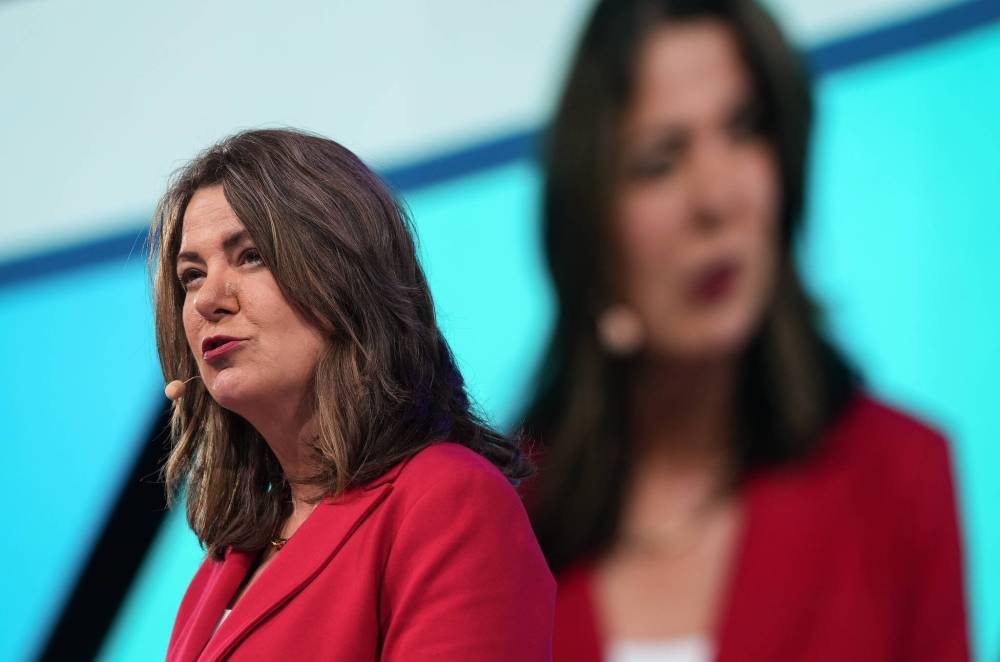
While politicians like Alberta Premiere Danielle Smith (shown here) misleadingly fish for votes by putting the economy over the environment, the evidence of an "impending climate catastrophe" mounts, writes columnist Andrew Lodge. (File)
Hardly the stuff of climate champions.
Meanwhile, evidence of impending climate catastrophe continues to amass. This month’s upcoming COP28 global climate conference set to be held in Dubai — the location itself akin to holding a child’s birthday party in a cemetery — will reaffirm that as a species and a planet we are headed towards a point of no return and may well have already passed it.
Adding voice to this argument is the recent article by former NASA head scientist James Hansen. Himself one of the mainstream pioneers of research into a changing climate, Hansen argues in an Oxford University journal that the 1.5 degree Celsius target — the level above pre-industrial global temperature averages set by the Intergovernmental Panel on Climate Change (IPCC), and the number often cited as being a threshold to avoid irreversible and disastrous environmental consequences — is “deader than a doornail,” and that even limiting warming to two degrees Celsius above pre-industrial levels is unlikely to be met.
While not everyone agrees with Hansen’s interpretation of the data, the consensus is that severe and profound change is upon us and that we are now firmly in the mitigation phase — as opposed to any semblance of prevention — when it comes to environmental transformation. This mess hardly bodes well for future generations.
In the interest of short-term political gain in the form of votes, politicians of all stripes in Canada and the western world have often deferred to the economy at the expense of ecological concerns. This unfortunate false dichotomy belies the fact that both words share the Greek root oikos, which refers to our “house.” Setting these terms up as mutually exclusive — and positioning them in a hierarchical structure to boot — has been dangerous and misleading, but highly profitable for corporate interests, all too willing to destroy our planetary home in the quest for monetary gain. Let the market sort it out? That strategy has clearly failed. Ongoing prostration before the altar of liberal economics as a means of ecological protection is like swimming upstream in a rapid above the lip of a plunging waterfall.
How, then, did this come about? Such an approach is made possible through the promotion of pernicious individualism, a mantra which is all too willing to kick anyone to the curb — including our own future generations — for the sake of material self-interest.
Witness New Brunswick premier Blaine Higgs’ argument that Canadians shouldn’t have to curtail emissions to any great extent, since in absolute terms, our emissions are relatively minimal on a global scale. This callous — even cruel — calculation belies the fact that we are the second highest per capita emitter of carbon in the world and have been for some time. We enjoy a far higher quality of life than the vast majority of the globe’s citizens. Moreover — and this is where we truly twist the knife — as a rich nation, we are more than resource-capable of transitioning to carbon neutrality and beyond immediately, and well-positioned to work with others to accomplish the same.
As Hansen, as well as the scores of scientists behind multiple IPCC reports and an overwhelming consensus of thousands of researchers worldwide, continue to assert in the most forceful of terms, we need to collectively act — immediately. Efforts by politicians — beholden to their corporate mandarins and the ideology they have carefully cultivated for decades — to dodge measures like carbon taxation are short-sighted and treacherous.
What we need instead — where societal focus must lie — is on communitarian action that focuses on meaningful, climate-centred strategies that work towards ensuring the ecological and economic well-being of us all. The climate can no longer be an afterthought, nor play second fiddle to profit-driven economic interests that use metrics such as GDP growth as benchmarks for success. It’s a matter of survival. Regardless of what our politicians say.
» Andrew Lodge is an assistant professor, University of Manitoba and medical director at Klinic Community Health.