
Brandon scientists working to improve wheat varieties
Advertisement
Read this article for free:
or
Already have an account? Log in here »
We need your support!
Local journalism needs your support!
As we navigate through unprecedented times, our journalists are working harder than ever to bring you the latest local updates to keep you safe and informed.
Now, more than ever, we need your support.
Starting at $15.99 plus taxes every four weeks you can access your Brandon Sun online and full access to all content as it appears on our website.
Subscribe Nowor call circulation directly at (204) 727-0527.
Your pledge helps to ensure we provide the news that matters most to your community!
To continue reading, please subscribe:
Add Brandon Sun access to your Free Press subscription for only an additional
$1 for the first 4 weeks*
*Your next subscription payment will increase by $1.00 and you will be charged $20.00 plus GST for four weeks. After four weeks, your payment will increase to $24.00 plus GST every four weeks.
Read unlimited articles for free today:
or
Already have an account? Log in here »
Hey there, time traveller!
This article was published 16/11/2023 (896 days ago), so information in it may no longer be current.
At the Brandon Research Station, Dr. Santosh Kumar has been working on breeding wheat to ensure the crop is able to handle challenges such as climate change and extreme weather, hoping to bolster the world’s food supply and ensure farms are sustainable at the same time.
A research scientist with the science and technology branch of Agriculture and Agri-Food Canada, and the team lead for breeding and genomics at the research station, Kumar’s work has focused on molecular breeding and germplasm improvement of wheat. He received his master’s degree in India, and then came to Canada to do his PhD studies at the University of Manitoba, where he also did his postdoctoral fellowship. He moved from Winnipeg to Brandon to work at the research station.
With a background in molecular physiology, biotechnology and genomics, his work has focused on crops that are important to the Westman area, including flax, barley and wheat.
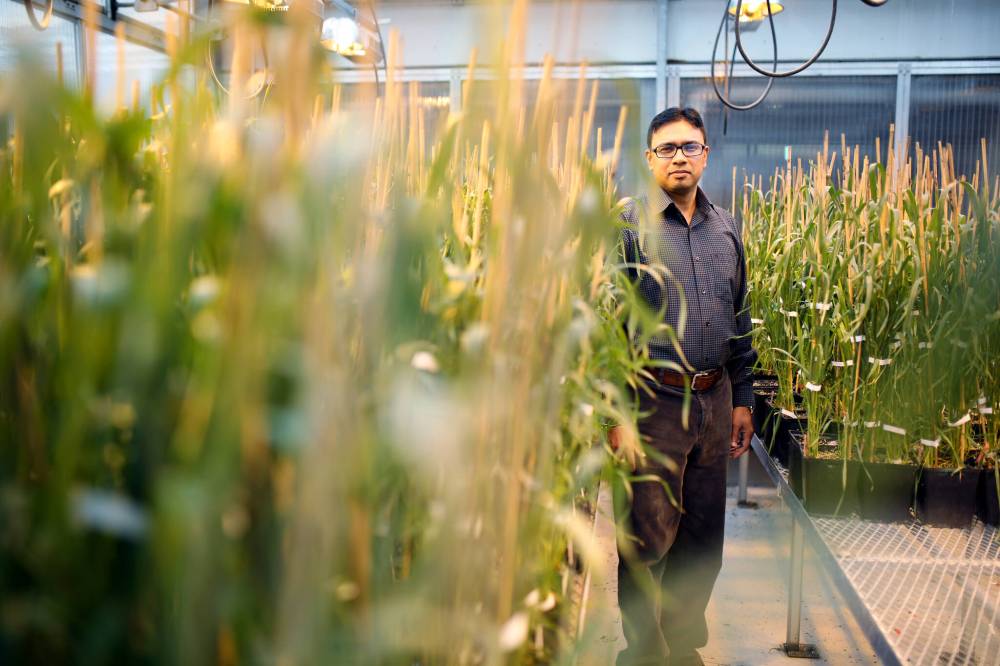
Dr. Santosh Kumar is a research scientist at the Brandon Research and Development Centre. He works in the wheat breeding program, looking at breeding a hard red spring wheat for the eastern prairies. (File)
“Since joining the program, my job has been primarily to develop wheat varieties for the farmers of Canada, and my primary focus is in the areas of the eastern Prairies and northern part of the Parkland region,” Kumar said. “Those environments are diverse, and that’s why we have to have parallel breeding programs to cater to the farmers here, and also in the regions around Brandon.”
Kumar manages a large group of people at the Brandon Research Station, but also oversees staff in Saskatchewan and Alberta, which allows him to focus on the different aspects of his program from different locations. But breeding wheat for that big of a region can be challenging at times, he said.
“The traits you want in those varieties of wheat for different reasons are quite different. They have to really breed area-specific varieties,” he said. “They make their observations and selections in those areas, and then hopefully, they have big ideas that come out of that, and they suit the region and are acclimatized to those regions.”
In 2021, Canada exported $8.3 billion worth of wheat, Statistics Canada’s website says, making it the fourth-largest exporter of wheat in the world. The main destination for Canadian wheat includes China, Japan, Indonesia, Peru, Colombia and the United States.
There are many different classes of wheat that Kumar and his team breeds that fall under the premium class of wheat called Canada Western Red Spring. It is exported to 82 countries every year, which is why so many producers grow it, Kumar said.
“Farmers like to grow Canadian Western Red Spring because they know there is a market for it. They won’t have to store it in their bins for years, because it makes money for them and they want to grow something they can sell.”
It’s the job of Kumar and his team to try to make the wheat even better. They do this through selectively breeding wheat to have increased resistance against all major diseases that affect wheat, so producers don’t have to spend their time and money spraying their crops repeatedly.
“The most important thing is the quality,” Kumar said.
Agriculture and Agri-Food Canada scientists have been breeding wheat for several decades, and have been constantly improving the varieties based on what market demands are like, he added.
“I’ts not just about science. It’s not just about research. It’s a lot about what the farmers want.”
And despite the global outreach of Kumar’s work, it all starts in the Brandon Research Centre, which Kumar says is a first-class facility and home to the largest funded breeding program in all of Canada.
“We are the best at what we do,” he said. “Of course, we need a lot of support from our stellar scientists who work in different areas … but I would say that we have done a remarkable job.”
The Russian war on Ukraine has made the global food system more precarious, Kumar says, and makes the work he and his colleagues are doing even more relevant in feeding not only Canada but many parts of the world.
“My heart goes out to the people who are suffering from the instability of war,” he said. “We need to feed these people.”
In Canada, scientists like Kumar have an important role to play not just to produce good quality wheat, but to feed people.
“We have a stable country. We have a modern country, a developed country. The farmers are doing well. If we continue breeding the varieties that lead to more wheat being produced, we can sell it so it gets out to the people,” he said.
Kumar hopes to continue breeding wheat so that Canadian producers can continue to feed the global community. The idea of feeding the world is one that motivates and inspires himself and his colleagues, he said.
“You can do exciting things, and sometimes the excitement goes away. But when you are motivated, when you’re inspired by a cause greater than your program, greater than the place you are, greater than the country you live in, that motivates you, that inspires you. That’s how I feel. That’s how we feel.”
» mleybourne@brandonsun.com
» X: @miraleybourne