
New ‘living lab’ to research greenhouse gas emissions
Advertisement
Read this article for free:
or
Already have an account? Log in here »
We need your support!
Local journalism needs your support!
As we navigate through unprecedented times, our journalists are working harder than ever to bring you the latest local updates to keep you safe and informed.
Now, more than ever, we need your support.
Starting at $15.99 plus taxes every four weeks you can access your Brandon Sun online and full access to all content as it appears on our website.
Subscribe Nowor call circulation directly at (204) 727-0527.
Your pledge helps to ensure we provide the news that matters most to your community!
To continue reading, please subscribe:
Add Brandon Sun access to your Free Press subscription for only an additional
$1 for the first 4 weeks*
- Enjoy unlimited reading on brandonsun.com
- Read the Brandon Sun E-Edition, our digital replica newspaper
*Your next Free Press subscription payment will increase by $1.00 and you will be charged $20.95 plus GST for four weeks. After four weeks, your payment will increase to $24.95 plus GST every four weeks.
Read unlimited articles for free today:
or
Already have an account? Log in here »
Hey there, time traveller!
This article was published 18/11/2023 (947 days ago), so information in it may no longer be current.
A new living lab project has been created in Manitoba as a collaboration between farmers and researchers to reduce greenhouse gas emissions.
On Wednesday, Agriculture and Agri-Food Canada Minister Lawrence MacAulay said the lab represents an investment of up to $9.2 million over five years under the Agricultural Climate Solutions (ACS) Living Labs program.
The living lab, led by the Manitoba Association of Watersheds, will aim to accelerate the agricultural sector’s response to climate change by bringing together producers, scientists and other sector partners to co-develop, test and evaluate on-farm beneficial management practices.
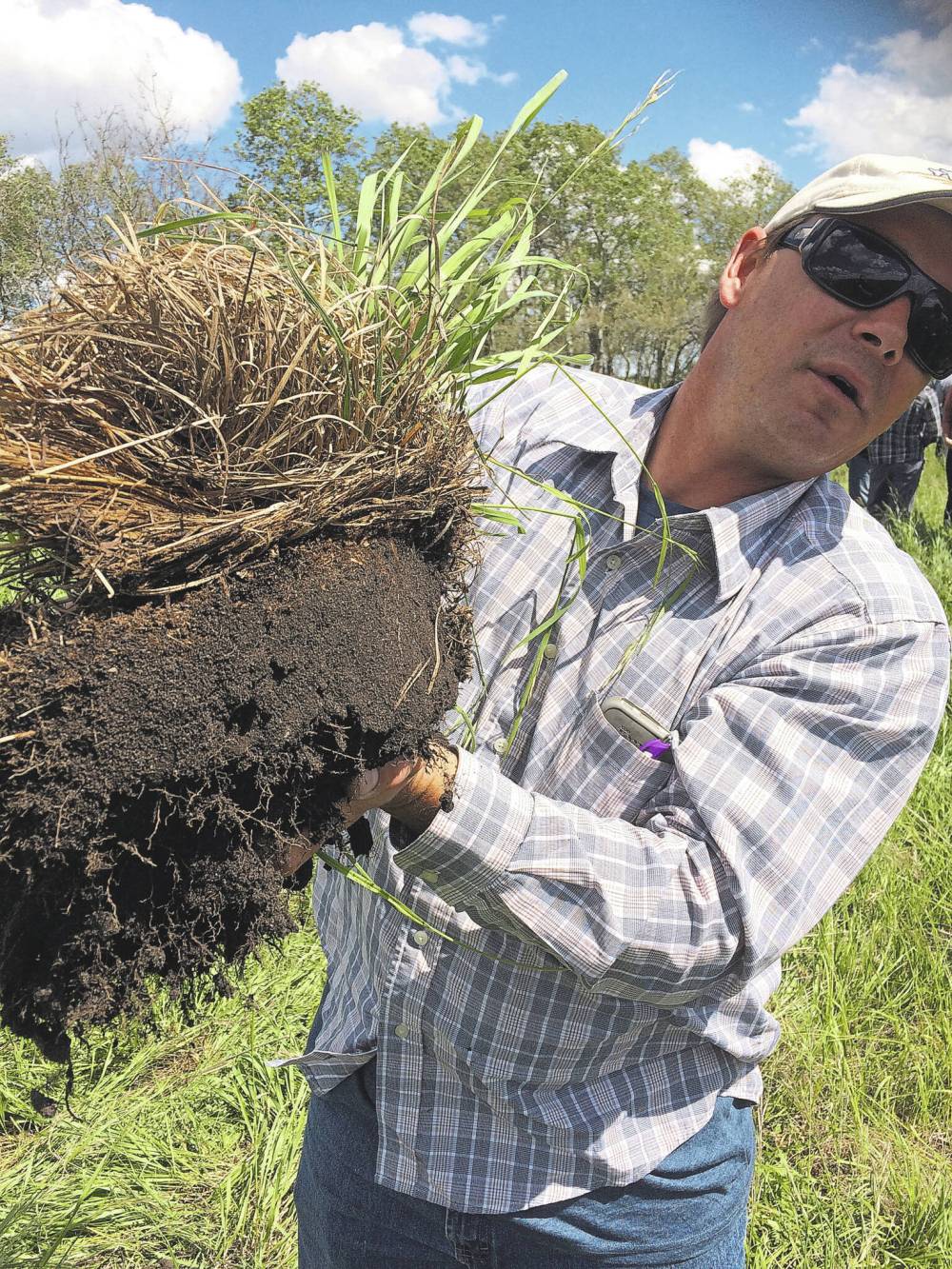
Assiniboine River Conservation District general manager Ryan Canart holds a clump of soil during a tour of the Russell area a few years ago. Canart says the new living lab in Manitoba announced by the federal government will connect farmers and researchers looking at reducing greenhouse gas emissions. The program will be overseen by the Manitoba Association of Watersheds. (File)
These practices, called BMPs, will be found on multiple sites across Manitoba. The BMPs support nutrient management, water retention, crop and livestock integration, soil health and more, and will help store carbon and reduce greenhouse gas emissions while providing environmental benefits to producers.
The program puts the focus on tangible, on-farm research to cut down on greenhouse gas emissions, Ryan Canart, the general manager of the Assiniboine West Watershed District, told the Sun.
“It tries to marry up BMPs that are being applied on the farm scale with a research component to measure and monitor the impacts of those practices,” he said.
The collaboration between producers and researchers is a unique part of the project, Canart added.
“It’s kind of neat in the sense that you get a landowner that’s wishing to address the environmental concern, you implement a practice, and then they also try to wrap a research component around that practice.”
The Manitoba Association of Watershed Districts will collaborate with partner organizations to encourage the transfer of knowledge and exchange between local producers, federal and provincial researchers, Indigenous communities and other patrons, a press release said Wednesday.
Collaborating with farmers and researchers through their local watershed districts brings tremendous value to Manitoba farmers, said Gary Wasylowski, the board chair of the Manitoba Association of Watersheds.
Practices developed on-farm and shared within communities are an effective way to increase adaptation of BMPs, Wasylowski said.
“Our hope is that innovative practices developed through Living Lab Manitoba will lead to healthier watersheds through an increase in sustainable agricultural practices and reduced greenhouse gas emissions,” he said.
Farmers are natural innovators, and by partnering with researchers, they can help develop novel solutions to build resilience and to address the challenges of climate change, MacAulay said.
“Manitoba’s rich farming history has laid the groundwork for this exciting new project.”
The new Manitoba living lab adds to the four living labs launched earlier this year — two in Quebec, one in Ontario, and one in Prince Edward Island — and the nine announced in 2022. With a total of 14 living labs under the program, there is now at least one living lab in every province.
The Manitoba Association of Watersheds previously led Living Lab Eastern Prairies under the former Living Laboratories Initiative, which ended this year.
Canada introduced the agroecosystem living labs concept to G20 agriculture ministers in 2018, who welcomed it as a novel way to accelerate the development of sustainable agricultural practices and technologies around the world.
First announced in March of 2021, the Agricultural Climate Solutions program is one of many initiatives undertaken to promote environmental sustainability and resiliency in the agricultural sector. It is part of Ottawa’s plan to reduce greenhouse gas emissions by 40 to 45 per cent from 2005 levels by 2030, and towards net-zero emissions by 2050. Those goals were announced ahead of the 2021 United Nations Climate Change Conference.
» mleybourne@brandonsun.com
» X: @miraleybourne