
Sioux Valley utilizing First Nations officers
Advertisement
Read this article for free:
or
Already have an account? Log in here »
We need your support!
Local journalism needs your support!
As we navigate through unprecedented times, our journalists are working harder than ever to bring you the latest local updates to keep you safe and informed.
Now, more than ever, we need your support.
Starting at $15.99 plus taxes every four weeks you can access your Brandon Sun online and full access to all content as it appears on our website.
Subscribe Nowor call circulation directly at (204) 727-0527.
Your pledge helps to ensure we provide the news that matters most to your community!
To continue reading, please subscribe:
Add Brandon Sun access to your Free Press subscription for only an additional
$1 for the first 4 weeks*
- Enjoy unlimited reading on brandonsun.com
- Read the Brandon Sun E-Edition, our digital replica newspaper
*Your next Free Press subscription payment will increase by $1.00 and you will be charged $20.95 plus GST for four weeks. After four weeks, your payment will increase to $24.95 plus GST every four weeks.
Read unlimited articles for free today:
or
Already have an account? Log in here »
Hey there, time traveller!
This article was published 08/12/2023 (1044 days ago), so information in it may no longer be current.
After a mandate between Sioux Valley Dakota Nation and the Virden RCMP was signed last month, an increased presence of First Nations safety officers will soon be seen on the reserve.
The mandate was signed by Chief Vincent Tacan and his council with the Virden RCMP on Nov. 20.
The officers have had a presence in Sioux Valley Dakota Nation for many years, and have been assisting the RCMP on calls quite often, Tacan told the Sun.
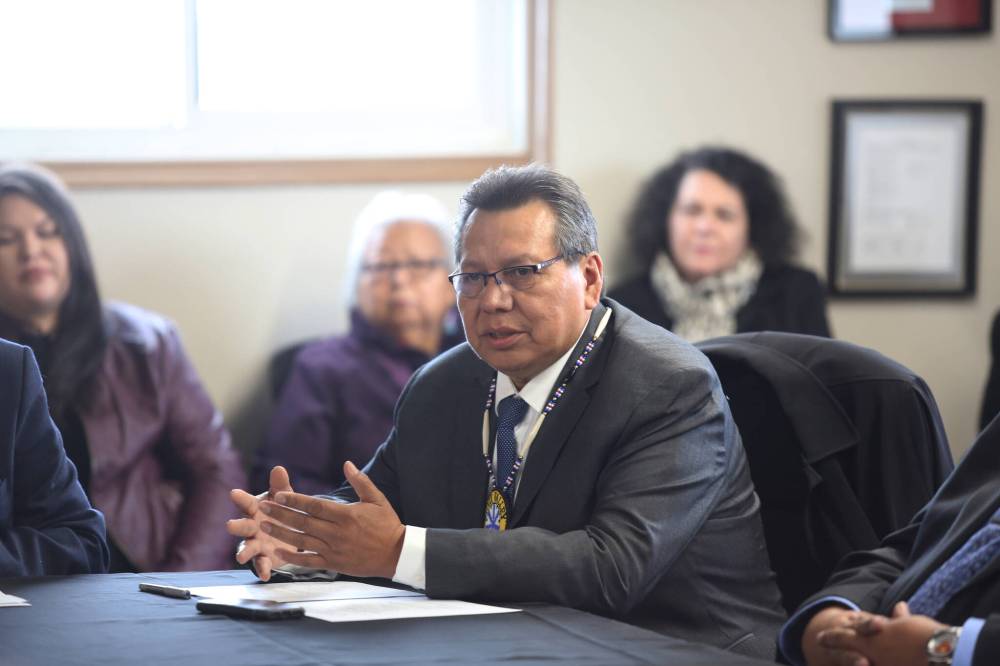
“They’re probably the first on site when a call comes in, so it’s a very important role that they play,” he said.
Helena Maziwasicuna, the justice co-ordinator of Sioux Valley Dakota Nation, sent an email out to members of the community explaining what the signing of the mandate means for the community.
According to the email, FNS officers will be able to enforce the Highway Traffic Act by giving out tickets to non-registered or non-licensed drivers and other individuals who breach the Act; the Minors Intoxicating Substance Control Act; SVDN bylaws; the Off-Road Vehicles Act; the Liquor and Gaming Act; and the Child and Family Services Act.
The officers will also have powers when it comes to public safety and crime prevention; victims and social services; arrests; search and seizures; and administrative tasks, such as note taking, report writing, interview basics and court preparation.
Other duties of the officers fall under warrant assist, radar speed and DUI issues.
It’s of vital importance that community members are familiar with the FNS officers and their powers and duties, Tacan said. It’s also just as important that the officers themselves are familiar with the community.
“They can navigate all that fairly well, and so that’s an asset for the RCMP,” he said. “The resource has been here all along. I’m not sure why (the mandate) wasn’t signed earlier.”
Having FNS officers in the community could also be a positive influence on the youth of Sioux Valley, Tacan said, particularly those who might be motivated to pursue a career in law enforcement.
“I think that the program also serves as a way of showing younger people that policing could be a career, and this gives them the first steps into (that),” he said.
Residents of Sioux Valley met at the end of last month to discuss a new law that allows for the banishment of people deemed dangerous to the community by acting violently or trafficking illegal drugs.
That law and the signing of the mandate between the community, the RCMP and the FNS officers are all part of Tacan’s strategy to cut down on crime and illegal drugs in the community, he said.
According to the federal government website, Public Safety Canada funds policing services that it considers professional, dedicated and responsive to First Nation and Inuit communities.
Through Public Safety Canada’s First Nations and Inuit Policing Program, policing services are funded and supported through policing agreements between the federal and provincial and territorial governments, and First Nations and Inuit communities. Ottawa covers 52 per cent of the costs, and the remaining 48 per cent is covered by provincial and territorial governments.
On Thursday, Sioux Valley announced on its website and via email another tactic to cut down on illegal drugs – the Sioux Valley Dakota Nation Illegal Drug Tip Line.
The goal of the tip line, the First Nation’s website says, is to “take whatever steps are necessary to protect the identities of our tipsters.” People who have any doubts about the anonymity that will be given them when using the tip line are encouraged to talk to the justice co-ordinator. The tip line can be called or texted at 204-901-4527.
Just like with the FNS officers, the tip line has been a part of the community for a while, but hasn’t been utilized very much, Tacan said.
“I don’t know why it wasn’t used, and maybe that’s one reason why the drug scene exploded. There was no checks and balances to make sure that some of the stuff was on somebody’s radar at least.”
» mleybourne@brandonsun.com
» X: @miraleybourne