
Canada learned lessons from Trump’s first term — and vice versa, says ambassador
Advertisement
Read this article for free:
or
Already have an account? Log in here »
We need your support!
Local journalism needs your support!
As we navigate through unprecedented times, our journalists are working harder than ever to bring you the latest local updates to keep you safe and informed.
Now, more than ever, we need your support.
Starting at $15.99 plus taxes every four weeks you can access your Brandon Sun online and full access to all content as it appears on our website.
Subscribe Nowor call circulation directly at (204) 727-0527.
Your pledge helps to ensure we provide the news that matters most to your community!
To continue reading, please subscribe:
Add Brandon Sun access to your Free Press subscription for only an additional
$1 for the first 4 weeks*
*Your next subscription payment will increase by $1.00 and you will be charged $20.00 plus GST for four weeks. After four weeks, your payment will increase to $24.00 plus GST every four weeks.
Read unlimited articles for free today:
or
Already have an account? Log in here »
Hey there, time traveller!
This article was published 21/12/2023 (742 days ago), so information in it may no longer be current.
WASHINGTON – It’s a truism in foreign-policy circles that the world learned some hard lessons from Donald Trump’s volatile first term as president.
But as the prospect of a second term looms, could it also be true that the notoriously stubborn Trump and his advisers left the White House with a better grasp of Canada’s relationship with — and importance to — the United States?
“Yeah, I think so — I do,” said Kirsten Hillman, Canada’s envoy in Washington.
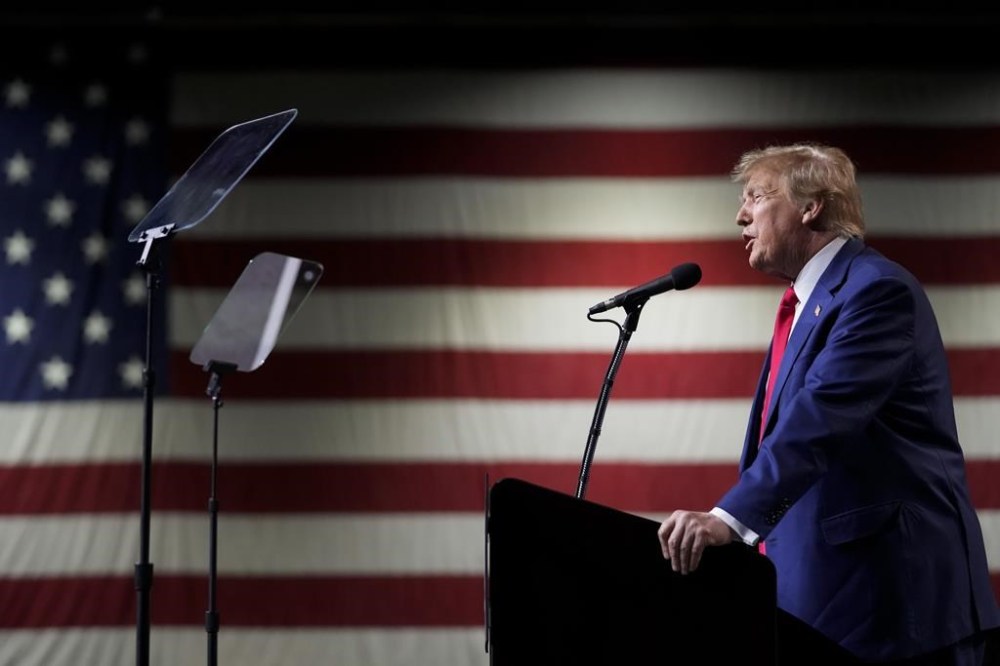
For starters, there was the arduous 18-month renegotiation of NAFTA, in which even America’s self-proclaimed champion dealmaker has long suggested Canada proved a more worthy adversary than he expected.
But Trump was also president in early 2020, when COVID-19 was beginning to flourish on North American soil, soon to blossom into a global crisis that showed the U.S. a thing or two about its largest trading partner.
“When we restricted movement on our border, it took less than a day for people to fully understand the implications,” Hillman said.
They promptly discovered just how much traffic, travel and commerce crossed the Canada-U.S. border each day, “and therefore, as a consequence, (came to) fully appreciate the degree to which we are integrated and mutually supportive.”
Hillman described daily conversations with senior members of Trump’s White House COVID-19 task force to talk about supply chains, vaccine development efforts and how to secure personal protective equipment.
Trump promptly imposed export restrictions on scarce commodities like gloves and surgical masks, but exempted both Canada and Mexico, because “they realized, ‘They need us, but we need them,'” she said.
“I’m not saying it’s front of mind, as it was obviously at the time, but it’s there — in a way that’s deeper than it was before.”
That has given Canada something of a head start as it continues outreach efforts with former officials, U.S. lawmakers and others who might be expected to play a role in a second Donald Trump presidency.
Those efforts have been underway for a while now, said Hillman, who described a more robust policy and transition “apparatus” around Trump than there was in 2016.
“All of it is being developed in quite a systematic way, much more akin to what happens normally with other candidates and both parties,” she said.
“So we can access that, right? We can talk to those people — and we are talking to them, and will continue to — to understand the policy positions they are advocating for the potential Trump administration.”
Hillman’s primary responsibility, and preferred strategy, is best described as making sure decision-makers across the U.S. at every level of government grasp how Canada touches their lives, often in discreet and unheralded ways.
One sign of that strategy working: the American Canadian Economy and Security caucus, a bilateral coalition of like-minded lawmakers unveiled this past summer by Rep. Mark Amodei (R-Nev.) and Rep. Lizzie Fletcher (D-Tex.).
It sprang up over the summer after Zaib Shaikh, Canada’s consul general in Los Angeles, pointed out that Amodei’s district alone was exporting nearly $1.5 billion a year north of the border, underpinning an estimated 12,000 U.S. jobs.
Amodei immediately wanted to know more, including which of his fellow U.S. lawmakers and senators had comparable stakes in Canada. The caucus now comprises some 52 members, House and Senate, Republican and Democrat alike.
“We had a very successful year in raising the profile of the relationship and deepening the relationship,” Hillman said.
“And it’s coming at a really important time: to be in this place now, as we head into an election year in the United States, is a good position to be in.”
When talking to Team Trump, “what’s crucial is that we bring the Canadian perspective” to issues of myriad mutual interest, she said — trade, defence, transportation and agriculture, to name a few.
Hillman lingered over one example in particular — energy policy — that’s sure to be a dominant theme for a would-be president who has promised to “drill, drill, drill” on his first day back in the West Wing.
“‘Canada is, by far, the biggest and most secure energy supplier for the United States across all areas of energy production, and we will always be here for you,'” she said, describing one such hypothetical conversation.
“‘So as you’re thinking about how you’re going to refine your energy policies, remember, we are sort of hand-in-hand with you on that.'”
This report by The Canadian Press was first published Dec. 21, 2023.