
Researchers study balsam poplars to increase drought resistance
Advertisement
Read this article for free:
or
Already have an account? Log in here »
We need your support!
Local journalism needs your support!
As we navigate through unprecedented times, our journalists are working harder than ever to bring you the latest local updates to keep you safe and informed.
Now, more than ever, we need your support.
Starting at $15.99 plus taxes every four weeks you can access your Brandon Sun online and full access to all content as it appears on our website.
Subscribe Nowor call circulation directly at (204) 727-0527.
Your pledge helps to ensure we provide the news that matters most to your community!
To continue reading, please subscribe:
Add Brandon Sun access to your Free Press subscription for only an additional
$1 for the first 4 weeks*
- Enjoy unlimited reading on brandonsun.com
- Read the Brandon Sun E-Edition, our digital replica newspaper
*Your next Free Press subscription payment will increase by $1.00 and you will be charged $20.95 plus GST for four weeks. After four weeks, your payment will increase to $24.95 plus GST every four weeks.
Read unlimited articles for free today:
or
Already have an account? Log in here »
Hey there, time traveller!
This article was published 18/01/2024 (950 days ago), so information in it may no longer be current.
Balsam poplars are a popular choice of tree for farmers in Westman and across the Prairies, who use them as wind shelters or to create lanes for growing crops. These trees could soon prove even more suited to the region thanks to the work researchers from the University of British Columbia (UBC) are doing to make the species more drought-resistant.
The balsam poplar, a medium-sized tree that grows up to 25 metres tall, features oval-shaped, pointed, shiny leaves with undersides that are dotted with resin, the Ontario government’s website says. The bark is flat, scaly and ridged on mature trees, and buds are sticky and smell like balsam. Their flowers feature long, hanging catkins that precede the trees’ buds, and their fruit consists of fluffy seeds that spread in the springtime.
Balsam poplars grow all across Canada and are one of the nation’s hardiest deciduous trees. The plant breeders at UBC are attempting to make them even hardier by creating new hybrid types that will be better able to withstand the drought-like conditions on the Prairies that have developed for the past few summers.
Thorsten Knipfer is an assistant professor of plant physiology at UBC’s Faculty of Land and Food Systems, and lead researcher on the new study. He received his master’s degree in Germany working on water uptake of corn roots, and went on to work on his PhD in Dublin, Ireland where he quantified water uptake in barley plants, looking at the molecular mechanisms that can affect water uptake and land penetration status. Once his PhD was finished, he moved to Sacramento, California, a large agricultural region that grows woody perennials such as walnuts and grapes. Knipfer relocated to Vancouver in 2020 where he started is current position.
“We were trying to work out traditional requirements of trees to make water usage more sustainable, and collaborating with a poplar breeder in Saskatoon,” he said. “That kind of led us into thinking more about poplars and apply our knowledge of plant reality to find out more about what makes these poplars more resistant to drought stress.”
From there, Knipfer and the other researchers identified traits and worked on implementing them into hybrid species to help make poplars more efficient in terms of drought resilience and rapid growth.
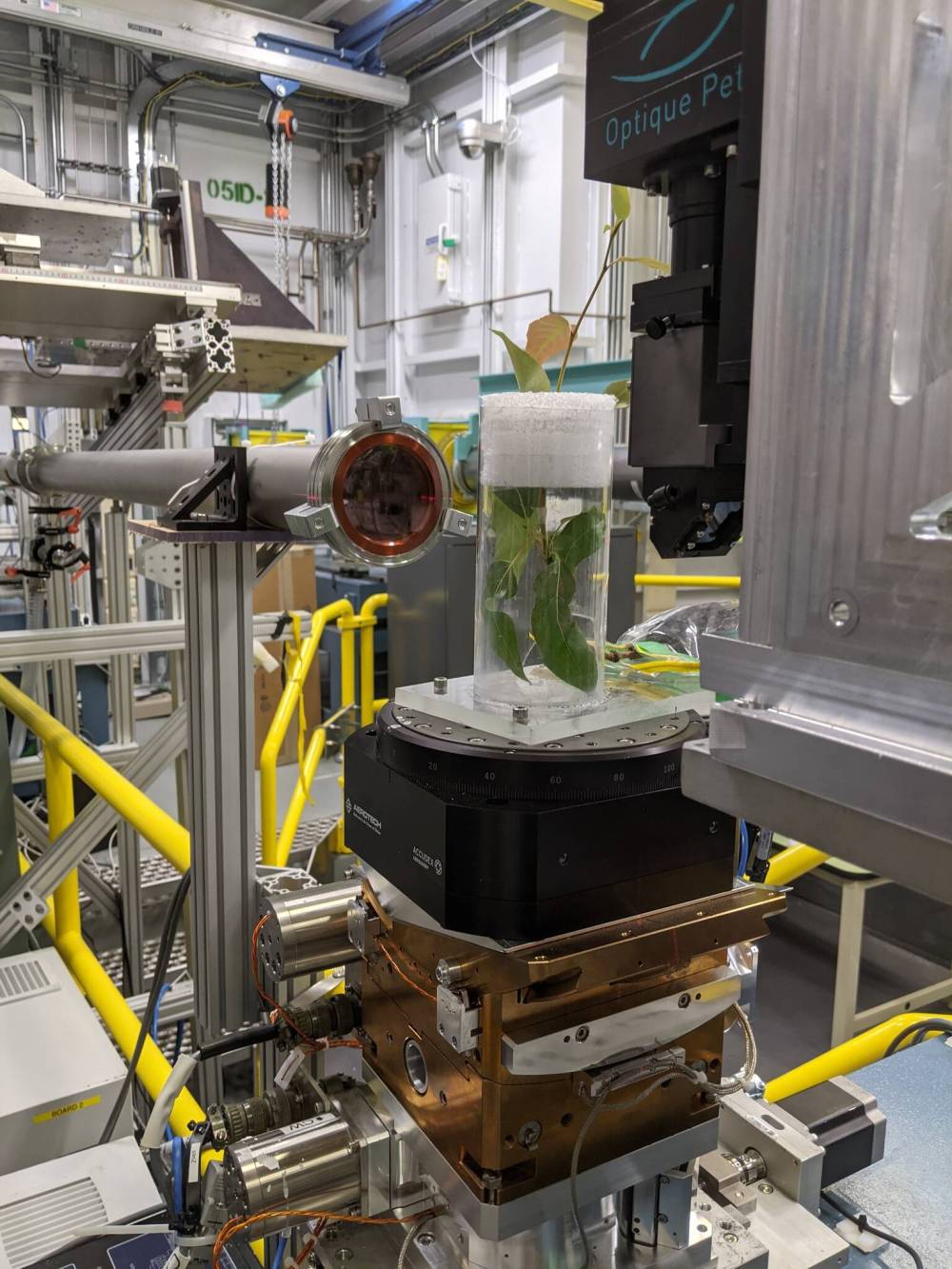
According to a press release from the Canadian Light Source, a national research facility of the University of Saskatchewan, the researchers are using the Canada Light Source to look inside two types of balsam poplar saplings to learn more about how their water transport system is affected by lack of moisture in soil.
Normally, water is carried upward from the roots of trees to their leaves in a continuous column of water, but during droughts, pockets of air can form in that column in the same way that an embolism develops in a human’s blood vessels. This “embolism” blocks the transport of water and nutrients to the leaves of the tree.
These drought-induced embolisms are a main cause of tree mortality that can be observed across the world in dry conditions, Knipfer said.
“They’re a huge problem for trees,” Knipfer said. “Our goal was to identify types [of poplars] that are more resistant to these formations … some genotype that can be stressed more [while] experiencing flow conditions.”
Xylem, the plant tissue that transports water from to the stems and leaves of a tree, is being studied by the researchers using x-ray computed tomography — imaging done by penetrating x-ray waves. Using the technology, called BMIT beamline, the researchers discovered that balsam poplars use their xylem fibres to store water and then release it into the xylem’s vessels, which house its hydraulic column. This is the balsam poplar’s way of adapting to reduce the risk of embolisms forming.
“Internally stored water is utilized that makes the plant less susceptible to air embolisms, which was cool to see,” Knipfer said, noting that this is the first time that researchers have obtained visual evidence of this phenomenon in an intact plant with X-ray and CT technology. Before now, he added, researchers thought the primary function of xylem fibres was to provide mechanical support to the tree.
“What started making our research much more interesting [is that] over the last decade or so … we had access to new imaging equipment, not just X-rays, that really allowed us to look inside the tree and evaluate these processes that are happening in terms of water transport, without excising the samples, which may introduce any sort of air into the system artificially,” Knipfer said.
Using the BMIT beamline, Knipfer and his team were able to look inside an intact plant, whereas in previous studies, researchers usually examined only a section of plant material that had been cut from the main body of the plant, exposing the hydraulic column to air and causing embolisms to form.
The findings of the study could help plant breeders develop new hybrid varieties of poplars that would have both the drought-resistant capabilities of the poplars they studied and the fast-growing capabilities of another genotype, Knipfer said.
“We know from the literature that there are other types of woody species where water is not stored in fibers, which is somewhat surprising because fibers make up the largest volume of the entire xylem in the stem,” he said. “You’d think that this volume would have to be used by the tree in some way — that it’s not just this empty compartment. Showing in a balsam poplar that it serves as a compartment for water storage is a very significant finding.”
According to the report, future studies will be needed to explain the plasticity in xylem physiology in response to the environment’s changing conditions and in mature trees.
“We need to find out more about how these trees will cope with these stressful conditions even in regions which are typically known to have enough moisture,” Knipfer said. “The main goal and outcome of this research is to find genotypes that are more resistant to drought conditions that can be used as material for hybrid poplars, for example.”
» mleybourne@brandonsun.com
» X: @miraleybourne