
City advances on affordable housing
Advertisement
Read this article for free:
or
Already have an account? Log in here »
We need your support!
Local journalism needs your support!
As we navigate through unprecedented times, our journalists are working harder than ever to bring you the latest local updates to keep you safe and informed.
Now, more than ever, we need your support.
Starting at $15.99 plus taxes every four weeks you can access your Brandon Sun online and full access to all content as it appears on our website.
Subscribe Nowor call circulation directly at (204) 727-0527.
Your pledge helps to ensure we provide the news that matters most to your community!
To continue reading, please subscribe:
Add Brandon Sun access to your Free Press subscription for only an additional
$1 for the first 4 weeks*
- Enjoy unlimited reading on brandonsun.com
- Read the Brandon Sun E-Edition, our digital replica newspaper
*Your next Free Press subscription payment will increase by $1.00 and you will be charged $20.95 plus GST for four weeks. After four weeks, your payment will increase to $24.95 plus GST every four weeks.
Read unlimited articles for free today:
or
Already have an account? Log in here »
Hey there, time traveller!
This article was published 24/01/2024 (965 days ago), so information in it may no longer be current.
Brandon City Council advanced efforts to improve the Wheat City’s stock of affordable housing on a couple of fronts on Monday evening, approving several initiatives tied to federal housing funding and approving incentives related to a new development.
To enter into an agreement with the federal government for funding under the Housing Accelerator Fund, council approved the implementation of seven initiatives to promote the construction of new housing.
After a previous attempt to develop the site fell through, council voted to sell the property at 2630 McDonald Ave. to Keller Developments for $1, provide $720,000 in funding and provide a tax offsetting grant so that a 16-unit building containing eight affordable housing units can be built there.
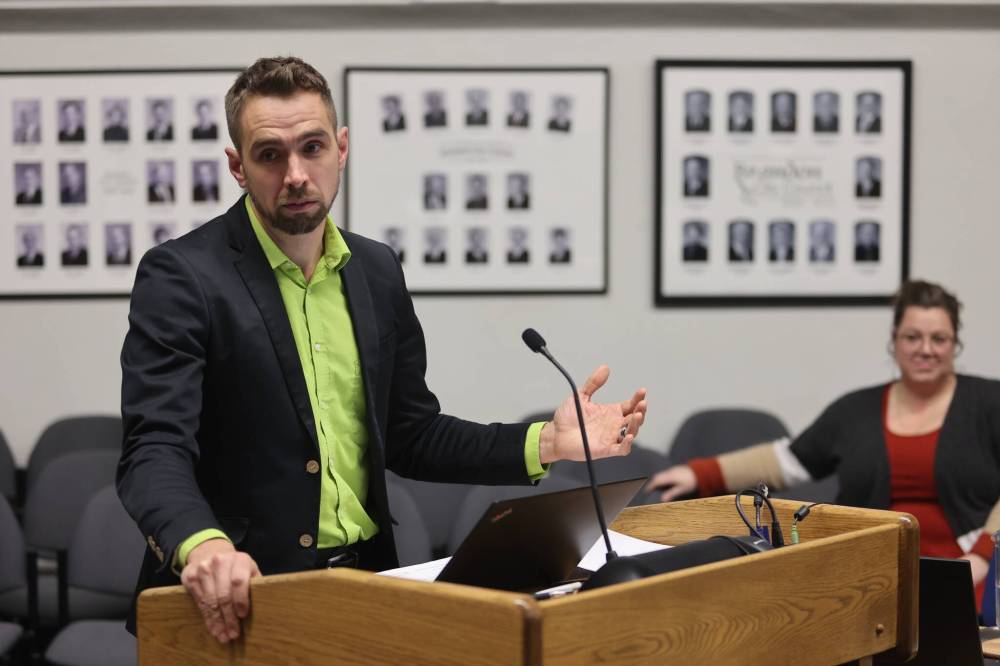
Brandon's director of planning and buildings, Ryan Nickel, discusses the city's application to the federal Housing Accelerator Fund at Monday's city council meeting as community housing and wellness co-ordinator Shannon Saltarelli looks on. Council unanimously voted to give city administration the authority to enter into an agreement with the federal government to receive funding. (Colin Slark/The Brandon Sun)
Community housing and wellness co-ordinator Shannon Saltarelli presented a diagram showing the housing continuum that shows the options available to people from least to more desirable: homelessness, emergency shelters, transitional housing, supportive housing, community housing, affordable housing and market housing.
Saltarelli said the McDonald Avenue development will not be considered low-income housing, but it will be more affordable than market-rate housing.
“The goal of the continuum is to always move people from left to right,” she said. “When there are gaps in the housing continuum, people get stalled or they move backwards or they start living outside their means. Affordable housing … is the gap between community housing and market housing, whether that be rental or home ownership.”
Without affordable housing, Saltarelli said it is difficult for someone to move from community housing or subsidized to market rents.
She said $420,000 in funding for the McDonald Avenue project is left over from $4,128,500 received from the Manitoba Housing and Renewal Corporation. This contribution has been approved by the province, Saltarelli said.
On top of that, the city is providing another $300,000 from its affordable housing reserve and providing 50 per cent tax offsetting grant for municipal property taxes for the next 20 years.
Another proposal for the site had been made in a prior year, but the developer involved dropped out after an environmental assessment discovered issues with the property.
Since then, Saltarelli said, multiple interested parties have explored developing the site, but rising costs of borrowing and construction as well as environmental remediation posed challenges to getting anything off the ground.
At the end of 2023, Keller Developments chose to proceed with the proposal presented to council on Monday. It proposes 16 total units with four bedrooms each, of which eight units will be considered affordable housing and one ground floor unit will be fully accessible.
According to Saltarelli, these units are aimed at families and the rent rates as well as income thresholds for the affordable units are being set by the Manitoba Housing and Renewal Corporation for the next 20 years.
Because it is not entirely comprised of affordable units, Saltarelli said city administration might have normally suggested a smaller than 50 per cent tax offsetting grant, but consideration for a higher grant was given due to the environmental issues with the property.
Those remediation costs are expected to be in the neighbourhood of $200,000, with the total development cost around $3.7 million.
With the city heading into 2024 budget deliberations next week, Coun. Kris Desjarlais (Ward 2) noted that this project is not included in this year’s budget and the affordable housing reserve is expected to be depleted in the next two years before authorizing $300,000 in spending from it.
“We have the money for it and it’s a good project, I’m not opposed to it,” Desjarlais said. “I’m just asking what we’re going to do about the reserve if we’re still going to have a housing incentive program in 2025, because we won’t have enough money for that.”
Coun. Heather Karrouze (Ward 1) also expressed support for the project, but said it was disappointing that funding for new projects like it are being considered but not to support existing developments like the Spruce Woods Housing Co-op.
Saltarelli said the city’s current affordable housing bylaw only covers new builds and not retaining existing stock, but that the city is looking at other options as it develops new housing incentives.
Nickel noted that while the Housing Accelerator Fund is aimed more at creating new housing, the city understands the importance of retaining existing stock and it will be incorporated into future bylaw proposals.
Mayor Jeff Fawcett suggested that a discussion about the city’s affordable housing reserve would be appropriate for budget deliberations.
Council approved the incentives for the project unanimously except for Coun. Greg Hildebrand (Ward 5), who recused himself because of a potential conflict of interest.
Addressing council about the Housing Accelerator Fund application, director of planning and buildings Ryan Nickel said executing an agreement with Ottawa “sets us up for success over the next three to four years in some of our housing policies and bylaw changes that we’re looking at doing.”
He said that until the federal government makes a formal announcement about its agreement with Brandon, the city is not allowed to discuss how much funding it is receiving or what its housing targets will be.
However, when Nickel discussed the city’s application last summer, it was for funding worth $7.2 million spread over 2024, 2025, 2026 and 2027.
In an email sent Tuesday, federal Housing, Infrastructure and Communities Minister Sean Fraser’s office said it couldn’t comment on specific details of Brandon’s application when asked about a timeline regarding an official announcement.
“Brandon’s Housing Accelerator Fund application is still under review,” the email read. “To respect the process, we can’t comment on the specific details at this point. However, we are working with them on the application and look forward to sharing additional details as soon as we can.”
To receive funding, the city is proposing seven initiatives to boost housing construction in the city.
“That’s how you score points in this program — reduce red tape,” Nickel said.
They include zoning changes to make the approval process for new builds faster, creating a housing liaison position, incentivizing developers to build higher-density housing, densifying established population corridors, establishing more housing incentives for market housing downtown and affordable housing across the city, creating a phasing system for the payment of development cost charges and having the city assemble more land that can be developed for housing.
The city’s application does not include proposals to eliminate single-detached zoning or making all zoning inclusive.
Nickel noted that had been a condition the government has placed on other communities like Winnipeg receiving funding from the housing accelerator. It is not being required of Brandon, but the government’s advice is that Brandon consider implementing those changes.
Regarding incentivizing higher density developments, Nickel said developers will be allowed to build more units if they are smaller and fewer parking spaces will be required for such developments.
“We have a shortage of big units and we have a shortage of smaller units,” Nickel said. “Sometimes it’s harder to convince people to build smaller units when a small unit is worth the same as a big unit in density. We’re looking at bedrooms instead of just units.”
While the city has seen some success in attracting more business to downtown Brandon over the last decade, Nickel said bringing market housing to downtown has been more difficult. According to him, first reading of a bylaw establishing that incentive will be brought to city council shortly after budget deliberations.
When an agreement with Ottawa is reached, Nickel said Brandon will receive one payment from the fund up-front, two subsequent payments will be dependent on the city meeting certain time limits and the final will be dependent on the city meeting specific housing targets.
The planning director warned that may require the city moving faster to achieve its goals than it typically has in the past.
The funds received are primarily intended to meet housing goals rather than building infrastructure, though Nickel acknowledged a lack of infrastructure capacity as an obstacle toward growth.
» cslark@brandonsun.com
» X: @ColinSlark