
Union cites worker safety in CPKC deadlock
Advertisement
Read this article for free:
or
Already have an account? Log in here »
We need your support!
Local journalism needs your support!
As we navigate through unprecedented times, our journalists are working harder than ever to bring you the latest local updates to keep you safe and informed.
Now, more than ever, we need your support.
Starting at $15.99 plus taxes every four weeks you can access your Brandon Sun online and full access to all content as it appears on our website.
Subscribe Nowor call circulation directly at (204) 727-0527.
Your pledge helps to ensure we provide the news that matters most to your community!
To continue reading, please subscribe:
Add Brandon Sun access to your Free Press subscription for only an additional
$1 for the first 4 weeks*
- Enjoy unlimited reading on brandonsun.com
- Read the Brandon Sun E-Edition, our digital replica newspaper
*Your next Free Press subscription payment will increase by $1.00 and you will be charged $20.95 plus GST for four weeks. After four weeks, your payment will increase to $24.95 plus GST every four weeks.
Read unlimited articles for free today:
or
Already have an account? Log in here »
Hey there, time traveller!
This article was published 02/03/2024 (904 days ago), so information in it may no longer be current.
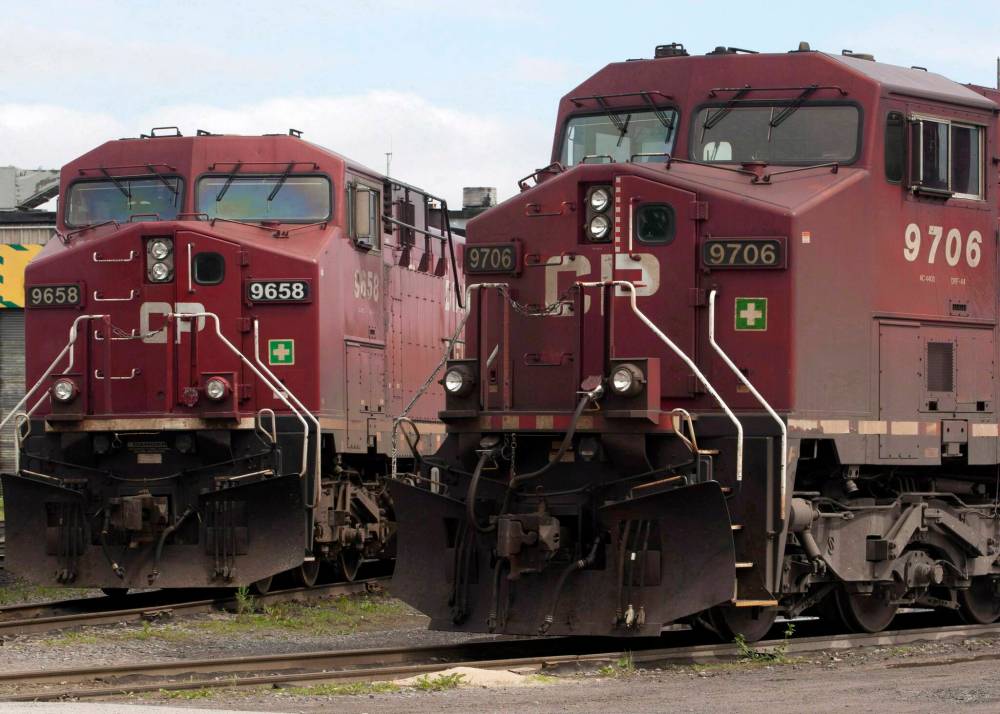
The Canadian Pacific Kansas City Ltd. and its workers, represented by Teamsters Canada, are locked in a protracted dispute that the union says hinges on critical worker fatigue provisions.
The negotiations, deadlocked since mid-February, prompted CPKC to seek the intervention of the federal labour minister on Feb. 16, requesting the appointment of a conciliation officer in contract negotiations.
The conciliation officer is to assist the company and both the Teamsters Canada Rail Conference (TCRC) — Train & Engine (T&E) division and TCRC — Rail Canada Traffic Controllers (RCTC) division in reaching renewed collective agreements at the bargaining table.
Union spokesperson Christopher Monette said the union — representing over 9,000 train conductors, engineers and yard workers — is committed to ensuring railroader safety, adding workers should have a say in their work conditions.
“Workers, being the judge of their condition, should be relieved after 10 hours on duty,” Monette told the Sun in an email. “I can also point to another article that allows rail workers to take up to 24 hours of rest at their home terminals. The companies want to eliminate both provisions, among many others.”
Citing scientific evidence, Monette warned of the dangers associated with extended working hours, comparing the impairment of a railroader after 17 hours to that of a driver with a .05 blood-alcohol level. A full 24 hours without sleep, he asserted, is comparable to a .10 blood-alcohol level.
“Consider the potential dangers the next time you observe a four-kilometre-long train weaving through your neighbourhood,” he said. “The demands to strip rest provisions from our agreement are, as our national president stated, non-starters. We are ready to negotiate and engage with the companies, but we will never compromise on safety.”
Teamsters, he said, engage in negotiations with over 3,000 employers across Canada, and have successfully renewed contracts without experiencing labour disputes. But CN and CPKC are notable exceptions, he added, as their negotiation strategies frequently result in unwarranted and preventable confrontations.
The Sun reached out to CPKC for comment on the labour dispute and spokesperson Terry Cunha provided a copy of its statement on the conciliation filing.
“It is unfortunate that once again the Teamsters Canada Rail Conference – Train & Engine division has chosen to grossly misrepresent the facts regarding our ongoing collective bargaining and the multiple proposals made by CPKC,” the statement said.
“After five months of bargaining that has produced no progress, CPKC requested the appointment of a Federal Conciliation Officer on February 16, 2024, to assist it and both the TCRC – T&E division and the TCRC – Rail Canada Traffic Controllers (RCTC) division with reaching renewed collective agreements at the bargaining table.”
CPKC, according to the statement, presented two contract options aimed at providing benefits to all employees. While the first option offers significant pay increases and improved work-life balance, incorporating a modern time-based pay model, the other maintains competitive wage increases consistent with recent settlements and adheres to new Transport Canada regulatory frameworks for rest.
CPKC argued its proposals, including the modification of certain work rules, do not compromise safety or employee well-being, criticizing the TCRC bargaining team for not presenting comprehensive offers of their own and emphasizing CPKC’s commitment to a negotiated outcome for the benefit of all stakeholders.
The dispute, marked by a history of confrontations, remains a significant challenge. CPKC highlights the need for stability in North American supply chains, especially after years of disruptions from various external factors.
“The company remains focused on negotiating an outcome that aligns with the best interests of railroaders, their families, customers, and the broader economy,” it added.
» aodutola@brandonsun.com
» X: @AbiolaOdutola