
Canada says it will join effort to get aid to Gaza through humanitarian sea corridor
Advertisement
Read this article for free:
or
Already have an account? Log in here »
We need your support!
Local journalism needs your support!
As we navigate through unprecedented times, our journalists are working harder than ever to bring you the latest local updates to keep you safe and informed.
Now, more than ever, we need your support.
Starting at $15.99 plus taxes every four weeks you can access your Brandon Sun online and full access to all content as it appears on our website.
Subscribe Nowor call circulation directly at (204) 727-0527.
Your pledge helps to ensure we provide the news that matters most to your community!
To continue reading, please subscribe:
Add Brandon Sun access to your Free Press subscription for only an additional
$1 for the first 4 weeks*
*Your next subscription payment will increase by $1.00 and you will be charged $20.00 plus GST for four weeks. After four weeks, your payment will increase to $24.00 plus GST every four weeks.
Read unlimited articles for free today:
or
Already have an account? Log in here »
Hey there, time traveller!
This article was published 10/03/2024 (741 days ago), so information in it may no longer be current.
OTTAWA – Canada will join an international effort to deliver humanitarian assistance to Gaza by sea, Foreign Affairs Minister Mélanie Joly announced on Sunday, as hundreds of thousands of Palestinians continue to go hungry.
Joly issued a statement saying Canada will join the international coalition that is working together to increase the flow of aid to Gaza through a humanitarian sea corridor originating from Cyprus. Further details have not yet been released.
The announcement came following a meeting between Joly and her counterpart in the United Arab Emirates, Foreign Affairs Minister Sheikh Abdullah bin Zayed.
“We discussed the need to increase the amount of humanitarian aid reaching Gaza through all means possible,” Joly said Sunday on X, formerly known as Twitter.
“I committed that Canada will join the coalition to do just that through a humanitarian sea corridor.”
On Friday, the UAE, along with the European Commission, Germany, Greece, Italy, the Netherlands, Cyprus, the United Kingdom and the United States jointly announced their intent to open a maritime corridor.
Hundreds of thousands of Palestinians are going hungry after five months of war, and the push for aid comes as the Muslim holy month of Ramadan begins Monday in much of the world.
The opening of the sea corridor, along with airdrops by the U.S., Jordan and others, reflected growing alarm over Gaza’s deadly humanitarian crisis and a new willingness to bypass Israeli control over land shipments.
But aid officials say air and sea deliveries can’t make up for a shortage of land routes. The number of aid trucks entering Gaza daily are far below the 500 entering before the war.
A ship belonging to Spanish aid group Open Arms and carrying 200 tons of food aid was expected to make a pilot voyage to test the corridor “as soon as possible” but not Sunday, said spokesperson Linda Roth with partner organization World Central Kitchen. There was no explanation after Cyprus’s president had said it would leave Sunday.
Israel has said it welcomes the sea deliveries and would inspect Gaza-bound cargo before it leaves a staging area in nearby Cyprus. Israel’s defense minister Yoav Gallant reviewed prep work off the Gaza coast on Sunday.
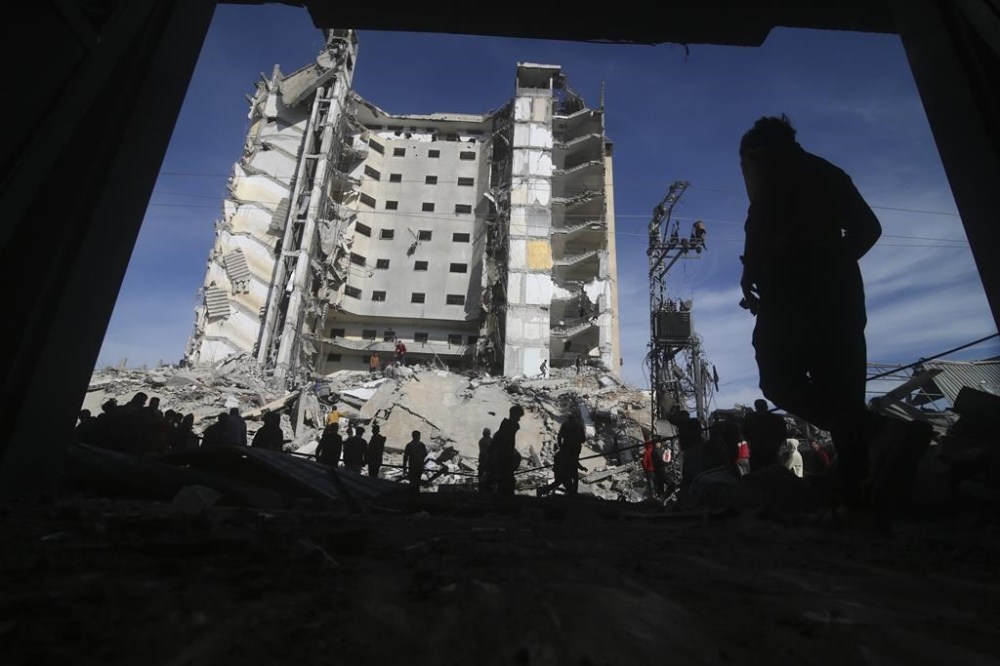
Israel declared war on Oct. 7 after Hamas militants killed about 1,200 people, mostly civilians, and took nearly 250 hostages. Israel’s air and ground offensive has devastated large parts of Gaza and displaced about 80 per cent of the population of 2.3 million.
The Hamas-run Health Ministry in Gaza said at least 31,045 Palestinians have been killed since the war began.
The ministry doesn’t differentiate between civilians and combatants in its count, but says that women and children make up two-thirds of the dead.
The ministry is part of the Hamas-run government, and its figures from previous wars have largely matched those of U.N. and independent experts.
This report by The Canadian Press was first published March 10, 2024.
— With files from the Associated Press.