
Alberta government releases no-go zone map for renewable power projects
Advertisement
Read this article for free:
or
Already have an account? Log in here »
We need your support!
Local journalism needs your support!
As we navigate through unprecedented times, our journalists are working harder than ever to bring you the latest local updates to keep you safe and informed.
Now, more than ever, we need your support.
Starting at $15.99 plus taxes every four weeks you can access your Brandon Sun online and full access to all content as it appears on our website.
Subscribe Nowor call circulation directly at (204) 727-0527.
Your pledge helps to ensure we provide the news that matters most to your community!
To continue reading, please subscribe:
Add Brandon Sun access to your Free Press subscription for only an additional
$1 for the first 4 weeks*
- Enjoy unlimited reading on brandonsun.com
- Read the Brandon Sun E-Edition, our digital replica newspaper
*Your next Free Press subscription payment will increase by $1.00 and you will be charged $20.95 plus GST for four weeks. After four weeks, your payment will increase to $24.95 plus GST every four weeks.
Read unlimited articles for free today:
or
Already have an account? Log in here »
Hey there, time traveller!
This article was published 15/03/2024 (814 days ago), so information in it may no longer be current.
EDMONTON – The Alberta government has released some details of where and how it will permit wind and solar development, prohibiting it along a broad stretch of the province’s western edge, assessing its visual impact in five other large areas and restricting it on agricultural land.
“Wind projects are no longer permitted in the buffer zones due to the impact of their vertical footprint,” said Affordability and Utilities ministry spokeswoman Ashley Stevenson. “With agricultural lands, development is still permitted as long as the project can coexist with livestock or crops.”
The new restrictions will only apply to renewable energy development.
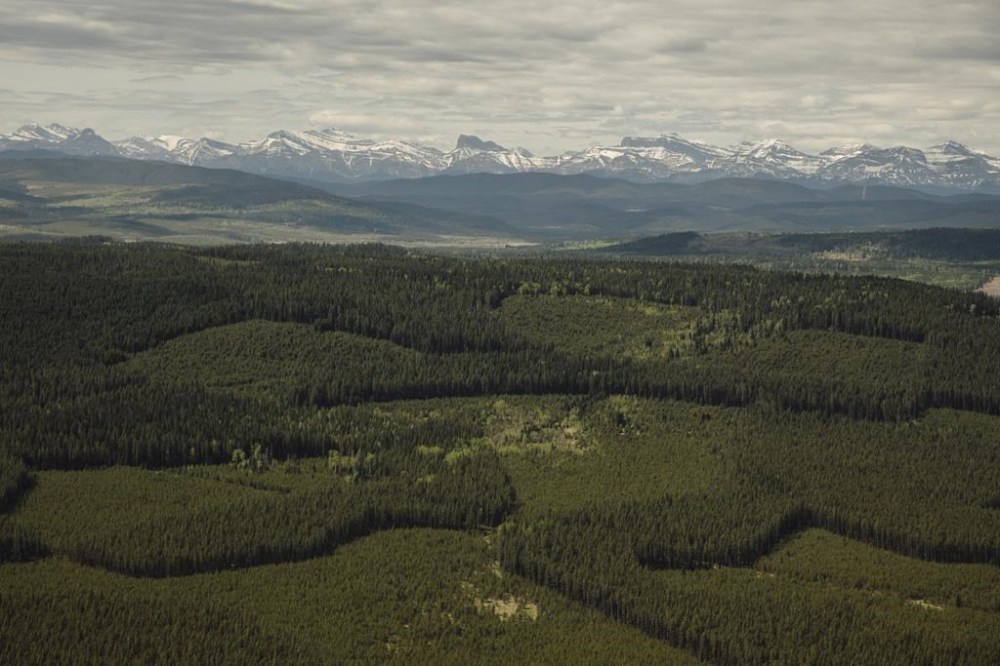
The no-go zone, according to a map released late Thursday, includes the entire length of the Rocky Mountains, stretching as far east as Calgary and Highway 2 in the south.
There are large zones around the Cypress Hills, Dinosaur Provincial Park, Writing-On-Stone Provincial Park, Head-Smashed-In Buffalo Jump and a stretch of foothills south of Rocky Mountain House where such projects will be subject to visual impact reviews — a process that remains undefined.
The map, together with the agricultural restrictions, will affect 57 projects worth $14 billion, said Jason Wang, an analyst at the Pembina Institute, a clean energy think-tank.
He said 35 projects are captured by the agriculture limitations. Another 22 will either be subject to a visual impact assessment or are in a no-go zone.
“That area, where these existing projects are, that’s where Alberta’s best wind resources are,” he said. “Those projects are now in the no-go zone.”
A report from the Alberta Utilities Commission on renewables development, requested by the United Conservative government, acknowledged the need to consider the visual impact of solar and wind development. But it said such considerations should be applied equally.
“The commission suggests that should the government find it in the public interest to pursue ‘no-go’ restricted viewscape zones, any prohibition on development intended to achieve viewscape preservation be industry agnostic and apply equally to all forms of development.”
Evan Wilson of the Canadian Renewable Energy Association wonders why the rules only apply to that industry.
“Why is this something that is just impacting wind and solar?”
Within the restricted zones are hundreds of oil and gas facilities. One open-pit coal mine in the Rockies is before the provincial regulator and the expansion of another has already been approved. Much of the area has been extensively logged.
“Wind turbines have a significant vertical footprint that isn’t shared by other developments in rural regions,” said Stevenson.
“(Visual impact zones) were established to ensure that the (Alberta Utilities Commission) conducts site visits to assess a proposed project’s visual impact.”
Wilson said the new map isn’t as restrictive as some feared it would be
“There is a significantly smaller portion of the province that is impacted by this map,” he said. “But it leads to a lot more questions.”
Developers still need to know what the next steps are and how they can mitigate concerns, he said. Nobody has explained how the lines on the map were drawn. Nobody, in a province dotted with pumpjacks and compressor stations, has outlined when human activity is part of the landscape and when it’s a visual impact.
“What we are seeking is clarity on what a pristine viewscape is,” said Wilson.
Maybe, he suggests, the definition is bigger than many think.
“There is something quite powerful about a view where you can see all of the different types of energy in Alberta coexisting with Alberta’s beauty behind,” he said. “To see a pumpjack, a wind turbine, a solar panel and the mountains is a truly Albertan vista.”
This report by The Canadian Press was first published March 15, 2024.