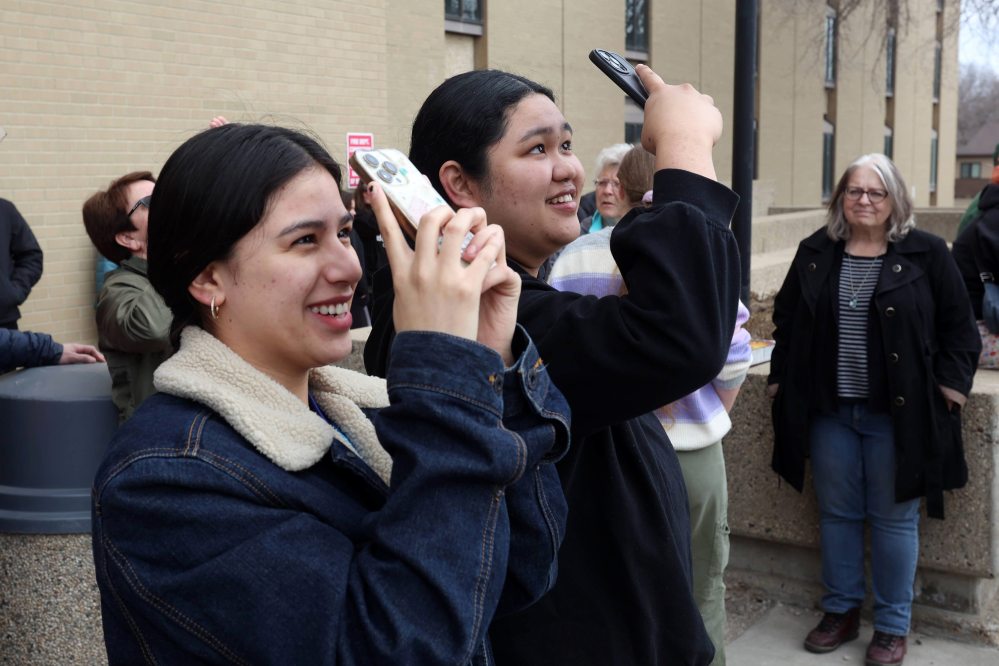
Spectators line up to view solar eclipse
Advertisement
Read this article for free:
or
Already have an account? Log in here »
We need your support!
Local journalism needs your support!
As we navigate through unprecedented times, our journalists are working harder than ever to bring you the latest local updates to keep you safe and informed.
Now, more than ever, we need your support.
Starting at $15.99 plus taxes every four weeks you can access your Brandon Sun online and full access to all content as it appears on our website.
Subscribe Nowor call circulation directly at (204) 727-0527.
Your pledge helps to ensure we provide the news that matters most to your community!
To continue reading, please subscribe:
Add Brandon Sun access to your Free Press subscription for only an additional
$1 for the first 4 weeks*
- Enjoy unlimited reading on brandonsun.com
- Read the Brandon Sun E-Edition, our digital replica newspaper
*Your next Free Press subscription payment will increase by $1.00 and you will be charged $20.95 plus GST for four weeks. After four weeks, your payment will increase to $24.95 plus GST every four weeks.
Read unlimited articles for free today:
or
Already have an account? Log in here »
Hey there, time traveller!
This article was published 09/04/2024 (884 days ago), so information in it may no longer be current.
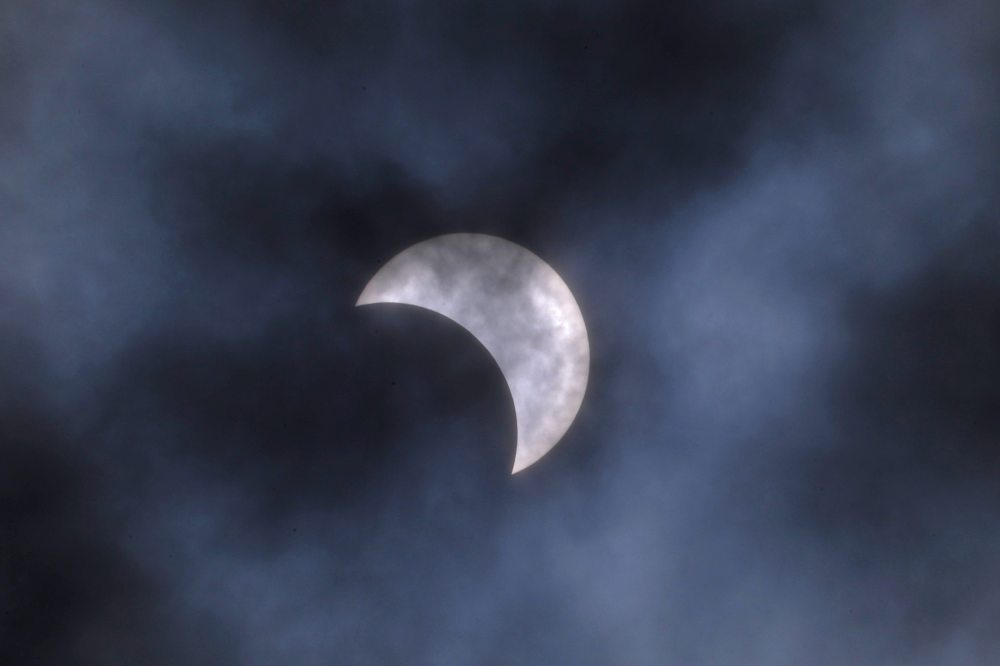
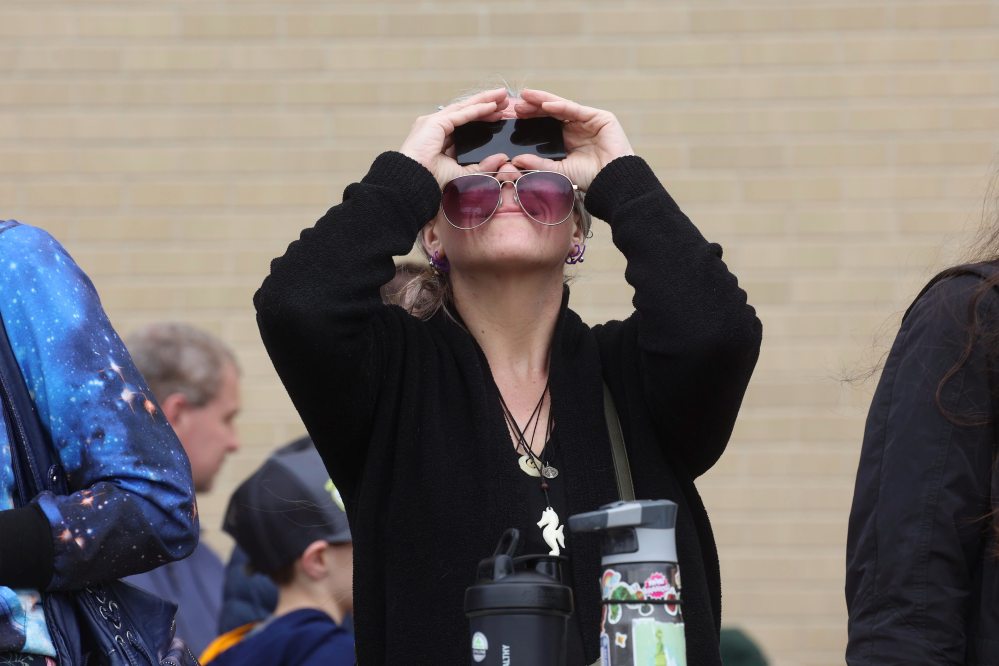
Clouds blocked most of the solar eclipse in Brandon on Monday afternoon, but there were moments of clarity for the dozens of spectators who gathered at Brandon University with their faces turned to the sky, peering through telescopes and thick safety glasses.
Western Manitobans saw a partial eclipse, not the total eclipse that other parts of North America experienced, when the moon passed between the Earth and the sun and obscured the view of the sun.
Shawna Corneau, a first-year BU student, said it was one of the most amazing things she had ever seen.
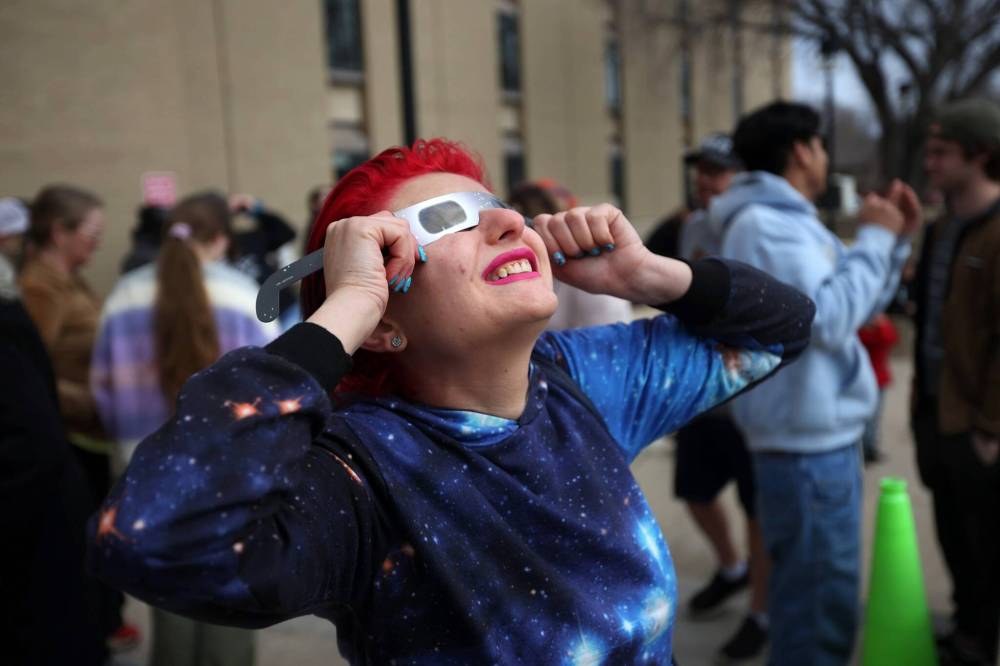
“You could clearly see the moon creeping across the sun, and the sun looked like a crescent. I had heard that we weren’t going to be in the path of totality and that we’d miss out on something. So, I didn’t know what to expect, but this was awesome,” Corneau said.
In Brandon, the last total solar eclipse was in 1979 and the last partial eclipse was in August 2017.
Steve Spuzak said he remembered the eclipse in ’79 and how the day went dark. That’s one of the reasons he brought his two daughters aged 10 and 14 to the viewing area outside BU’s Brodie Science Building.
“I was 10 years old in 1979, so, this is as close as we’ll get to seeing that and it’s really good for the girls to see. They’re interested in science and it’s really a pretty unique opportunity.”
The Brandon School Division made the decision to keep students inside during the eclipse.
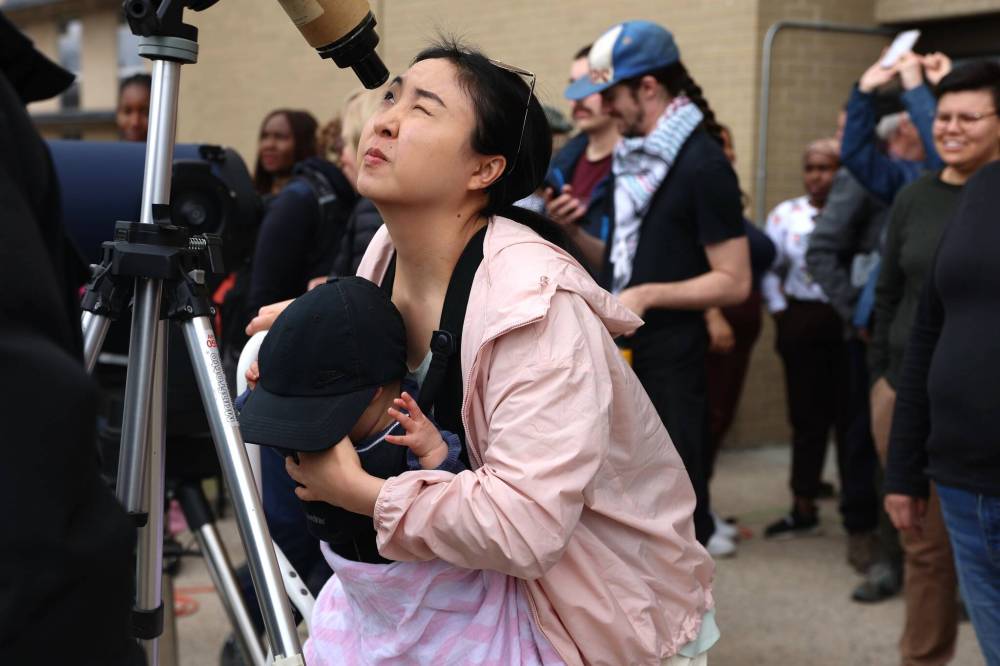
A woman peers into a solar-filtered portable telescope outside the Brodie Science Building at BU to see the partial eclipse on Monday afternoon. (Michele McDougall/The Brandon Sun)
Fourteen-year-old Stephanie explained how “the moon goes over the sun,” and she laughed as she said, “It got us out of school, but also, this rarely happens. We can see about 60 per cent of the sun, which isn’t normal, not an everyday thing, so we came to check it out.”
Tyler Foster and Austin Gulliver, astronomy professors in the Department of Physics and Astronomy at BU, organized the viewing event and had two portable telescopes with solar filters set up as well as welding glasses to ensure everybody could safely catch sight of the celestial event.
Foster added a filter to one of the telescopes while people lined up to take a turn. He said there are usually one or two solar eclipses that happen each year.
But, he added, because the blocking of the sun can only be seen on such a small area on the Earth each time, people don’t get to experience them as often.
“That’s why we don’t see them all the time, because the shadow is so small and the Earth is so big that your chances of actually being in the path of the shadow is very low,” said Foster.
“So, it’s your location on Earth. When the shadow of the moon hits the Earth, it’s only about 100 kilometres wide. When you think about how big the Earth is, well 100 kilometres is just a spot. So, you have to be standing in that shadow to see the total eclipse,” he said.
The eclipse’s path of totality went through six Canadian provinces on Monday: southeastern Ontario, southernmost Quebec, the northwest tip of Prince Edward Island, central New Brunswick, the far northern coast of Nova Scotia and right through the middle of Newfoundland.
Gulliver stood next to one of the portable telescopes at BU, helping to guide people where to look through the cloud cover.
He said he experienced a total eclipse in the 1960s “and it was spectacular.” He was hopeful that the people who came out on Monday wouldn’t be disappointed in seeing the partial path.
“Looking around, there are a lot of people who are interested in astronomy,” Gulliver said. “And it truly is a spectacle. And we have many different kinds of spectacles that we can show our students, so this is a big advantage.”
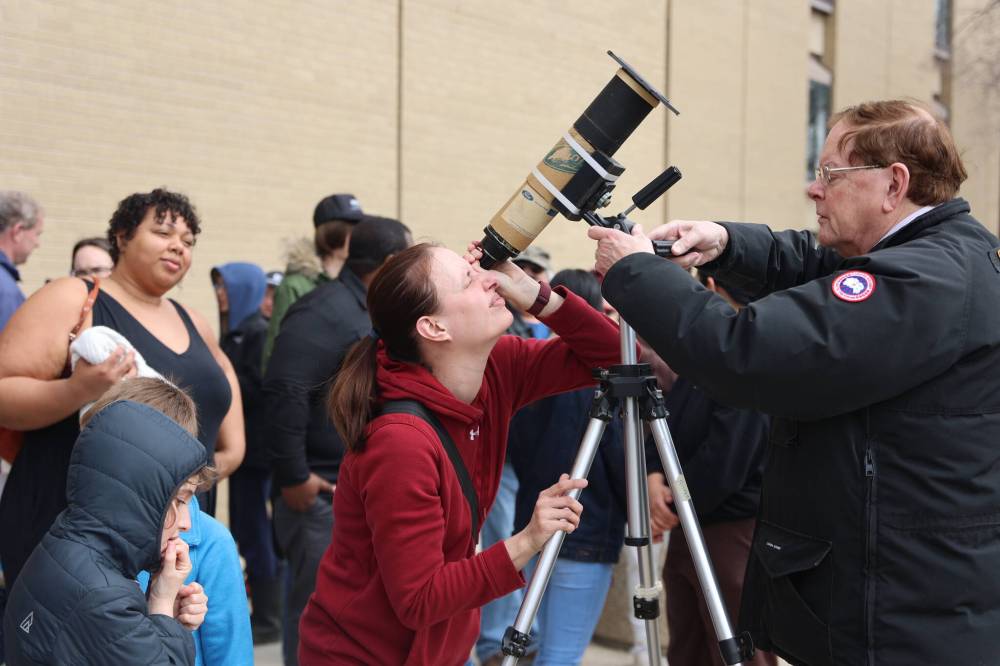
A woman peers into a solar-filtered portable telescope outside the Brodie Science Building at BU to see the partial eclipse on Monday afternoon in Brandon. (Michele McDougall/The Brandon Sun)
Bailey Preston is an alumnus of the physics and astronomy department, having graduated two years ago. It was important enough for him to take a few hours off from his new job and join the others at BU, because “this is a pretty big event,” he said.
“The next total solar eclipse isn’t happening until something like 2044, so this is kind of a big deal. Plus, I think it’s good to see everyone here, and put into perspective how small we really are in the grand scheme of things,” said Preston.
“I think that looking up into the stars, and seeing how big the world really is, broadens your view of the world and makes it feel like the world is a little bit smaller and closer together,” he said.
Monday’s eclipse is the last total solar eclipse that North Americans will see until 2044. And the next significant partial eclipse that Brandonites can view will be in January 2029.
BU’s astronomical observatory has an 18-inch and a 16-inch telescope and can be booked by members of the public during celestial events such as eclipses as well as transits, which happen when a planet passes in front of another planet, or in front of a star.
For more information, call 204-727-9677.
» mmcdougall@brandonsun.com
» X: @enviromichele