
Federal budget ignores Indigenous infrastructure needs: Assembly of First Nations
Advertisement
Read this article for free:
or
Already have an account? Log in here »
We need your support!
Local journalism needs your support!
As we navigate through unprecedented times, our journalists are working harder than ever to bring you the latest local updates to keep you safe and informed.
Now, more than ever, we need your support.
Starting at $15.99 plus taxes every four weeks you can access your Brandon Sun online and full access to all content as it appears on our website.
Subscribe Nowor call circulation directly at (204) 727-0527.
Your pledge helps to ensure we provide the news that matters most to your community!
To continue reading, please subscribe:
Add Brandon Sun access to your Free Press subscription for only an additional
$1 for the first 4 weeks*
*Your next subscription payment will increase by $1.00 and you will be charged $20.00 plus GST for four weeks. After four weeks, your payment will increase to $24.00 plus GST every four weeks.
Read unlimited articles for free today:
or
Already have an account? Log in here »
Hey there, time traveller!
This article was published 17/04/2024 (721 days ago), so information in it may no longer be current.
OTTAWA – The national chief of the Assembly of First Nations is denouncing a federal budget that she says all but ignores the needs of the communities she represents.
The federal government is neglecting a long-standing promise to close the widening First Nations infrastructure gap by 2030, Cindy Woodhouse Nepinak said Wednesday in Ottawa.
And her fellow chiefs are angry that they were not consulted on the federal government’s plans to transform federal land into housing for Canadians.
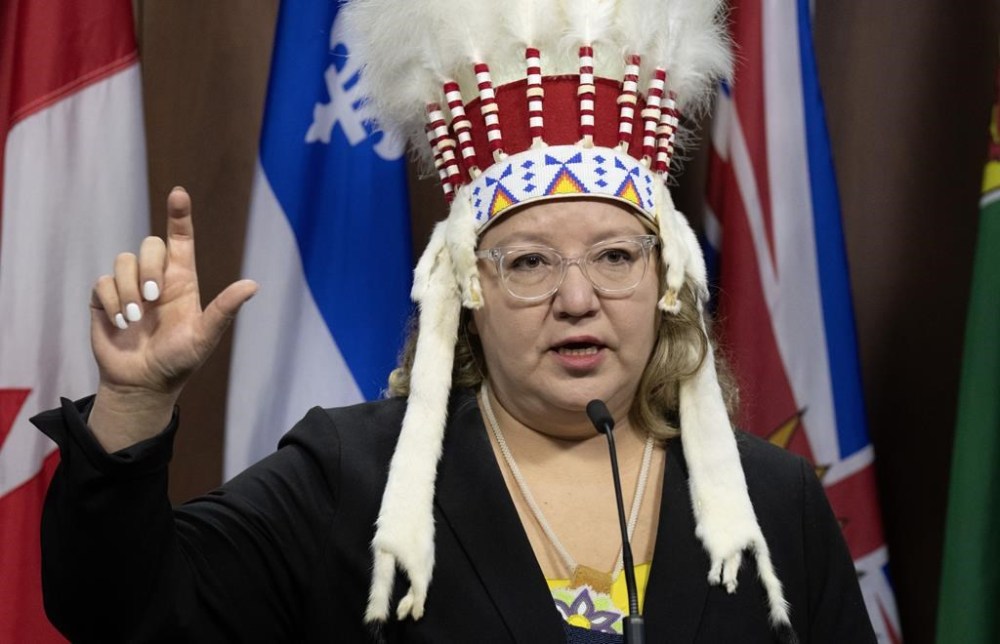
“Now, more than ever, we need to be working together in a good way to make sure First Nations and Canada achieve our full potential by working together and continuing on the path of reconciliation,” Woodhouse Nepinak said.
“Which, unfortunately, I did not hear in the speech yesterday.”
Neither Finance Minister Chrystia Freeland’s 3,500-word budget speech Tuesday nor Prime Minister Justin Trudeau’s remarks to caucus Wednesday made mention of reconciliation or Indigenous Peoples.
Woodhouse Nepinak called Freeland’s speech “alarming.”
It’s a far cry from 2015, when a new, more productive relationship with Indigenous Peoples was a key plank in Trudeau’s successful Liberal election platform.
The Indigenous services minister says the government remains committed to the same ideals, despite there being no mention of Indigenous Peoples in the speeches.
“I wouldn’t say $9 billion is a drop in priority,” Patty Hajdu told reporters after the Liberal caucus meeting Wednesday, referring to the total sum of money put forward in the budget for Indigenous communities.
“I think that our ambitious investments have gone a long way. We have more, for example, in schools and housing in this budget, but we’re going to need to be very solutions focused” to close the infrastructure gap, she said.
Woodhouse Nepinak, meanwhile, said she wants Trudeau and Freeland to explain the budget themselves in person when the AFN meets in Montreal in July.
A recent AFN report found it will take $349 billion to bring Indigenous infrastructure to the same standard as elsewhere in Canada — and that without prompt action, the gap will only continue to grow.
Trudeau pledged to close the infrastructure gap by 2030, but the federal auditor general concluded earlier this year that it’s only getting wider.
The needs include housing, water treatment plants, roads, schools and ports, among other things.
The AFN is also upset about not being consulted on the federal government’s budget promise to earmark underused federal lands to ease Canada’s housing crunch.
“Our entire team was talking about that this morning,” Woodhouse Nepinak said.
Acting Ontario regional Chief Abram Benedict noted the divestiture of federal properties includes a priority list that determines who gets first right of refusal, but First Nations are third on the list after provinces and municipalities — something he called “unacceptable.”
“When it’s our treaty partners, and those are traditional territories that are within all of our lands across Turtle Island, we need to have first priority so that our homes, our communities, can continue to prosper,” said Benedict.
The government has “no desire” to move away from its constitutional obligation to consult with Indigenous Peoples who may be affected by decisions, said Housing Minister Sean Fraser.
Land and territorial rights are frequently a contentious issue between both parties, Fraser acknowledged.
“There are unique opportunities to leverage federal lands that may not engage in Indigenous rights, but we still have to do appropriate consultations,” he said.
Woodhouse Nepinak said she’s also meeting with opposition parties to lay out the assembly’s top priorities in advance of the next federal election.
After her January meeting with Conservative Leader Pierre Poilievre, she said she wanted to renew the AFN’s relationship with the party, which became tense under former prime minister Stephen Harper.
Poilievre has yet to attend one of the AFN’s national assemblies, where hundreds of First Nations chiefs meet to vote on resolutions and discuss priorities they want to take to the federal government.
Conservatives reached out to the AFN following Tuesday’s budget release, Woodhouse Nepinak said. She wouldn’t say whether the party has made any commitments about what it would do differently.
This report by The Canadian Press was first published April 17, 2024.