
Therapy-dog screening a first in Canada
Advertisement
Read this article for free:
or
Already have an account? Log in here »
We need your support!
Local journalism needs your support!
As we navigate through unprecedented times, our journalists are working harder than ever to bring you the latest local updates to keep you safe and informed.
Now, more than ever, we need your support.
Starting at $15.99 plus taxes every four weeks you can access your Brandon Sun online and full access to all content as it appears on our website.
Subscribe Nowor call circulation directly at (204) 727-0527.
Your pledge helps to ensure we provide the news that matters most to your community!
To continue reading, please subscribe:
Add Brandon Sun access to your Free Press subscription for only an additional
$1 for the first 4 weeks*
*Your next subscription payment will increase by $1.00 and you will be charged $20.00 plus GST for four weeks. After four weeks, your payment will increase to $24.00 plus GST every four weeks.
Read unlimited articles for free today:
or
Already have an account? Log in here »
Hey there, time traveller!
This article was published 09/05/2024 (693 days ago), so information in it may no longer be current.
Therapy dogs and their handlers in Brandon will be tested on their suitability to respond to crisis situations at the country’s first animal-assisted crisis response screening session on Saturday.
HOPE Animal Assisted Crisis Response is an American non-profit, volunteer organization that deploys “comfort dog teams” to provide support to people affected by crises and disasters. While Canadian dog teams have to travel to the U.S to complete the certification process, Saturday’s event will be the first time HOPE AACR comes to Canada to do screening.
“It’s a huge deal for us,” said Ngaire Abernethy, a member of the PATDogs Therapy team, a group of dog and handler teams in Brandon that offer canine therapy to places like hospitals and long-term care homes.
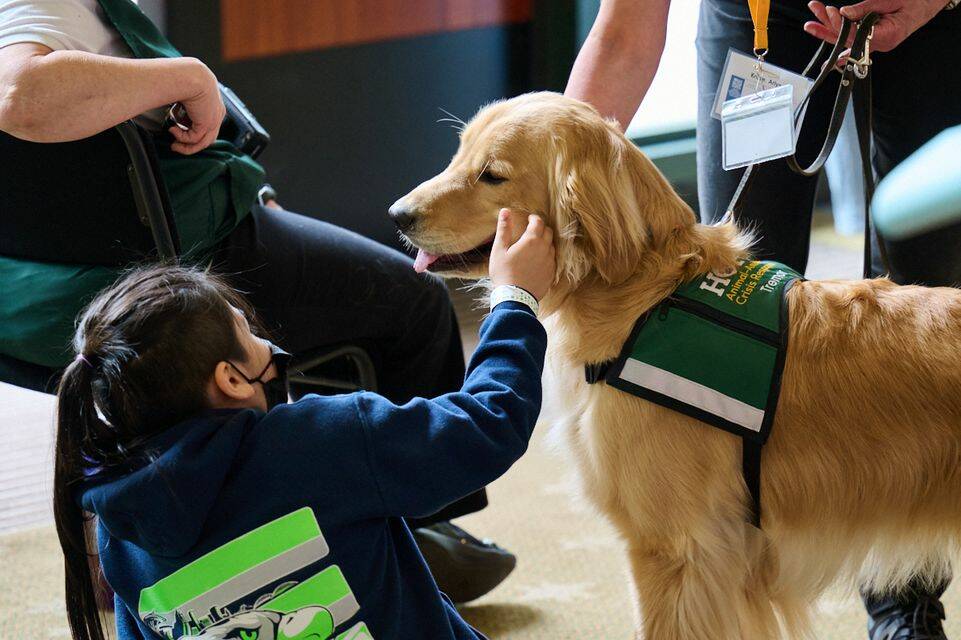
Local therapy dogs and their handlers will be participating in a screening test in Brandon on Saturday to work toward becoming certified in animal-assisted crisis response by a U.S. organization called HOPE. It will be the first time that the screening process has been held outside of the U.S. (Submitted)
“What we’ve been talking about for a long time is to have workshops and screenings outside (the organization’s) normal sites.”
Abernethy describes HOPE as a PhD for current therapy dogs, who must have a least one year as a therapy dog before passing the screening test and attending a three-day workshop in specialized training held in locations across the U.S. She said any therapy dogs — not just dogs that are part of the PATDogs group — are eligible for HOPE training.
“Both the dogs and their handlers have a higher level of training and skill, so that they’re better prepared to respond to crisis situations,” she said.
While there are three members of the PATDogs group that are certified by HOPE, they did so by travelling to Colorado Springs, Colo., (Manitoba’s “region” for the organization) to complete both the screening and the training.
The first Canadian deployment of the HOPE-trained Westman teams was to assist in the aftermath of the tragic bus crash outside of Carberry that killed 17 seniors from Dauphin.
Since then, Abernethy has been working to try to get enough canine and human teams in Manitoba for the organization to come to them.
“It’s a 16-hour drive to Colorado Springs — to have to do two trips just represents a huge ask of volunteers,” she said.
“Our hope now is that we’ll have enough of a volunteer base that we can run our own workshop locally here to save that travel cost.”
With four candidates (or “HOPEfuls”) participating, the group struck a compromise with HOPE to have the screening held in Brandon, but if any dog team passes the screening, they will have to travel to Colorado to complete the workshop training.
HOPE Rocky Mountain region managers Sandy Miller and Tina Jones told the Sun that having enough canine-human teams in Brandon made it possible for Miller to travel to Brandon.
“We’ve got a big class this time — let’s send somebody up there and do the screening right there,” Miller recalled saying. “So, they don’t have to travel, and they don’t have the expense of travelling.”
During the screening, dogs and their handlers are put through a mock disaster or trauma centre to expose the teams to the chaos and noise that often accompanies crisis situations — very different from a typical environment that a therapy dog is accustomed to.
“You’re going into a hospital or you’re going into a nursing home or something like that, it’s more controlled. And they’re only there for an hour or two at a time,” Miller said.
HOPE teams in the U.S. work under the incident command system and with emergency response authorities like the Federal Emergency Management Agency (FEMA) and the Red Cross. HOPE was the first animal-assisted crisis response organization in the U.S. and co-wrote its national standard.
Miller and Jones emphasized the importance of both the suitability and the rigour of training needed for both humans and canines responding to crisis situations, because without those qualities, what is intended to be a comfort can end up doing more harm. The three-day workshop after the screening tests involves intensive education sessions, mock situations and field work.
“It’s great that people want to help, but if they aren’t prepared themselves and you walk into this kind of disaster situation, it can impact your own mental health (and cause) secondary trauma,” Jones said.
“We try and share those national standards so that people understand that we’re trying to work with these groups and help people.”
The regional managers said HOPE teams have responded to natural disasters, car crashes and shootings and have been able to see the comfort the dogs provide to people in traumatic situations.
Jones recalled a moment from when she and her first crisis response dog, Hondo, were deployed to the Navy Yard shooting in Washington, D.C., in 2013.
Hondo leaned up against one man, and once he began to pet the dog he started to open up about his co-worker, who didn’t survive the shooting that killed 12.
“You just let them unload, and the dog helps them to do that,” Jones said. “And it’s really amazing to watch.”
The screening session will take place at the Grasslands Canine Development Centre.
» gmortfield@brandonsun.com
» X: @geena_mortfield