
Westman chiefs hail CFS declaration
Advertisement
Read this article for free:
or
Already have an account? Log in here »
We need your support!
Local journalism needs your support!
As we navigate through unprecedented times, our journalists are working harder than ever to bring you the latest local updates to keep you safe and informed.
Now, more than ever, we need your support.
Starting at $15.99 plus taxes every four weeks you can access your Brandon Sun online and full access to all content as it appears on our website.
Subscribe Nowor call circulation directly at (204) 727-0527.
Your pledge helps to ensure we provide the news that matters most to your community!
To continue reading, please subscribe:
Add Brandon Sun access to your Free Press subscription for only an additional
$1 for the first 4 weeks*
- Enjoy unlimited reading on brandonsun.com
- Read the Brandon Sun E-Edition, our digital replica newspaper
*Your next Free Press subscription payment will increase by $1.00 and you will be charged $20.95 plus GST for four weeks. After four weeks, your payment will increase to $24.95 plus GST every four weeks.
Read unlimited articles for free today:
or
Already have an account? Log in here »
Hey there, time traveller!
This article was published 15/05/2024 (740 days ago), so information in it may no longer be current.
The chief of Sioux Valley Dakota Nation says a declaration made by First Nations in Manitoba and the provincial government over child and family services is a first step toward improving the system.
On Monday, Premier Wab Kinew, Families Minister Nahanni Fontaine and representatives from First Nations across the province signed the declaration, which has the province committing to transfer control over child welfare services for Indigenous children to First Nations.
While Sioux Valley Chief Vince Tacan said Tuesday that the move won’t impact his community as much as others because of its self-governing status, he is pleased that it will allow First Nations to have jurisdiction over children who live off-reserve.
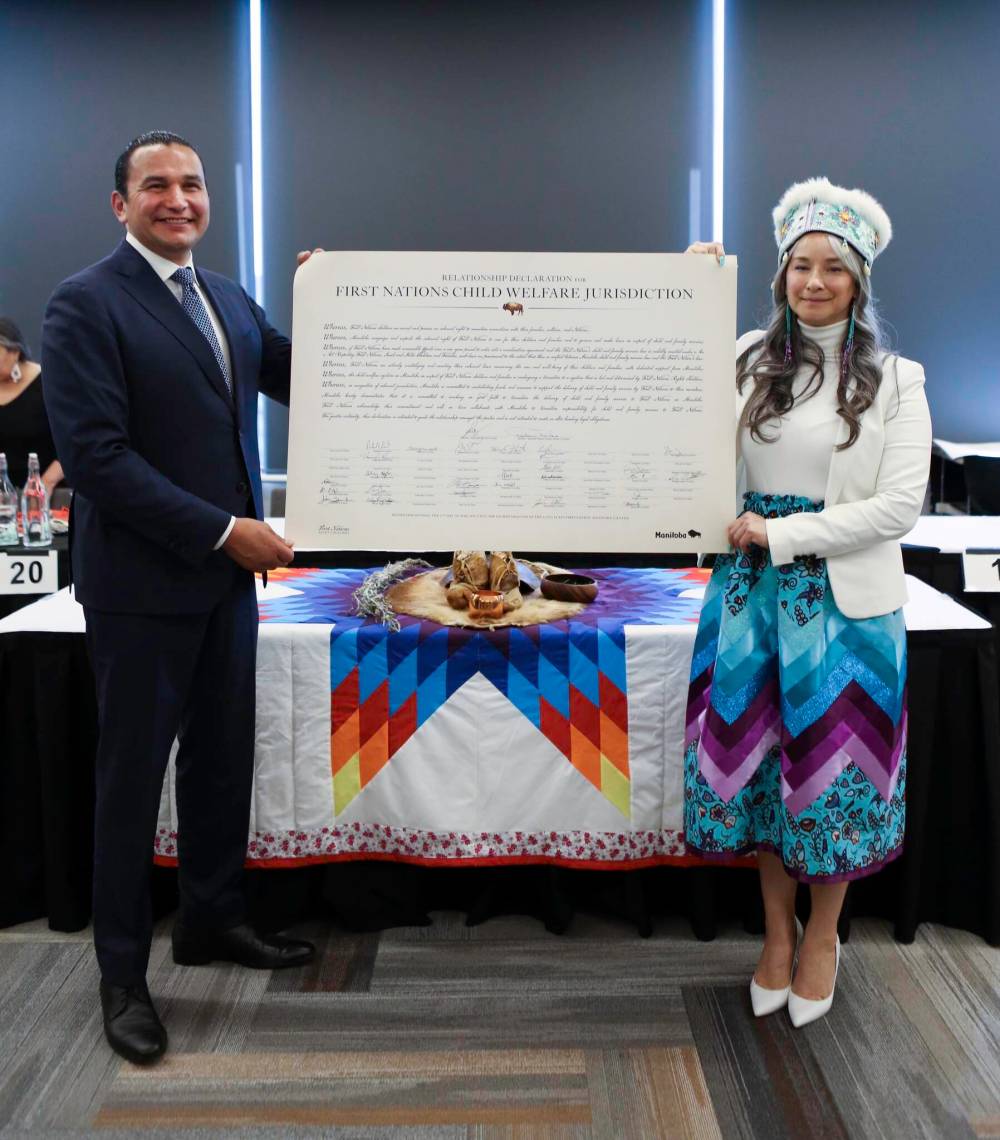
“One of the things in our self-government arrangement is that we’re able to benefit from future laws, take the good parts … and incorporate them into our settlement law,” Tacan said in a phone interview.
On top of that, he said Sioux Valley’s chief and council currently have no say or influence over the community CFS agency, and this move will change that once council passes a law governing those services.
“We have no influence on the delivery of child care in our community, and I believe that’s right across the board for all the other chiefs as well,” Tacan said.
“The minister did say that’s one thing that they’re going to change in the law, that chiefs can finally have a say in what happens to their children in their community. Because at the end of the day, when there’s an issue regarding children, who do people go to? The chief and council.”
The chief said that would be a positive after a century of having their CFS system administered by other groups.
“We see the disastrous results of it in the form of incarceration rates for our people and, unfortunately, it’s our women and band members that are showing up missing and murdered.”
As the conversation with the province continues, Tacan said he’d like to make sure that Indigenous communities are given the same resources for child welfare that currently exist.
He said one of his comments at the Monday meeting was that for too long there has been a for-profit model for CFS, which has been counter to the idea of reuniting children with their families.
Going forward, he said he’d like to see Sioux Valley put more resources into the prevention of poor outcomes for children as they work toward undoing the harms of residential schools and the Sixties Scoop.
“As a chief, I’d like to work on a different agenda, which is economic development,” Tacan said. “But that’s going to be all for naught if I don’t have children and families healthy enough to benefit from that kind of work.”
Another chief who signed the declaration was Chief Murray Clearsky of Waywayseecappo First Nation, who said his community had already been working toward taking over its own child welfare services as of July 2.
Like Sioux Valley, Clearsky said Waywayseecappo will pass its own laws governing its services. The chief said he agreed with Tacan’s assessment about too much emphasis having been placed on apprehension rather than prevention.
“In a lot of cases, taking the children away was the quickest solution,” Clearsky said. “We don’t see it that way, you know? We want to keep the children here. We want to accommodate them, get back with their parents, their grandparents.”
He said he thought Kinew and Fontaine would be good partners on the file as this was the first time a government has ever asked if First Nations wanted to be involved in solving the problem.
Currently, Clearsky said, there are roughly 280 kids from Waywayseecappo in care.
In a release issued Monday, Kinew said every child in Manitoba deserves to know who they are and where they come from.
“That is why our government is working with First Nations to ensure children in care maintain connection to their families, their culture and their language,” the premier said.
“Together, we can build a future in Manitoba where we don’t have to come back and apologize to the next generation of children.”
Fontaine noted that the declaration responds to one of the Truth and Reconciliation Commission’s calls to action, which is to reduce the number of Indigenous children in care and affirm the right of Indigenous governments to establish their own child-welfare agencies.
She also said it aligns with the United Nations Declaration of the Rights of Indigenous Peoples.
Fontaine’s press secretary told the Sun by email that 37 chiefs or their proxies attended Monday’s event along with representatives from the Assembly of Manitoba Chiefs, Southern Chiefs’ Organization and Manitoba Keewatinowi Okimakinak.
Of those representatives, 27 signed the declaration while the rest are taking time to confer with their councils.
“This is a living document at the Manitoba Legislative Building and First Nations are welcome to sign onto (it) as the relationship continues,” the spokesperson said.
Monday’s release noted that of the 8,990 children in care in Manitoba, 91 per cent are Indigenous.
A Tuesday release from the AMC said the declaration was “historic.”
“First Nations never surrendered jurisdiction over their children and families. Rather, Canada stole that jurisdiction and allowed the province to steal our children, destroy our families and try to weaken First Nations,” said Grand Chief Cathy Merrick.
“The province of Manitoba remains the steward of this colonial and genocidal legacy, and it is high time for positive change for First Nations in Manitoba.”
» cslark@brandonsun.com
» X: @ColinSlark