
NDP should welcome private investment in energy projects
Advertisement
Read this article for free:
or
Already have an account? Log in here »
We need your support!
Local journalism needs your support!
As we navigate through unprecedented times, our journalists are working harder than ever to bring you the latest local updates to keep you safe and informed.
Now, more than ever, we need your support.
Starting at $15.99 plus taxes every four weeks you can access your Brandon Sun online and full access to all content as it appears on our website.
Subscribe Nowor call circulation directly at (204) 727-0527.
Your pledge helps to ensure we provide the news that matters most to your community!
To continue reading, please subscribe:
Add Brandon Sun access to your Free Press subscription for only an additional
$1 for the first 4 weeks*
*Your next subscription payment will increase by $1.00 and you will be charged $20.00 plus GST for four weeks. After four weeks, your payment will increase to $24.00 plus GST every four weeks.
Read unlimited articles for free today:
or
Already have an account? Log in here »
Hey there, time traveller!
This article was published 26/06/2024 (678 days ago), so information in it may no longer be current.
There’s a new wind energy project coming out of Saskatchewan that should catch the attention of Manitoba’s governing NDP — that is, if they can see past their ideological blinders for a bit.
Earlier this week, Enbridge Inc. and Six Nations Energy Development LP announced plans to develop a massive wind energy project in southeast Saskatchewan.
As The Canadian Press reported, the Seven Stars Energy Project, located near Weyburn, is slated to produce 200 megawatts of clean electricity — enough to fuel more than 100,000 homes for a year.
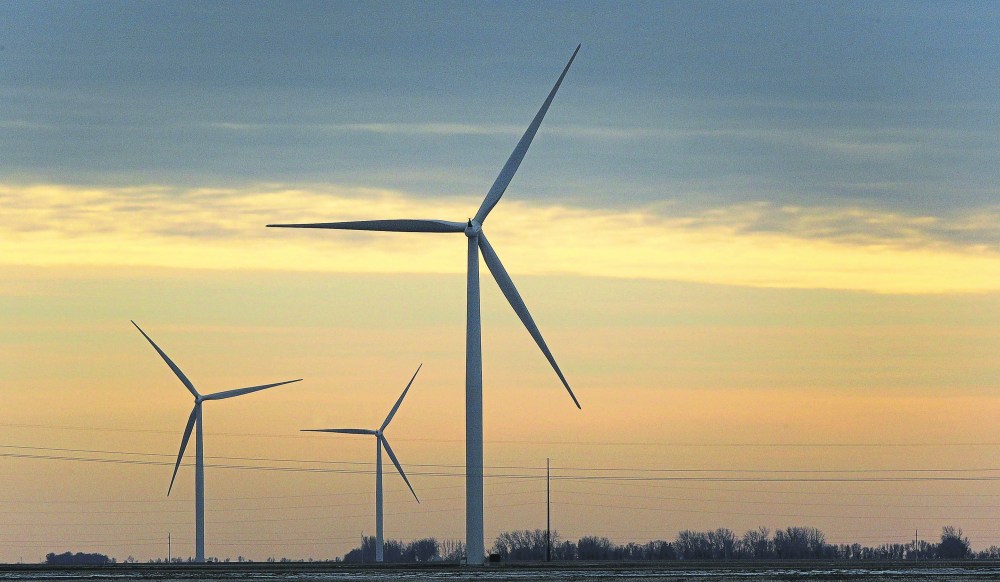
As part of the agreement, a wholly owned indirect subsidiary of Enbridge is to develop, construct and operate the facility, which is expected to come online in 2027 if it manages to meet the regulatory and investment criteria.
This is a big deal, particularly for Saskatchewan First Nations and Métis Nation-Saskatchewan, which have an opportunity here to acquire at least a 30 per cent stake in the project. That’s being made possible by a $100-million loan guarantee from the Saskatchewan government’s Indigenous Investment Finance Corp.
“It’s very momentous for us, as Treaty 4 Nations, as Métis Nations,” Chief Matthew Peigan of Pasqua First Nation told CP. “I credit Enbridge for kicking the door open, for allowing (this partnership) to grow. I don’t like to call it building bridges, I like calling it fill in the gaps, because bridges crumble.”
Enbridge has been working on a long-term power purchase agreement with SaskPower — Saskatchewan’s counterpart to Manitoba Hydro. Not only does this project seem to have the support of Saskatchewan’s Crown utility, it would appear that Saskatchewan’s minister of economic development, Jeremy Harrison, and his government are standing behind private investment in wind power too.
“We wanted to make sure we had a great project, and this is a great project that is going to be deeply successful and deeply impactful for all the partners involved,” Harrison said.
This is the kind of economic potential that the Kinew government is in danger of passing up.
Manitoba Hydro was sounding the alarm last year regarding a coming shortage of surplus power. Hydro is only a few short years away from being unable to generate enough electricity to satisfy surging demand in this province.
That fact was brought into clear relief earlier this year when our sister paper, the Winnipeg Free Press, reported that a September briefing note to the province it had obtained revealed that the surplus capacity used to mitigate fluctuating water levels and shore up revenue from power sales had become “very limited” as electricity demand had grown.
“A single energy intensive connection may consume all remaining electrical capacity,” the note read.
That March revelation came a few months after former Hydro CEO Jay Grewal told an audience of Manitoba Chambers of Commerce members that the province had decided against new hydroelectric dams, largely because the utility is already handicapped by excessive debt from previous hydro projects.
Grewal said at the time that Manitoba Hydro would issue a call for proposals to build out its generation infrastructure, particularly more wind farms, through partnerships with more independent producers. That statement led to a public rebuke one day later by Manitoba Finance Minister Adrien Sala, who said the province would look to add capacity to the grid without external partners.
“There’s no question that we need to find ways of building new capacity here in Manitoba, and we do have energy needs that need to be met, but our position is that new generation should be publicly owned,” Sala said.
Two weeks after her speech, Grewal was let go from her role with Manitoba Hydro. Yet to date the province has not provided an alternative path forward toward attaining new energy production.
Building wind infrastructure is expensive, and the province of Manitoba has never been flush with cash. The NDP’s rather Quixotic belief that new power production has to be wholly owned by our own Crown corporation seems destined to leave us falling behind when, as a province, we need to become more innovative and open to business investment.
Ironically, two large wind farms created with private investment under the former NDP government already exist as pragmatic examples of forward thinking. We’d like to see Wab Premier Wab Kinew take a page out of Gary Doer’s playbook on this file and reconsider his government’s position. Groups like Enbridge, and several Manitoba First Nations, would no doubt jump at the chance to invest in wind energy in this province.
After all, it’s an ill wind that blows nobody any good.
» Matt Goerzen, editor