
Apology a good sign of changes to come
Advertisement
Read this article for free:
or
Already have an account? Log in here »
We need your support!
Local journalism needs your support!
As we navigate through unprecedented times, our journalists are working harder than ever to bring you the latest local updates to keep you safe and informed.
Now, more than ever, we need your support.
Starting at $15.99 plus taxes every four weeks you can access your Brandon Sun online and full access to all content as it appears on our website.
Subscribe Nowor call circulation directly at (204) 727-0527.
Your pledge helps to ensure we provide the news that matters most to your community!
To continue reading, please subscribe:
Add Brandon Sun access to your Free Press subscription for only an additional
$1 for the first 4 weeks*
*Your next subscription payment will increase by $1.00 and you will be charged $20.00 plus GST for four weeks. After four weeks, your payment will increase to $24.00 plus GST every four weeks.
Read unlimited articles for free today:
or
Already have an account? Log in here »
Hey there, time traveller!
This article was published 13/07/2024 (634 days ago), so information in it may no longer be current.
“We’re not asking for all of Canada back, we’re just asking for that recognition that we are in our own lands.”
— Canupawakpa Dakota Nation Chief Raymond Brown
In a ceremony that is supposed to take place this coming Monday at a reserve just south of Saskatoon, Sask., the Canadian government is poised to offer nine Dakota and Lakota First Nations a formal apology for historical actions taken against them.
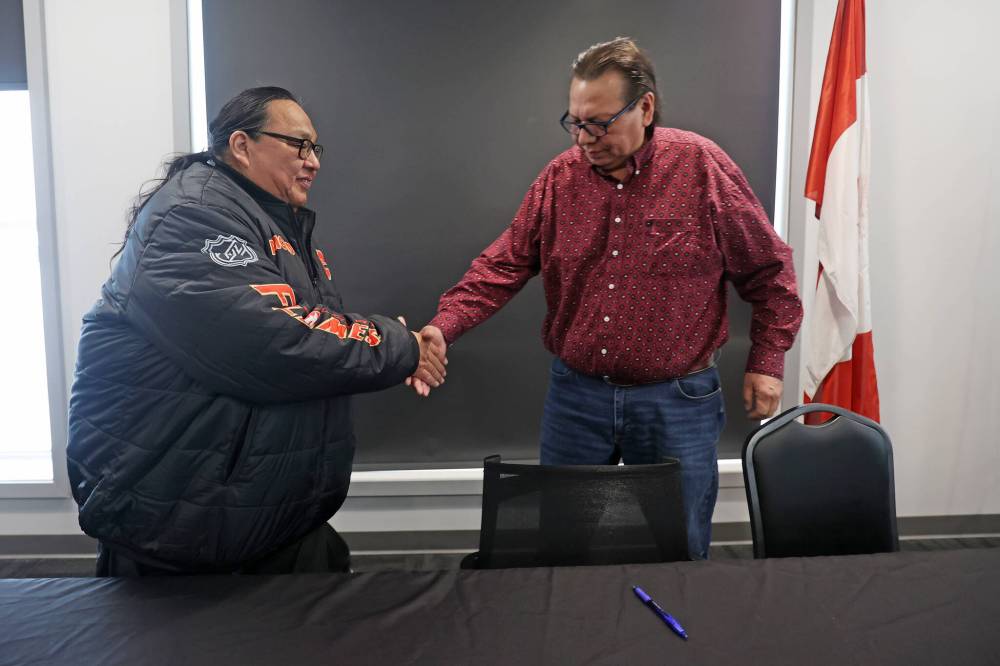
Canupawakpa Dakota Nation Chief Raymond Brown (left) is shown in this recent photo with Sioux Valley Dakota Nation Chief Vince Tacan. It's expected that on Monday the Canadian government will offer a formal apology to nine Dakota and Lakota First Nations for historical actions taken against them. (File)
A press release issued on Thursday by the federal government offered no contextualization or clarity. And of course the minister’s office offered no help on Friday when contacted by the Sun.
But if you ask one of Manitoba’s Dakota chiefs, it appears that the nine Dakota and Lakota nations are going to have one of their longest arguments and most fervent demands realized on Monday.
For 162 years, the nine Dakota and Lakota First Nations in Manitoba and Saskatchewan have been considered refugees in Canada and the formerly British-held territory, an historical mistake that dismissed their territorial ties to the land north of the 49th parallel. These First Nations have long argued against that designation, as they consider Canada part of the traditional territory they held before the arrival of European settlers — territory that had once extended down into the United States.
The marginalization of the Dakota people largely began when the group fought alongside the British in the War of 1812. Even though the Dakota and Lakota were promised a permanent settlement for making this alliance, the English abandoned their Indigenous allies at the Treaty of Ghent signing in Belgium in 1814 that brought the conflict to an end.
In the years that followed, the eastern Dakota were pressured by the United States government into ceding large tracts of territory in a series of treaties signed in 1837, 1851 and 1858, in exchange for money and supplies. They were further encouraged to take up farming and end their nomadic way of life. But broken promises by the U.S. government, coupled with food shortages and crop failure, forced the Dakota’s hands, and an uprising soon followed.
Following the events of the Dakota War in 1862, the United States military drove some of the Dakota population into Canada, back to lands they had not given up. Yet they were forced to live on reserve lands in Manitoba and Saskatchewan.
As the Sun has previously reported, by the time Confederation took place in 1867, the Canadian government didn’t give serious consideration to the Dakota people and never bothered to include them in the numbered treaty system that was negotiated with other Indigenous groups before the Dakota and Lakota returned.
That lack of a formal treaty relationship left the Dakota with smaller reserves than other First Nations in the country and a built-in economic hurdle that has hampered their ability to build a future for themselves.
In 2019, former Birdtail Sioux Dakota Nation Chief Ken Chalmers was in the midst of negotiations in the wake of a framework agreement that had been signed with then minister of Crown-Indigenous relations Carolyn Bennett that would have given that First Nation full treaty rights under Canadian law. At the time, the former chief had given the Sun an exclusive look at the document, which offered the first view of where Canada was looking to go with negotiations.
The federal government was willing to concede that members of the Birdtail Nation, as descendants of the Dakota, “traditionally used and were present on the lands that would become Canada after Confederation.”
It was a stunning admission by the federal government, one that marked the continuation of talks between Canada and the non-treaty Dakota and Lakota tribes. Seemingly, those discussions have since borne fruit, however slowly. That Canada is now willing to offer an apology to the Dakota and Lakota tribes is further evidence that changes are coming for these Indigenous peoples.
Brown is right to point out that an official apology and a potential recognition of the Dakota and Lakota as “nation builders” of Canada is but the starting point for further negotiations. But Monday’s expected acknowledgment is a good sign of changes to come.
The Dakota and Lakota peoples of Saskatchewan and Manitoba should never have been considered refugees by Canada. It’s about time that Canada owns up to that mistake and creates a new and modern treaty with these peoples that will not just benefit the Dakota and Lakota, but all of us who call the Prairies home.
» Matt Goerzen, editor