
Canadian news engagement down significantly one year after Meta’s ban: study
Advertisement
Read this article for free:
or
Already have an account? Log in here »
We need your support!
Local journalism needs your support!
As we navigate through unprecedented times, our journalists are working harder than ever to bring you the latest local updates to keep you safe and informed.
Now, more than ever, we need your support.
Starting at $15.99 plus taxes every four weeks you can access your Brandon Sun online and full access to all content as it appears on our website.
Subscribe Nowor call circulation directly at (204) 727-0527.
Your pledge helps to ensure we provide the news that matters most to your community!
To continue reading, please subscribe:
Add Brandon Sun access to your Free Press subscription for only an additional
$1 for the first 4 weeks*
*Your next subscription payment will increase by $1.00 and you will be charged $20.00 plus GST for four weeks. After four weeks, your payment will increase to $24.00 plus GST every four weeks.
Read unlimited articles for free today:
or
Already have an account? Log in here »
Hey there, time traveller!
This article was published 01/08/2024 (641 days ago), so information in it may no longer be current.
MONTREAL – A new study is painting a grim portrait of how local Canadian news outlets are struggling to reach audiences one year after Meta began blocking Canadian news content on its Facebook and Instagram platforms.
The Media Ecosystem Observatory study published today finds that Canadians’ total engagement with news content on social media has been reduced by 43 per cent, despite efforts to increase social media engagement on other platforms.
The social media giant banned Canadian news content after Ottawa passed the Online News Act in June 2023, which compelled tech companies to enter into agreements with news publishers for the use of their content.
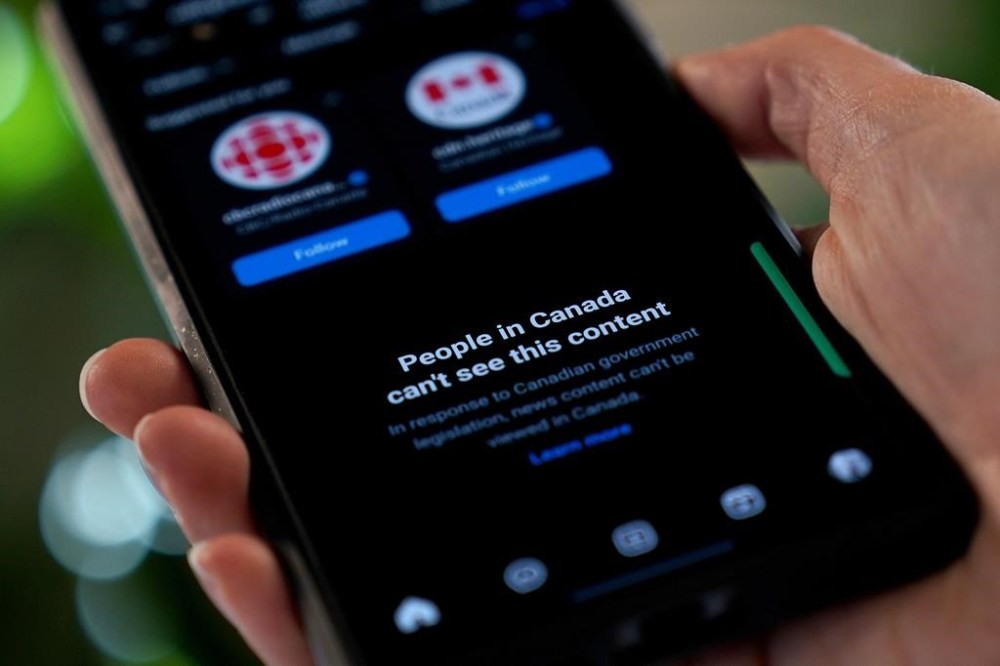
Local news outlets, many of which rely on Facebook, have been especially hit hard — 30 per cent of them are now inactive on social media, the study found.
Although just 22 per cent of Canadians are aware a ban is in place, according to the research, Canadians are seeing less news online — a decline to the tune of 11 million fewer daily views on Facebook and Instagram.
At the same time, workaround strategies such as screenshots are allowing a significant chunk of the population using Facebook and Instagram — more than a third of Canadian users — to engage with online news on those platforms.
The Media Ecosystem Observatory, a research initiative led by McGill University and the University of Toronto, has received funding from Ottawa, but its researchers are independent from the federal government.
This report by The Canadian Press was first published Aug. 1, 2024.