
Following criticism, Ottawa removes funding caps for residential school searches
Advertisement
Read this article for free:
or
Already have an account? Log in here »
We need your support!
Local journalism needs your support!
As we navigate through unprecedented times, our journalists are working harder than ever to bring you the latest local updates to keep you safe and informed.
Now, more than ever, we need your support.
Starting at $15.99 plus taxes every four weeks you can access your Brandon Sun online and full access to all content as it appears on our website.
Subscribe Nowor call circulation directly at (204) 727-0527.
Your pledge helps to ensure we provide the news that matters most to your community!
To continue reading, please subscribe:
Add Brandon Sun access to your Free Press subscription for only an additional
$1 for the first 4 weeks*
*Your next subscription payment will increase by $1.00 and you will be charged $20.00 plus GST for four weeks. After four weeks, your payment will increase to $24.00 plus GST every four weeks.
Read unlimited articles for free today:
or
Already have an account? Log in here »
Hey there, time traveller!
This article was published 16/08/2024 (581 days ago), so information in it may no longer be current.
OTTAWA – The federal government is backtracking on a move to limit funding for searches of former residential school grounds.
Crown-Indigenous Relations Minister Gary Anandasangaree said in a statement Friday the government has heard concerns from Indigenous leaders and communities “loud and clear.”
Communities could previously receive up to $3 million per year through the Residential Schools Missing Children Community Support Fund, but the government had moved to cap funding at $500,000.
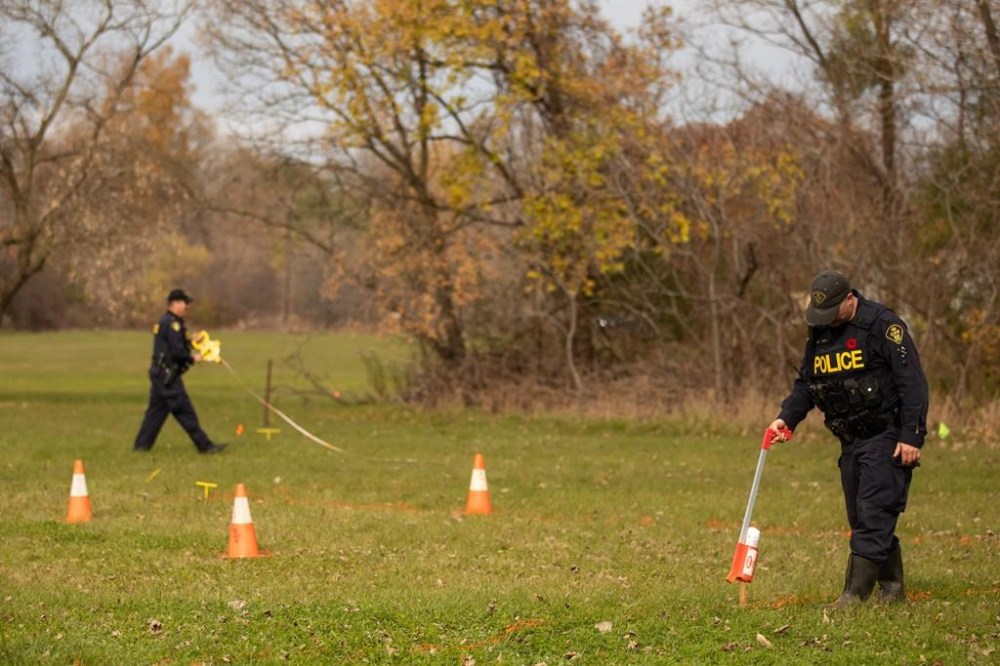
Ontario Provincial Police members take measurements during the search for unmarked graves using ground-penetrating radar on the 500 acres of the lands associated with the former Indian Residential School, the Mohawk Institute, in Brantford, Ont., Tuesday, November 9, 2021. THE CANADIAN PRESS/Nick Iwanyshyn
Anandasangaree said the government will now lift that cap and remove planned restrictions on the funding, which goes toward locating burial sites at former residential schools and identifying children who never returned.
The recent changes, he said, “fell short of our solemn commitment to finding the children.”
The Assembly of Manitoba Chiefs was among the groups that had decried the change, with deputy grand chief Betsy Kennedy calling the decision “not only disheartening but also disrespectful to the survivors and families affected by the residential school system.”
Anandasangaree said in the statement Friday the government’s intention was to fund as many initiatives as possible but it made a mistake in not being flexible enough. “Communities know best what is needed to undertake this important work, on their own terms,” he said.
The Manitoba organization said the government’s reversal marked a “significant moment.”
“The government’s acknowledgment of the need for flexibility and responsiveness to the concerns of First Nation communities underscores the importance of dialogue and collaboration in addressing the painful legacy of residential schools,” it said in a statement Friday.
The community support fund was created in the wake of Tk’emlups te Secwépemc First Nation’s report in 2021 about 215 anomalies found on the grounds of a former residential school in Kamloops, B.C., reinvigorating the national conversation about the history and legacy of residential schools.
This report by The Canadian Press was first published Aug. 16, 2024.