
Nuclear threat as prevalent as ever
Advertisement
Read this article for free:
or
Already have an account? Log in here »
We need your support!
Local journalism needs your support!
As we navigate through unprecedented times, our journalists are working harder than ever to bring you the latest local updates to keep you safe and informed.
Now, more than ever, we need your support.
Starting at $15.99 plus taxes every four weeks you can access your Brandon Sun online and full access to all content as it appears on our website.
Subscribe Nowor call circulation directly at (204) 727-0527.
Your pledge helps to ensure we provide the news that matters most to your community!
To continue reading, please subscribe:
Add Brandon Sun access to your Free Press subscription for only an additional
$1 for the first 4 weeks*
- Enjoy unlimited reading on brandonsun.com
- Read the Brandon Sun E-Edition, our digital replica newspaper
*Your next Free Press subscription payment will increase by $1.00 and you will be charged $20.95 plus GST for four weeks. After four weeks, your payment will increase to $24.95 plus GST every four weeks.
Read unlimited articles for free today:
or
Already have an account? Log in here »
Hey there, time traveller!
This article was published 12/10/2024 (579 days ago), so information in it may no longer be current.
“Nuclear weapons remain a clear and present danger to humanity, once again appearing in the daily rhetoric of international relations. It is time for world leaders to be as clear-eyed as the hibakusha, and see nuclear weapons for what they are: devices of death that offer no safety, protection or security.”
— United Nations Secretary-General Antonio Guterres
I was a younger man of 26 when I first visited the Japanese city of Hiroshima. I will never forget the impact of that trip. Not because of the beautiful city that Hiroshima has become, but rather because this community possesses a hauntingly palpable legacy within its streets and waterways.
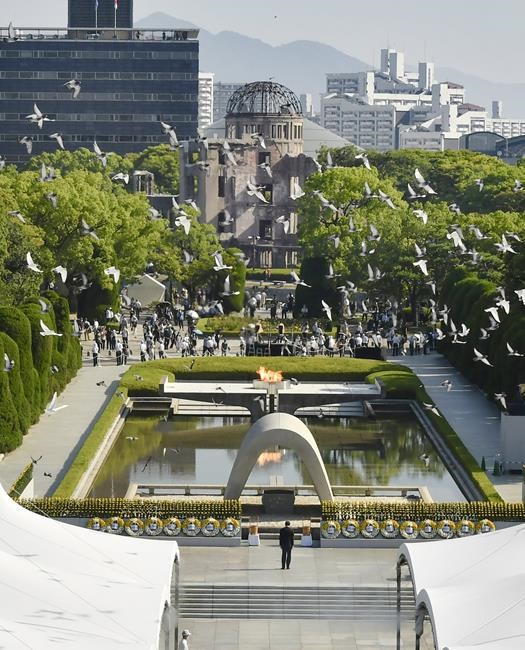
I was an English as a Second Language teacher at the time, stationed at a new school in the rural city of Izumo, and I had a little vacation time on my hands. So a friend of mine and I decided to take a little tour of Japan and drive up to Hiroshima together. We had planned to take in the sights, of course. From the cuisine and night life — a Hiroshima-style savoury pancake called okonomiyaki is absolutely delicious — to the shopping districts and the beauty of the Japanese autumn.
But anyone who goes to Hiroshima from abroad knows that the largest and most important draw for foreigners — and visiting Japanese alike — is the Hiroshima Peace Memorial Park located in the centre of the city.
The park, which holds the remains of the famous Hiroshima Dome, is dedicated to the city’s legacy as the first in the world to suffer a nuclear attack. The dome building itself was the only structure left standing in the area after the atomic bomb exploded on Aug. 6, 1945 at the end of the Second World War.
Among the other “attractions” of the park and museum include a national Peace Memorial Hall for atomic bomb victims. It’s said that more than a million people visit the park each year to learn about the effects of nuclear war. And I can tell you that no one walks away from that memorial in a bright and sunny mood.
It’s a sombre place that is meant to show you the devastation that could be wrought upon the world if nations lose sight of the need for diplomacy and self-preservation.
Many of Hiroshima’s citizens — along with those of Nagasaki, where the second atomic bomb was dropped only days later — are themselves fierce advocates for nuclear disarmament and for lasting peace between nations. This is especially true of the men and women who survived these attacks, and who dedicated their life to peaceful activism and nuclear disarmament.
That activism was recognized this week by the Norwegian Nobel Committee when it awarded the Nobel Peace Prize to Nihon Hidankyo, a Japanese organization of survivors of the U.S. atomic bombings of both Hiroshima and Nagasaki.
This isn’t the first time that attempts to eradicate nuclear weapons have been honoured by the Nobel committee. It has happened at least twice before — the first such prize was awarded in 1995 to Joseph Rotblat and the Pugwash Conferences on Science and World Affairs for their efforts to “diminish” the part played by nuclear arms within international affairs, and then again in 2017 when it was given to the International Campaign to Abolish Nuclear Weapons (ICAN).
But this time there came with the prize a greater sense of urgency. Committee chair Jørgen Watne Frydnes was quoted by The Associated Press on Friday as saying that the award was made as the “taboo against the use of nuclear weapons is under pressure.”
For anyone paying attention to current world events, that is a frightening statement.
Last September, Russian President Vladimir Putin indicated that his country’s nuclear doctrine was being “expanded” from the previous 2020 doctrine. He has said that Russia would be prepared to use a nuclear weapon in response to an attack with conventional weapons that, as the New York Times reported, creates a “critical threat to our sovereignty” and would treat “aggression against Russia by any nonnuclear state, but with the participation or support of a nuclear state,” as a “joint attack on the Russian Federation.”
Considering the ongoing conflict that it instigated against Ukraine more than two years ago, and the fact that Ukraine’s president has requested to use American weapons systems against Russian targets, this is not a subtle threat. This particular change in Russia’s nuclear doctrine potentially increases the likelihood of a nuclear war.
And as AP reported yesterday, spiralling levels of violence over the past year in the Middle East have killed tens of thousands of people, including women and children. The war, sparked by a raid into Israel by Hamas-led militants on Oct. 7, 2023, that left about 1,200 people dead, mostly civilians, has spilled into the wider region.
Israel has sent ground troops into Lebanon this past week to pursue Hezbollah militants firing rockets into Israel, while Iran — which backs both Hamas and Hezbollah — fired ballistic missiles into Israel. Though Israel has yet to respond, its defence minister vowed this week that its retaliation would be both devastating and surprising.
Though U.S. President Joe Biden has urged Israel to mount a “proportional” response and not hit nuclear facilities in Iran, Canadian Conservative Leader Pierre Poilievre doubled down this week on his call for Israel to pre-emptively strike Iran’s nuclear facilities, saying such an act would be “a gift by the Jewish state to humanity.”
Such a move would be a dangerous escalation between two of the Middle East’s most well-armed nations, and quite frankly, I find Poilievre’s comments irresponsible. The thought of nuclear war starting in the Middle East would almost certainly draw in NATO powers, including Canada.
Poilievre has famously stated that embattled Canadian Prime Minister Justin Trudeau should go take a walk in the snow like his father — former prime minister Pierre Trudeau — did before resigning in 1984.
Considering his public stance, I would urge Mr. Poilievre to enjoy a few days’ vacation in Hiroshima this fall. Go try the delicious okonomiyaki. Take in a Hiroshima Carp baseball game at Koshien Stadium.
And then go take a walk in the park.
» Matt Goerzen, editor