
Premier chooses Axworthy to lead rail relocation study
Advertisement
Read this article for free:
or
Already have an account? Log in here »
We need your support!
Local journalism needs your support!
As we navigate through unprecedented times, our journalists are working harder than ever to bring you the latest local updates to keep you safe and informed.
Now, more than ever, we need your support.
Starting at $15.99 plus taxes every four weeks you can access your Brandon Sun online and full access to all content as it appears on our website.
Subscribe Nowor call circulation directly at (204) 727-0527.
Your pledge helps to ensure we provide the news that matters most to your community!
To continue reading, please subscribe:
Add Brandon Sun access to your Free Press subscription for only an additional
$1 for the first 4 weeks*
*Your next subscription payment will increase by $1.00 and you will be charged $20.00 plus GST for four weeks. After four weeks, your payment will increase to $24.00 plus GST every four weeks.
Read unlimited articles for free today:
or
Already have an account? Log in here »
Hey there, time traveller!
This article was published 16/10/2024 (535 days ago), so information in it may no longer be current.
WINNIPEG — Premier Wab Kinew and former federal cabinet minister Lloyd Axworthy want Manitobans to think big when it comes to the decades-old discussion about moving rail lines out of Winnipeg.
While launching a rail relocation feasibility study Tuesday, the pair pointed out that initial plans for The Forks — a former rail site in the heart of the city — and the Red River Floodway were met with naysaying or concerns about high costs.
“It just shows what you can do with some imagination and some creativity, and some real courage by governments themselves,” Axworthy said about The Forks.
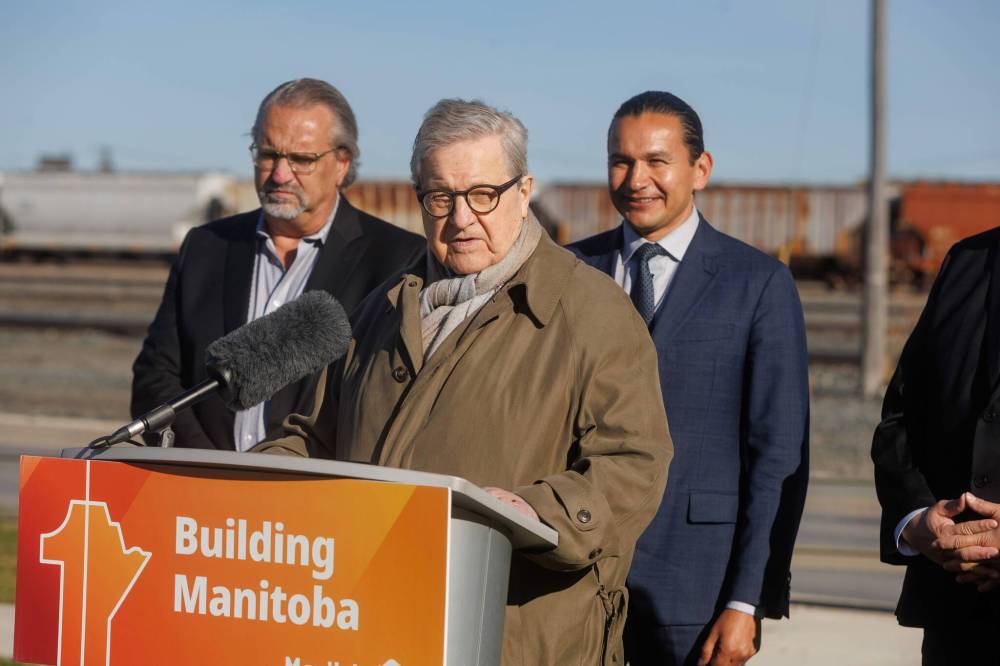
Lloyd Axworthy speaks at a press conference on Tuesday after Premier Wab Kinew announced his government had selected Axworthy to lead a study to determine the feasibility of relocating Winnipeg’s rail lines. (Mike Deal/Winnipeg Free Press)
Converted rail land could be used for housing or open spaces, while rationalization could create advantages for rail companies and strengthen Manitoba’s position as a major transport hub, he said at a news conference next to the Canadian Pacific Kansas City rail yards, which are beneath the Slaw Rebchuk Bridge that connects Salter and Isabel streets.
Axworthy was Canada’s transport minister in the 1980s when a federal Liberal government negotiated the transfer of the former Canadian National Rail yards to become what is now The Forks.
Kinew has tapped him to lead a study that will look at the feasibility of rail relocation in the capital region. The Manitoba government set aside $200,000 for the study in April’s budget.
Expected to take two years, the study will determine which lines or yards can realistically be relocated and at what estimated cost, while exploring the potential social and economic effect, said Kinew.
Axworthy said he is “fairly optimistic” the study will produce “good conversations” with rail company executives. The study will include public consultations.
Canadian Pacific Kansas City Ltd. spokeswoman Rebecca Stephen said any study must be comprehensive, and involve railroads, shippers and industries, all levels of government and federal regulators.
The company’s rail network through Winnipeg is an essential part of integrated supply chains in North America, she said.
“Evaluating the feasibility of relocating railway infrastructure is an enormously complex matter and the magnitude of the challenges should never be underestimated,” Stephen wrote in an email.
“A comprehensive study that considers all factors would be required to evaluate the feasibility of relocating rail infrastructure without compromising safety, essential rail service to customers, capacity for future growth, and also capture the full costs, which will be significant.”
A CN Rail spokesperson said the company “will work collaboratively” with the province.
The word “billions” has been used to put a rough estimate on the cost of moving rail lines and yards out of the city.
While he is concerned about the potential overall price tag, Kinew said there is also a cost to maintaining the status quo.
“The only way we’d be able to proceed is with buy-in from all levels of government,” he said.
Kinew described the CPKC rail yards as a divide between Winnipeg’s North End, downtown and other neighbourhoods. He also mentioned yards in St. Boniface and Transcona, and a spur line that leads to the North End Water Pollution Control Centre at 2230 Main St.
“What we’re going to be asking Dr. Axworthy to consider is what are some bite-size rail relocation projects that we might take on in the next few years that could maybe deliver some exciting near-term results, and what is that longer vision for the future of the province and the capital region,” he said, noting bigger aspects could take a decade or two.
Axworthy, who has been in contact with Transport Minister Anita Anand, said the study will look at rail safety and risk scenarios, such as derailments of trains that haul hazardous goods, in urban areas.
Axworthy said his conversations will include Manitoba’s Liberal, Conservative and NDP MPs, and former Quebec premier Jean Charest, who was hired by then-NDP premier Greg Selinger to lead a rail relocation task force in 2016. The provincial Progressive Conservatives scrapped the task force after winning the election that year.
The discussion about relocation escalated in 2023, following a derailment of tanker cars above the McPhillips Street underpass, and the indefinite closure of the decaying Arlington Street Bridge, which crosses the CPKC yards.
Mayor Scott Gillingham welcomed the study, which he hopes will identify potential funding sources for relocation, and potential impacts on rail operations, jobs and city infrastructure.
Gillingham said some unused or little-used spur lines could be decommissioned to make way for housing or active transportation paths.
“I think we can look at incremental steps,” said the mayor, who was unable to attend the news conference due to meetings related to the hiring of Winnipeg’s next police chief.
The Business Council of Manitoba, Social Planning Council of Winnipeg and Treaty One Nation were invited to speak in support of the study at the news conference. Mike Pyle, chair of the business council, called on governments, railroads, the private sector and community to work together.
“Collectively, we can improve on our strength as a logistics hub, and move to a more efficient and environmentally sustainable transportation system, while vastly improving our city on every level,” he said.
Social planning council executive director Kate Kehler is part of a coalition that is advocating for relocation. Converted land could be used to build a “complete community,” with greenways and active transportation, she said.
Coalition research found 75 per cent of Winnipeg residents live within 800 metres of a rail line. The city has 240 rail yard crossings, which affect planning and development, said Kehler.
“If you’ve got those in your way, you have a hard time actually envisioning anything different,” she said.
Relocation would present an opportunity for land reclamation, said Kathleen BlueSky, CEO of Treaty One Nation, which includes seven First Nations.
“If you think about the thousands of acres of rail that exist within the city of Winnipeg, it really does create a lot of land development opportunities for everyone, not just government,” she said.
The Tories said Kinew has raised the issue of railway relocation to distract from problems his government wants to avoid talking about.
“It’s another total distraction by this premier and this government from his failings and from what’s been happening in the last year since they took power,” interim leader Wayne Ewasko said late Tuesday.
“We’ve got some major things that Manitobans are waiting to be addressed,” he said, pointing to a shortage of classroom space, retail crime and cancelled surgeries.
» Winnipeg Free Press, with files from Joyanne Pursaga and Carol Sanders