
A decision that comes with risks
Advertisement
Read this article for free:
or
Already have an account? Log in here »
We need your support!
Local journalism needs your support!
As we navigate through unprecedented times, our journalists are working harder than ever to bring you the latest local updates to keep you safe and informed.
Now, more than ever, we need your support.
Starting at $15.99 plus taxes every four weeks you can access your Brandon Sun online and full access to all content as it appears on our website.
Subscribe Nowor call circulation directly at (204) 727-0527.
Your pledge helps to ensure we provide the news that matters most to your community!
To continue reading, please subscribe:
Add Brandon Sun access to your Free Press subscription for only an additional
$1 for the first 4 weeks*
- Enjoy unlimited reading on brandonsun.com
- Read the Brandon Sun E-Edition, our digital replica newspaper
*Your next Free Press subscription payment will increase by $1.00 and you will be charged $20.95 plus GST for four weeks. After four weeks, your payment will increase to $24.95 plus GST every four weeks.
Read unlimited articles for free today:
or
Already have an account? Log in here »
Hey there, time traveller!
This article was published 19/10/2024 (599 days ago), so information in it may no longer be current.
Now that the City of Brandon is the owner of one of the city’s biggest eyesores – the site of the former Esso gas station at 402 Rosser – what will happen to the property now, and how much will it end up costing Brandon taxpayers?
For those unfamiliar with the history of the site, it was a gas station for many years but was shut down and boarded up several years ago. It was a frequent property tax delinquent, but the owner had always made the minimum payment to protect the property from tax sale proceedings. Until this year, that is.
As of this week, the total amount owing to the city with respect to the property was $90,745.38, which included the unpaid property taxes plus the costs incurred by the city to demolish the building and other fixtures on the site. When the minimum amount was not paid by the owner in order to avoid tax sale proceedings, the property was put up for auction and was purchased by the city at Thursday’s auction for $91,000.
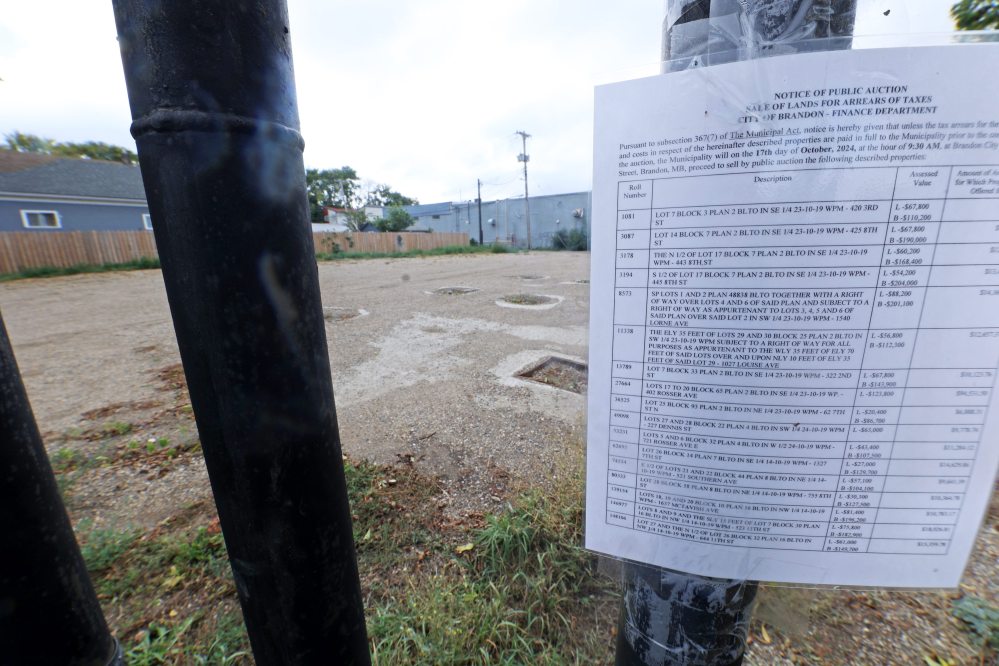
That money won’t go to the former owner of the property. It will simply extinguish the outstanding amount owed to the city. Whether the property is actually worth $91,000 is a valid question.
Many downtown advocates will be pleased that the unsightly gas station is gone and the city is the new owner of the property, but that satisfaction is offset by the reality the city may have placed itself into something of an environmental and legal quagmire.
That is because the property may be contaminated due to its past use as a gas station, and the old underground fuel tanks are reportedly still present at the site. Whether the tanks are leaking, or have leaked in the past, is anybody’s guess at this time.
Ryan Nickel, the city’s director of planning and buildings, says the city intends to either develop the property or turn it into green space, depending on the results of environmental testing. If those tests reveal significant contamination on the site, he says it could make development too expensive. In that case, the city plans to convert the property into green space.
For those worried about costs the city may incur, Nickel told the Sun that “there is somewhat of an exemption there for municipalities if they acquire impacted sites through a tax sale process, where legally we’re responsible for a little less than, say, a private property owner who’s acquiring it for development purposes.”
Nickel is correct that the Contaminated Sites Remediation Act exempts a municipality from responsibility for the remediation of a contaminated site if its only involvement with the site or its contamination is that it became an owner of the site as a result of a tax sale proceeding.
That exemption does not mean, however, that a contaminated site can be left in its polluted state simply because the city is the owner. City hall could not turn a blind eye to a city-owned contaminated site that could endanger those present on the property and those living nearby.
Our city council would be politically, morally and perhaps legally obligated to spend the money required to make the property safe.
Beyond that, there is some reason to be concerned about potential legal liabilities outside the scope of the Contaminated Sites Remediation Act. For example, could the city be potentially liable if tests reveal that contamination from the subject property has migrated to nearby properties, adversely impacting the values of those properties and/or the health of those living within them?
Until the tests are done, nobody knows the answer. It may be something to be concerned about, however.
If you feel a sense of déjà vu about this transaction, you’re not alone. More than a decade ago, the city acquired the old Brandon Inn on Ninth Street via tax sale, thinking it would be an inexpensive way to spur downtown revitalization. They were wrong. The demolition and remediation of that property ended up costing taxpayers much more than anticipated, and the land where the hotel once stood remains vacant to this day.
Despite that costly precedent, this may be another “damned if they do, damned if they don’t” situation for the city. The old gas station was an embarrassing eyesore that needed to go, but accomplishing that objective may expose the city to more risk than currently anticipated.
The results of the forthcoming environmental tests will tell us how big that risk really is.