
Increased costs concern for police
Advertisement
Read this article for free:
or
Already have an account? Log in here »
We need your support!
Local journalism needs your support!
As we navigate through unprecedented times, our journalists are working harder than ever to bring you the latest local updates to keep you safe and informed.
Now, more than ever, we need your support.
Starting at $15.99 plus taxes every four weeks you can access your Brandon Sun online and full access to all content as it appears on our website.
Subscribe Nowor call circulation directly at (204) 727-0527.
Your pledge helps to ensure we provide the news that matters most to your community!
To continue reading, please subscribe:
Add Brandon Sun access to your Free Press subscription for only an additional
$1 for the first 4 weeks*
*Your next subscription payment will increase by $1.00 and you will be charged $20.00 plus GST for four weeks. After four weeks, your payment will increase to $24.00 plus GST every four weeks.
Read unlimited articles for free today:
or
Already have an account? Log in here »
Hey there, time traveller!
This article was published 02/11/2024 (518 days ago), so information in it may no longer be current.
The last few weeks of October were both a pleasant and unpleasant reminder of the fact that our climate has been changing.
Environment Canada senior climatologist David Phillips told CTV News a few weeks back that September and October had been about two degrees warmer than normal — “not hot, but delightfully mild,” he said.
In the Maritimes, an unusually warm Halloween broke several 100-year records in places like Moncton and Fredericton in New Brunswick and down in Kentville, N.S.
And out walking with the kids on Thursday night here in Brandon, plenty of parents were remarking that it was one of the warmest Halloween evenings they could remember.
This is the pleasant side of climate change here in the Prairies — warmer weather well into the fall months. But there is another side to it, too, and it comes at a definite cost, one that is specific to Brandon as well.
Just ask the Brandon Police Service.
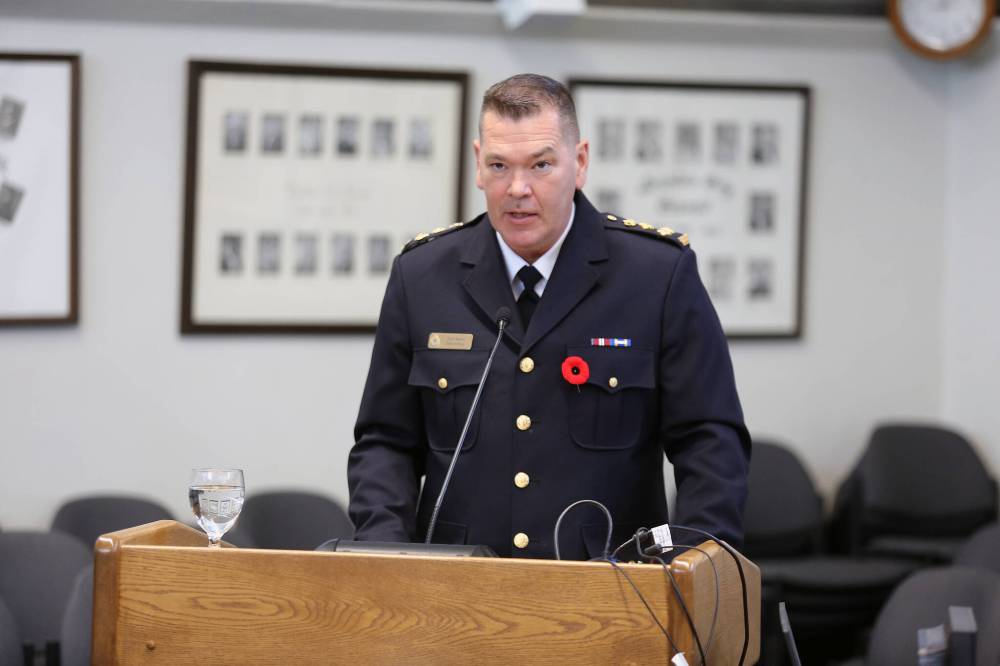
In its Friday meeting, the Brandon Police Board heard its first report from newly sworn-in BPS Chief Tyler Bates, who provided a rundown of the current state of the police budget.
As you can read in today’s paper, Bates reported that the police service is projecting a $741,000 surplus in 2024 following its budget review process. Of that total, $673,000 comes from a surplus in operating costs, while $68,000 comes from the police vehicles budget.
There’s a couple of interesting factors in the line items of which Brandonites should take particular notice.
The first is the fact that the service noted a $1.151-million decrease in expenses due to the “management of vacancies” — that would refer back to the statement made earlier this week by Police Board chair Deb Arpin, who stated that the force was about “eight to 10 officers short right now.”
The second is the fact that members of the force chalked up $90,000 in the operational overtime budget. Board member Shannon Brichon explained much of that $90,000 was specifically racked up over the summer when Brandon was hosting wildfire evacuees from northern Manitoba this year.
In his comments to the board, Insp. Greg Hebert said there have been preliminary conversations with Manitoba Justice about BPS being reimbursed for some of those costs.
“They weren’t opposed, but it’s a conversation as we move forward,” Hebert said. “Our costs were roughly $50,000 for the month of August.”
That’s a lot of overtime.
But considering how many calls police needed to attend that involved evacuees in Brandon over that time period, that number might even seem low.
Recall that the number of wildfire evacuees in Brandon had reached about 1,000 people toward the end of August, with several First Nation communities up north having been affected, including Manto Sipi Cree Nation, St. Theresa Point First Nation and Red Sucker Lake Anisininew Nation.
It’s a difficult situation for any people who are ripped out of their homes because of an emergency over which they have no control, and placed in hotels with little to do but wait for days and weeks on end. It only stands to reason that police will begin to have their hands full.
Displaced Manitobans don’t want to be here, and they bring their frustrations as well as some of their own issues of drug and alcohol addictions with them. As one of the evacuees told the Sun from her hotel back in August, “It’s been very tiring. Frustrating. Because we miss our home.”
Never mind the fact that BPS has saved more than $1 million in salaries — the fact that the force has had to incur tens of thousands of dollars in overtime as a result isn’t really a sustainable situation.
Climate change may be extending the warmth of our summers into the autumn season, but a lack of seasonal precipitation is turning our northern forests into a powder keg. And all of us bear the costs of that reality.
And with the situation worsening each year, we have to wonder what those costs will be in the longer term.
As the province’s second-largest city, Brandon is going to be near the top of the list when it comes to finding a temporary home for evacuees. It’s not a case of if we get more evacuees, but when and how many.
Bates told the police board “there has to be some acknowledgment of the increased costs that are borne as a result” of these evacuations. We agree.
It would only make sense for the province to set up a fund to reimburse municipalities in these circumstances or there may come a time when financial realities force them to turn evacuees away.