
Alberta government introduces legislation to enable halal mortgage options
Advertisement
Read this article for free:
or
Already have an account? Log in here »
We need your support!
Local journalism needs your support!
As we navigate through unprecedented times, our journalists are working harder than ever to bring you the latest local updates to keep you safe and informed.
Now, more than ever, we need your support.
Starting at $15.99 plus taxes every four weeks you can access your Brandon Sun online and full access to all content as it appears on our website.
Subscribe Nowor call circulation directly at (204) 727-0527.
Your pledge helps to ensure we provide the news that matters most to your community!
To continue reading, please subscribe:
Add Brandon Sun access to your Free Press subscription for only an additional
$1 for the first 4 weeks*
- Enjoy unlimited reading on brandonsun.com
- Read the Brandon Sun E-Edition, our digital replica newspaper
*Your next Free Press subscription payment will increase by $1.00 and you will be charged $20.95 plus GST for four weeks. After four weeks, your payment will increase to $24.95 plus GST every four weeks.
Read unlimited articles for free today:
or
Already have an account? Log in here »
Hey there, time traveller!
This article was published 04/11/2024 (555 days ago), so information in it may no longer be current.
EDMONTON – The Alberta government has introduced legislation that will, if passed, enable provincially regulated banks to offer halal home financing products.
Paying and receiving interest is prohibited in the Islamic faith under Shariah law, which means traditional interest-based mortgages aren’t an option for many Muslims in Canada.
A few private lending firms, such as the Edmonton-based Canadian Halal Financing Corp., do currently offer alternative financing plans that don’t include interest payments, but these alternatives aren’t available through any of Canada’s larger banks.
These alternative financing plans include a program where a financial institution buys a home on behalf of a client and charges fixed monthly payments, which includes a profit margin for the institution, until the client’s home is paid off.
Another existing option involves a financial institution and prospective homeowner becoming co-owners of a home, and the client eventually buys out the company’s stake in the home.
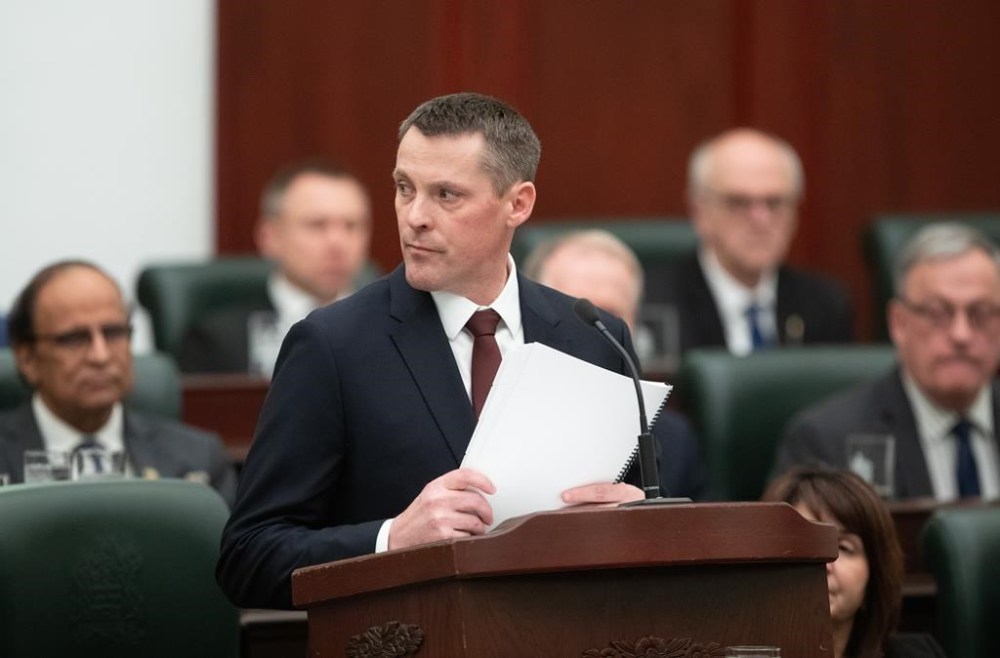
Alberta Finance Minister Nate Horner says the legislation enables credit unions and ATB Financial, a Crown corporation, to offer halal mortgages, but these banks won’t be required to do so.
“We are not requiring any financial institutions to implement alternative financing models, but clearing the way for any who wish to offer these models to do so,” Horner said at a Monday press conference.
Horner said he expects these financial institutions to develop their products in short order as the changes embodied in the legislation were sought by the industry.
“They came to us in a large way,” he said. “There’s already been some investments made in IT and systems that would be required, so I think that shows that they’re very committed to this process.”
In an emailed statement, ATB Financial said it’s open to offering such products, though it would need to do significant consultations before it does.
“ATB Financial is committed to understanding the diverse needs of our clients, including those seeking halal financing options,” the statement reads.
“We recognize the complexities involved in developing such specialized products and are dedicated to actively listening to our clients to ensure any future offerings align with market demand.”
Horner said these alternative financing options, if eventually offered by credit unions and ATB Financial, would be open to all Albertans regardless of faith.
Sharif Haji, the Opposition NDP’s shadow minister for affordability and utilities, told reporters that, on paper, the legislation looks like a good first step, but he questioned whether or not the UCP did enough consultation on the changes.
“What I’m hearing from the communities is that they haven’t been consulted, whether it is faith-based institutions or whether it is individuals and experts that have been working, developing, and have knowledge around the products like this,” Haji said.
The omnibus bill tabled by Horner on Monday also amends the Fuel Tax Act to set the stage for the implementation of the government’s planned $200 annual tax on electric vehicles sometime next year, as well as a change to how provincial social benefits such as Assured Income for the Severely Handicapped (AISH), are funded each year.
Horner said that moving forward, annual funding increases for AISH and other social benefit programs, by default, will either be two per cent or the rate of inflation, whichever is lower.
Horner told reporters that this new default calculation isn’t final, as the government could set a different rate higher than two per cent if it wanted to.
He said this change is being made to ensure that each benefit program is calculated the same way, as currently the fiscal year for some programs are different, which means it’s possible some programs are seeing bigger increases than others.
“This is just the default,” Horner said. “It has to be looked at every year (and) if no decision is made, this is the default that applies.”
In 2019, the UCP government under former premier Jason Kenney de-indexed programs like AISH to inflation, arguing the province couldn’t afford the cost increases.
Last year, that decision was reversed by the UCP and the programs were re-indexed to inflation, but advocacy groups argued at the time that since the re-indexation wasn’t retroactive, the roughly 300,000 people who receive these benefits were still being left behind.
This report by The Canadian Press was first published Nov. 4, 2024.