
Kinew talks about all things Brandon in year-end Q&A
Advertisement
Read this article for free:
or
Already have an account? Log in here »
We need your support!
Local journalism needs your support!
As we navigate through unprecedented times, our journalists are working harder than ever to bring you the latest local updates to keep you safe and informed.
Now, more than ever, we need your support.
Starting at $15.99 plus taxes every four weeks you can access your Brandon Sun online and full access to all content as it appears on our website.
Subscribe Nowor call circulation directly at (204) 727-0527.
Your pledge helps to ensure we provide the news that matters most to your community!
To continue reading, please subscribe:
Add Brandon Sun access to your Free Press subscription for only an additional
$1 for the first 4 weeks*
- Enjoy unlimited reading on brandonsun.com
- Read the Brandon Sun E-Edition, our digital replica newspaper
*Your next Free Press subscription payment will increase by $1.00 and you will be charged $20.95 plus GST for four weeks. After four weeks, your payment will increase to $24.95 plus GST every four weeks.
Read unlimited articles for free today:
or
Already have an account? Log in here »
Hey there, time traveller!
This article was published 24/12/2024 (672 days ago), so information in it may no longer be current.
Around this time of year, many news outlets request end-of-year interviews with the sitting Manitoba premier — in this case Premier Wab Kinew. Knowing that other journalists would be asking questions that are more Winnipeg-centric and pan-Manitoban, we decided to keep our own questions for the premier as local as possible. The following is a transcript of Sun editor Matt Goerzen’s interview with the premier that took place on Dec. 11. It has been edited for length and clarity.
Matt Goerzen — Thank you very much for taking the time today. I’m going to start off with the Park Community Centre. The last I heard on this situation, the province was looking over the options for our community centre. And I was wondering, is there anything that you can give us in terms of time lines and what the situation is right now?
Wab Kinew — Yeah, this is a big priority for us. This is an election commitment that we’re fulfilling. The first step of that was to get the million dollars for the community centre side of the project out the door. I think we’ve got ink dried on an agreement with the city on that side. And then the work that we’re focused on right now is just hashing out the details about the child-care side, if we could describe the project that way. So it’s definitely going to be a child-care facility as part of this Park Community Centre redevelopment. That’s something we talked about during the election as well.
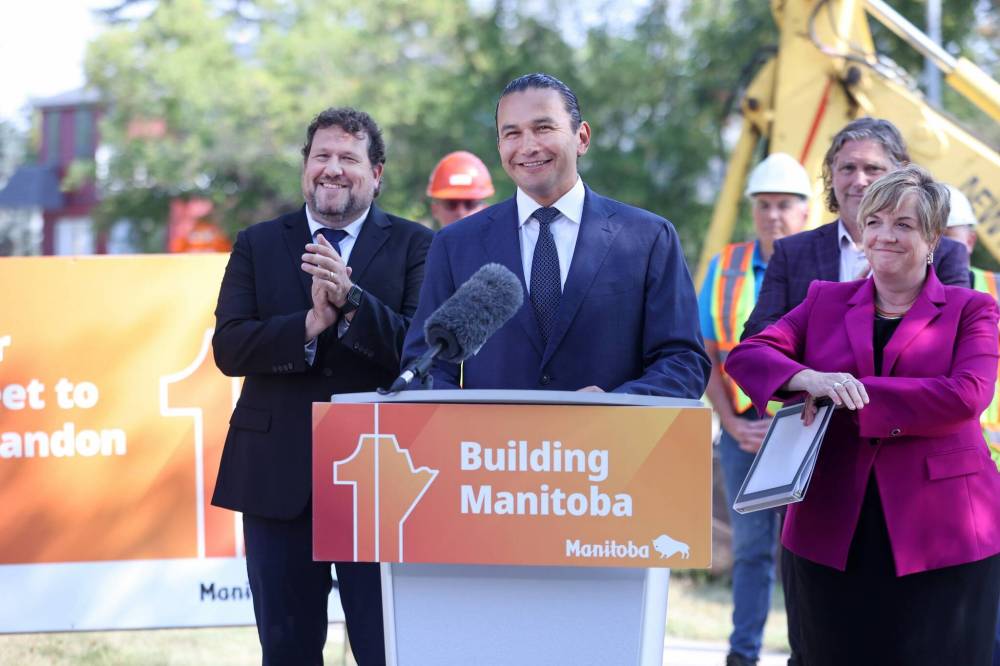
Flanked by Sport, Culture, Heritage and Tourism Minister Glen Simard, Brandon Mayor Jeff Fawcett, and Transportation and infrastructure Minister Lisa Naylor, Manitoba Premier Wab Kinew announces $9.7 million to resurface 18th Street from Aberdeen Avenue to Rosser Avenue during a press conference outside Brandon University in early September. (File)
So we want to make sure we hold up our end of that promise. And where it stands right now is we’re just identifying the exact levels of how we’re going to share this with some of our partners who are working together with this. As you know, we get some child-care money from the feds, and, of course, the city’s a partner here, and you’ve got great local I guess, advocates, I would say, too. So we’re looking at hashing out those details. So I’m hoping you know, before too long, in 2025 we’ll be able to share all the specifics of how we’re going to move ahead and make sure that the Park Community Centre redevelopment proceeds and that there’s a bunch of child-care centre spaces added as part of that. So still some details to hash out.
MG — Is there a target amount for those child-care spaces? I know they were talking about 63, 64 somewhere in there.
WK — Yeah. I think those are some of the discussions that we’re looking at. And then obviously the costing is affected by the size. There’s no specific details to confirm now, but just to let you know that we’re hashing out those details, both internally and with our partners in terms of the cost-sharing and most of all, just delivering on the commitment that we made to people in Brandon to get this project moving ahead.
MG — I know that child care is not a cheap thing to try and fund. Is cost an issue here?
WK — I think one thing that I’ve learned a year and change in the government is that, you know, the wheels of government move at their own pace. So even when there’s support for an idea and you have partners that are all working together, as you do in this case, still takes time for us to, you know, crank that machine that is government and make sure that all the bases get covered, and that we have all the specifics of a funding agreement in place. So I don’t know that there’s any daylight between all the partners. I think we all want to see this happen. It’s more just fine-tuning the specifics before and gets put to paper on the contribution agreement type thing.
MG — Then I’ll move on here the Keystone Centre. Back in 2023, the previous government had worked together with the city to put in place a five-year funding agreement with the City of Brandon and the province of Manitoba. It’s about, I think it’s about $16 million. But there’s, you know, the future of the building. It’s aging. They have put in a 50-year forward-looking plan, right? What part does the province have to play in this?
WK – Well, I think the Keystone Centre is an important part of making sure that Brandon is a regional hub, and our commitment as a government is to make sure that the Keystone Centre is sustainable and continues to be an economic driver for Brandon and for the Westman region. The minister, you know — Minister Smooth, as we call him, Glen Simard — he is raising this issue and making sure that it gets the necessary attention to move forward. Actually in his portfolio now, he was able to just allow a reprofiling of some of the capital dollars in future considerations to be able to use those as operating funding. That’s an interim measure, if you will, but maybe just to show you that we’re there, listening to the Keystone Centre’s needs and responding by just helping them be able to get through whatever current needs that they have so that we can help them fulfil the long-term vision continue to drive the economy on that change in portfolio for Minister Simard, I think he and his successor on the sports culture heritage file, Nell Kennedy, are going to be at the Keystone Centre early next week, meeting with the Keystone Centre team and also the ownership of the team of the Brandon Wheat Kings organization. Again, just to show that seriousness and positive working relationship that we want to have to make this work.
MG – On that note … I mean, sustainable is a difficult word for the Keystone Centre. For most of its existence, it has operated at a loss. I mean, even this year, they’re looking at a projected operating loss for the coming fiscal year of $616,000. Is there a point where we’re throwing good money after bad, or is this something that is necessary for the community to have and continue looking at finding ways to make it sustainable?
WK — I think we got to keep working with the Keystone Centre team to make this sustainable. I think we all recognize the value to the community, the important investments have gone into the facility over the years, not least of which is, you know, the rink. We were there for the home opener for the Wheat Kings. So it’s great to see the seats and the loges and, you know, the boxes there some an amazing in-game experience. That’s a huge asset for the community, the facility itself, you know, that’s big. We’ll, we’ll be back soon for, Ag Days, and for you know, other events like the Winter Fair later in the year. And like most Manitobans, we know that this is a great facility for economic, cultural, sporting events, and so we’ll find that ability to make sure that it’s sustainable. I just think having Minister Simard on the Municipal and Northern Relations file just also helps to ensure that the Keystone Centre is going to be high priority. So few weeks in office, he’s got that, you know, reprofiling of some capital dollars to help with the operating needs. Longer term, we’ll work together on finding a bigger-picture working relationship.
MG — Earlier this year, it was announced that Brandon University would have funding gearing up for a significant transformation, adding the medical school facility, in what I guess we call the annex (to the Brodie Building). Where are we on this project? Now, I know they’re they’re chomping at the bit to try and move forward. Are we a little bit further along in planning this situation?
WK — Yeah, we are. We’ve got the planning pretty far along. It basically sees us, you know, phasing in a number of seats, and then making sure that there’s the capital infrastructure investments necessary to support those students. So I think the goal is to have 32 students receiving their medical education in Brandon by the fall of 2027 and then looking at bringing that number up even further to 64 students by the fall of 2029. So again, kind of taking some big steps over, you know, the next two years, and then the next two years coming up after that. So in the current year, when you’re asking for, I guess, more specific milestones, our Advanced Ed and Training department has put some project management dollars towards setting up this planning process and making sure that the med students will be able to get that training in the Westman region. That’s $370,000, and then there’s the investments into the expansion at the university site. And then, of course, there will be some further investments into the hospital, so the BRHC getting some training capacity there as well.
MG — Can we something coming out in the budget next year?
WK — Well, this stuff was in the current year’s budget. So next year’s budget would see us building on that towards those other timelines of bringing in those future students. Like, I think there’s five students at BRHC now, and then we’re looking to bring that up, you know, from five to 16 for those third- and fourth-year med students, undergraduate med students, to be clear about that. And then again, after we get from 16, then we get to 32 and then we get to 64 two years after that.
MG — In the last budget, I don’t recall there being a specific dollar amount for BU for the medical school, so that’s why I was asking.
WK — Oh, OK, yeah, I think the current-year dollars are that? Are those project management dollars to do the planning exercise here, and I get Ryan to maybe sendover some details on that. If you want some of the specifics I would love that. If that would be possible, sure. It also leads me, let’s do that. OK.
MG — Your government gave a little bit extra top-up money for Brandon University earlier this this year, I think that was much appreciated by the administration. I am curious, though: we have had a situation where Brandon always seems to have to go cap in hand, compared to other universities in our province. Is there a move to try and give more sustainable funding from the province for Brandon University?
WK — We want to be a good partner for Brandon University because this is, this is a regional school, right? Like, I mean, the history of BU is serving Brandon. It’s serving the region, but it’s also about serving the north. And I think (Assiniboine College) plays an important role in terms of that, you know, regional service, and serving people from northern Manitoba as well. So I think there’s a huge value added that BU brings to the table, and I think that’s part of the reason why, when we heard about that gap in terms of operating dollars, we took action. And moving forward, I think there’s going to be that responsiveness from our government to continue to work with BU to ensure that they have, you know, the ability to continue to meet the needs of patients in Brandon and also in the surrounding area and other parts of the province, too.
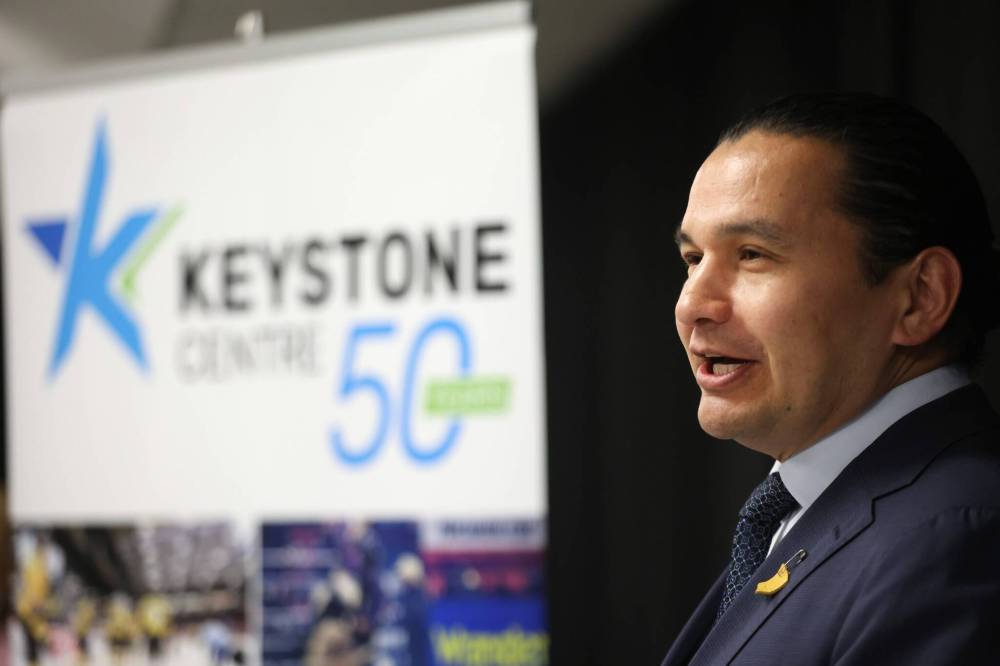
Manitoba Premier Wab Kinew offers his thoughts on the most recent results of an economic survey that shows the facility has a $78.1-million impact on the fortunes of the province, during a media conference at the Keystone in May. The announcement was made as part of the Keystone Centre’s 50th anniversary celebration. (File)
MG — OK, so we won’t be looking at a minuscule amount of increased funding compared to other universities under under your government. I mean, it happened under the previous government, so I’m looking at down the road.
WK — No, we want, we want our universities and colleges to be adequately supported. And, you know, I think BU’s and (Assiniboine’s) important regional presence is going to be recognized by us, and that means both the working relationship and, you know, investments like these medical training and other programs. So we’re very interested in but also, yeah, just when it comes to the operating dollars necessary to run these facilities in a good way.
MG — I’m going to move on, just in the last few minutes here, to school funding. I know the province was looking again at school funding. There have been a couple of schools that are receiving funding for construction. Not in Brandon. Can we, in the new year, look to see some schools that are necessary here in the region come to fruition?
WK — You’re talking about new school construction, new school construction. I think new school construction, yeah, I would say, when you see us do our budget this spring, I think there’ll be some welcome news for Brandon in there.
MG — OK, in terms of Maryland Park, I know there seems to be a little bit of a delay they were looking at trying to move forward with their expansion. The last I heard from Glen Simard, he was saying that that expansion was going to be complete sometime in 2026. Is that still the target date?
WK — Yeah, it is. And yes, like, as a teacher formerly in the Brandon School Division, you can bet that Glen is raising this and other projects all the time. Yeah, we’re on track for the ’26-’27 school year. So yeah, I guess that’s September 2026 that we’re looking at constructions coming up in the new year, and this thing is ready to go out to tender. So we’re looking at a cost estimate up to $20 million for 14 new classrooms. And so obviously this is going to help with the class-size needs and some of the overcrowding issues, but also it’s an important investment, just in the education system, too. So yeah, that project is is ready to go out to tender … which means it’s happening. This thing’s moving ahead, and the investment into education for your kids and Brandon.
MG — We reported earlier this year — I believe it was back in October — that Manitoba school divisions were facing, as we were told, hundreds of millions of dollars in urgent infrastructure needs. A number of those schools are here in Brandon — leaking roofs, aging boilers, that kind of thing. Now, a lot of those dollars were not spent. They were held off, and these kind of capital projects are still needed. Is this something that we can look forward to trying to deal with in the new year?
WK — I’ve got a list in front of me with a bunch of capital maintenance, roof-replacement, boiler-replacement projects across Brandon that are gonna happen next year … some of these are currently in flight, but there’s about a dozen investments into Brandon-area schools that we’re moving ahead with. I mean, the challenge here is that, like, maintenance was ignored too often under the previous government, and that just built a long queue, and so we’re working diligently to address those needs. And obviously this is about making sure your kids have the good environment that they need to study and succeed in. This is about making sure that we’re taking care of the investments that we make into public education, and that teachers have the tools to be able to do their good work, too. So yeah, this is moving ahead. And yeah, I think there’s a bunch of these projects coming online over the course of the next year.
MG — My last question for you is this. You are a year in — well, a little more than a year into your first mandate. Compared to where you were when you first started, and looking now a year in, do you have a different vision for Manitoba than when you started? Is there anything that you would add or change or expect for the next three years that we should watch for?
WK — Well, I think the vision of the province is, it’s a positive one. The thing that really stood out to me after the election, and I still feel this way, is that once the votes were counted, everyone just kind of nodded their heads, looked around and said, All right, let’s work together. And that’s been very true in Brandon and in the Westman region. People have been bringing forward good ideas, whether that’s, you know, on the topics we discussed today, on educators or the Wheat Kings organization or economic development projects. You know, people brought forward these great ideas, and we’re in a position to find the resources, in some cases, to get them done, or in other cases, to make connections to ensure that the right people in the room.
It’s just been super positive to see Manitoba having a sense of optimism and a sense that the way we do these big projects and big dreams that we have is by working together. And so, after a year and change in government, that positive sense has been very, very reaffirming, and it’s continued.
So it wasn’t just like the initial aftermath of the election, or the wake of the election. We’re here, heading into 2025, and people are still stepping up and saying, like, yeah, I’ll put up my hand and do this economic initiative. Or I’ll put up my hand and work with you on, you know, a health-care idea that we want to pursue together. So to me, that’s awesome. That’s what Manitoba is all about, is, you know, kind of that humble, blue-collar work ethic, but that ability to work together and to work across community and industry and government lines to make sure that we’re going to do good things for everyone who lives here.
And then the thing that’s changing in my mind is, you know, the comments that we’ve heard from Donald Trump south of the border just really underline the fact that we’re going to have to really lean in to the economy this coming year and make sure that we’re protecting our ag jobs, manufacturing jobs, transportation jobs. And just telling that positive story about how our economy here in Manitoba, with agriculture, mining, manufacturing, transportation, that that’s good for the U.S. as well, too, and making sure that that new administration, Trump 2.0 has a good working relationship with our province.
MG – Thank you, Mr. Premier.