
BPS, PMH to collaborate more to tackle drug crisis
Advertisement
Read this article for free:
or
Already have an account? Log in here »
We need your support!
Local journalism needs your support!
As we navigate through unprecedented times, our journalists are working harder than ever to bring you the latest local updates to keep you safe and informed.
Now, more than ever, we need your support.
Starting at $15.99 plus taxes every four weeks you can access your Brandon Sun online and full access to all content as it appears on our website.
Subscribe Nowor call circulation directly at (204) 727-0527.
Your pledge helps to ensure we provide the news that matters most to your community!
To continue reading, please subscribe:
Add Brandon Sun access to your Free Press subscription for only an additional
$1 for the first 4 weeks*
- Enjoy unlimited reading on brandonsun.com
- Read the Brandon Sun E-Edition, our digital replica newspaper
*Your next Free Press subscription payment will increase by $1.00 and you will be charged $20.95 plus GST for four weeks. After four weeks, your payment will increase to $24.95 plus GST every four weeks.
Read unlimited articles for free today:
or
Already have an account? Log in here »
Hey there, time traveller!
This article was published 04/01/2025 (661 days ago), so information in it may no longer be current.
With 2024 in the rear-view mirror, law enforcement and health-care authorities in Brandon are now turning their attention to work that will be required in 2025 to curb the flow and supply of crystal methamphetamine throughout the region.
The Brandon Police Service (BPS) and health-care providers, such as Prairie Mountain Health (PMH) are hoping to learn from the data collected last year, and in previous years, which reflects a noticeable increase in methamphetamine-related overdoses, and a spike in instances of lethal toxins being added to the Wheat City’s drug supply.
Furthermore, these institutions are also collaborating to educate and spread more awareness in the community about these harmful substances that are often mixed with poisonous adulterants that can prove to be lethal for their consumers.
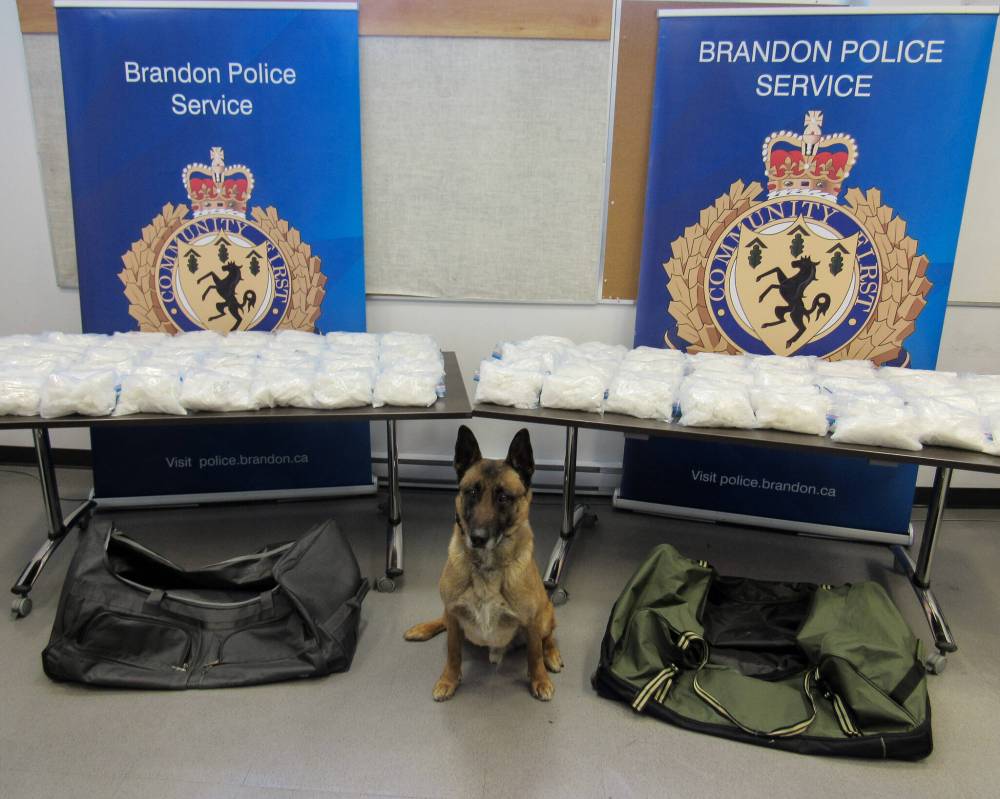
Brandon Police Service officers seized about $800,000 worth of crystal meth from a commercial truck driving on the Trans-Canada Highway in May 2024. The driver, who was from Ontario, was arrested on trafficking charges. Police dog Storm helped BPS officers nab the culprit. (Submitted)
Janet Reichert — a recruitment and communications specialist at BPS — told the Sun that despite the increase in methamphetamine availability on the streets of Brandon, police are actually seizing a higher amount of the supply and apprehending more traffickers, which is an important component as far as reducing and eliminating this crisis in concerned. She added that BPS officers helped remove 105,099 grams of methamphetamine from the city’s streets in 2024.
“This year, we have made significant progress, cracking down on drug trafficking and possession, with 33 meth trafficking charges and 28 possession of meth charges brought forward in 2024. These efforts have resulted in the removal of a staggering 128,630 grams of drugs from our streets — 105,099 grams of which were methamphetamine,” Reichert pointed out.
BPS also seized 9,087 grams of fentanyl in 2024, an opioid so powerful that just a small amount can be lethal, especially when it’s mixed with methamphetamine, which is often the case nowadays. In addition, BPS confirmed that there were 60 drug overdoses reported last year throughout the city, and that several of them resulted in fatalities.
“While these numbers are troubling, they also demonstrate our unwavering commitment to making Brandon a safer, healthier place for all who live here. The impact of meth on our community cannot be overstated, and the collective effort of law enforcement, health professionals and community organizations is making a real difference,” Reichert explained.
“The progress we’ve made this year is a testament to the resilience of this city, and with the continued support of our citizens and partners, we are hopeful that we can build an even brighter, healthier future. We remain dedicated to tackling crime and drug use head-on and ensuring that Brandon remains a city where every individual has the opportunity to thrive,” said Reichert, while also crediting local health-care centres that play a crucial role when it comes to treatment, education and support for those in the community who are still struggling with addiction issues in 2025.
“Looking ahead, BPS is more determined than ever to continue working together to protect our families, our neighbourhoods and our future. Our partnership with the health community remains a vital component of this fight, as we recognize that addressing addiction requires not only enforcement, but also support, treatment and education,” said Reichert, referring to the collaboration between local law enforcement and community health groups.
Her views were echoed by a spokesperson from PMH — the region’s primary health-care provider.
“As is the case provincially, Prairie Mountain Health has seen an increase in the numbers of individuals using crystal meth, compared with five to 10 years ago.
Prairie Mountain Health works with clients who use substances to meet them where they are at and help them obtain support related to their substance use,” a PMH spokesperson told the Sun.
Moreover, PMH explained that crystal meth use is often linked to trauma, and addicts attempt to mask the emotional pain stemming from past experiences through substance abuse. PMH also highlighted the stigma tied to methamphetamine use, and the challenge addicts face in terms of asking for help, or even considering that help might be available.
“The use of substances by some clients is often related to trauma they may have experienced in their lives. Unfortunately, there can be negative stigma that is attached to clients who use substances. Prairie Mountain Health provides education and information to the public about substances and stigma,” the spokesperson added before promoting options that currently exist for those who are struggling, including their Rapid Access to Addiction Medicine (RAAM) program.
PMH even accepts walk-ins for clients who are seeking help with substance use and abuse, and urged anyone with these concerns to contact them by telephone at 204-578-4800. Individuals struggling with substance abuse issues can also attend PMH’s 7th Street Health Access Centre in person, Mondays to Wednesdays from 11 a.m. to 1 p.m. More information can also be found on PMH’s official website under the heading Programs and Services.
According to PMH, six community withdrawal support beds are also available in Brandon through a partnership between the community health and housing associations of western Manitoba. A Mobile Withdrawal Support Services initiative also offers non-medical support to individuals experiencing drug withdrawal symptoms in the comfort of their own home.
If you or someone you know is struggling, it is crucial for them to be aware that recovery services in the Wheat City do exist and it’s never too late to ask for support.
» dstein@brandonsun.com
» X: @davidpstein_