
Get jab for measles: Asagwara
Advertisement
Read this article for free:
or
Already have an account? Log in here »
We need your support!
Local journalism needs your support!
As we navigate through unprecedented times, our journalists are working harder than ever to bring you the latest local updates to keep you safe and informed.
Now, more than ever, we need your support.
Starting at $15.99 plus taxes every four weeks you can access your Brandon Sun online and full access to all content as it appears on our website.
Subscribe Nowor call circulation directly at (204) 727-0527.
Your pledge helps to ensure we provide the news that matters most to your community!
To continue reading, please subscribe:
Add Brandon Sun access to your Free Press subscription for only an additional
$1 for the first 4 weeks*
*Your next subscription payment will increase by $1.00 and you will be charged $20.00 plus GST for four weeks. After four weeks, your payment will increase to $24.00 plus GST every four weeks.
Read unlimited articles for free today:
or
Already have an account? Log in here »
Hey there, time traveller!
This article was published 06/02/2025 (414 days ago), so information in it may no longer be current.
WINNIPEG — Health Minister Uzoma Asagwara encouraged people to get vaccinated against measles — telling them the jabs are safe and effective — after five cases in southern Manitoba were linked to an outbreak in Ontario.
A Winkler church and locations at Health Sciences Centre and Children’s Hospital were identified as potential exposure sites visited by all or some of the five people, who live in the same household, on certain dates in January.
“It’s very, very important to note, and I will say this to all Manitobans, that vaccines are safe, vaccines are effective,” Asagwara said Wednesday, a day after Manitoba confirmed its first cases since 2019.
“It is so important, in a time where we’ve seen disinformation and misinformation rampant, that people talk to their nurse practitioners, they talk to their doctors, they talk to their primary-care providers and get accurate, science-based evidence, information to take care of their health.”
Manitoba Health did not reveal the vaccination status of the five people, nor their ages, genders or community.
The highly contagious measles virus spreads via airborne droplets as an infected person breathes, coughs or sneezes. It causes a potentially life-threatening disease that is generally more severe in babies and young children.
Vaccination is the best defence for children and adults, said Dr. Jared Bullard, a professor who is section head of pediatric infectious diseases at Children’s Hospital.
Officials expected cases in Manitoba due, in part, to outbreaks in Eastern Canada.
“We also know that in Manitoba, the rate of measles vaccination isn’t as ideal as it could be,” Bullard said.
He said the COVID-19 pandemic slowed uptake.
“In addition, we don’t see certain childhood diseases for which we vaccinate much any more, so people don’t have any living memory of it,” Bullard said. “They don’t realize how serious it can be, and so they don’t tend to necessarily get the vaccines to the same degree that they used to.”
Manitoba has a voluntary two-dose vaccine program for measles, mumps, rubella and varicella (chickenpox) for kids who are at least a year old. A second dose is given when children are four to six.
According to provincial records, 65.4 per cent of children who were seven years old in 2023 received all recommended doses of a measles vaccine, down from 74.3 per cent in 2020 and 75.1 per cent in 2005.
By health region (where populations vary), Prairie Mountain had the highest uptake (72.8 per cent) in 2023, while Southern Health, which includes Winkler, had the lowest (53.3 per cent). The uptake within the Winnipeg Regional Health Authority was 66.7 per cent.
For those aged 17 in 2023, more than three-quarters (77.3 per cent) in Manitoba had full vaccine coverage. Northern Health ranked highest (95.7 per cent) by region, and Winnipeg ranked lowest (69.9 per cent). Southern Health’s coverage in that age category was 79.7 per cent.
Nationally, 79.2 per cent of seven-year-old children in 2021 were vaccinated by that birthday, the federal government reported.
Bullard said the vast majority of vaccine hesitancy that he sees from parents comes from a “good place.”
“They’re concerned about harms associated with vaccines, or they’ve seen something online that they find very concerning, so it’s really helpful to talk through that in a comprehensive manner,” he said.
Physicians use the best available evidence about vaccine efficacy, and their expertise to address concerns, Bullard said.
He said the first vaccine dose at age one is 95 per cent effective, while a second dose at pre-school age increases the efficacy to 99 per cent. There is no antiviral treatment for measles.
Some people, Bullard noted, are not interested in vaccination at all.
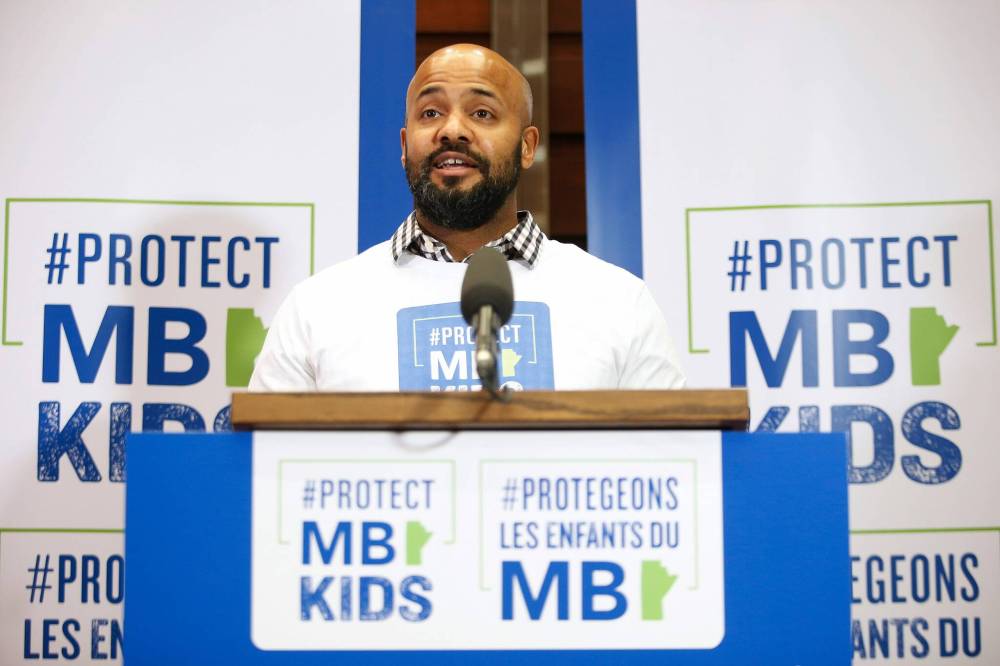
Vaccination is the best defence for children and adults, said Dr. Jared Bullard, a professor and section head of pediatric infectious diseases at the University of Manitoba. (The Canadian Press files)
A 2021 federal survey asked 5,446 parents about vaccines. Of those who said they were hesitant to vaccinate their children, concern about side effects, believing vaccines were not necessary and a lack of confidence in vaccine effectiveness were cited as the most common reasons.
Religious or philosophical reasons were cited in less than two per cent of responses from vaccine-hesitant parents in a similar survey in 2017.
The five Manitoba cases were linked to contact with infected people while travelling in Ontario. Manitoba Health said they were asked to isolate.
Asagwara said contact tracing has been completed.
“It’s a situation that we’re going to pay very close attention to to make sure that more communities here in Manitoba are safe,” they said.
The province said people may have been exposed to measles at a Sunday school and main service at Reinland Mennonite Church in Winkler between 9:15 a.m. and 12:30 p.m. on Jan. 26. People who were there were advised to monitor for symptoms until Feb. 16.
Other potential exposure sites, all at HSC’s campus on Jan. 31, were the first-floor children’s laboratory and waiting rooms of Clinic X and Clinic W (from 11:30 a.m. to 2 p.m.); Orange Bison Zone Level 1 in and around Guildy’s Eatery and adjacent corridors (from noon to 3 p.m.); and the fourth-floor cardiology clinic and waiting room in Children’s Hospital (from 1 p.m. to 4 p.m.).
People who were in those areas were told to monitor for symptoms until Feb. 21.
Measles infects the respiratory tract. Initial symptoms, which generally appear seven to 21 days after exposure, may include a fever, runny nose, drowsiness, irritability and red eyes. Small white spots may appear inside the mouth or throat.
A red blotchy rash appears days later on the face and spreads down the body. An infected person can spread the virus from four days before the rash appears until four days after, the province said.
The virus can lead to serious complications such as encephalitis (brain swelling), blindness and pneumonia.
Adults born before 1970, when there were high levels of measles circulation, are presumed to have natural immunity.
Canada reported 146 cases in 2024, mostly in Quebec, New Brunswick and Ontario.
» Winnipeg Free Press