
Saskatchewan premier to visit Washington to talk Trump tariffs, border security
Advertisement
Read this article for free:
or
Already have an account? Log in here »
We need your support!
Local journalism needs your support!
As we navigate through unprecedented times, our journalists are working harder than ever to bring you the latest local updates to keep you safe and informed.
Now, more than ever, we need your support.
Starting at $15.99 plus taxes every four weeks you can access your Brandon Sun online and full access to all content as it appears on our website.
Subscribe Nowor call circulation directly at (204) 727-0527.
Your pledge helps to ensure we provide the news that matters most to your community!
To continue reading, please subscribe:
Add Brandon Sun access to your Free Press subscription for only an additional
$1 for the first 4 weeks*
*Your next subscription payment will increase by $1.00 and you will be charged $20.00 plus GST for four weeks. After four weeks, your payment will increase to $24.00 plus GST every four weeks.
Read unlimited articles for free today:
or
Already have an account? Log in here »
Hey there, time traveller!
This article was published 07/02/2025 (449 days ago), so information in it may no longer be current.
REGINA – Saskatchewan Premier Scott Moe says he’s visiting Washington next week to convince U.S. officials that imposing tariffs on Canadian goods is a bad idea and that he shares their concerns about border security.
Speaking to reporters, Moe said Friday that not having tariffs would ensure the United States and Canada stay economically strong, as both depend on cross-border trade.
“We still need to work alongside the federal government in ensuring … that we’re getting to that broader goal to have that non-tariff environment where we can create wealth for not only people in Saskatchewan, but people on both sides of the border,” he said.
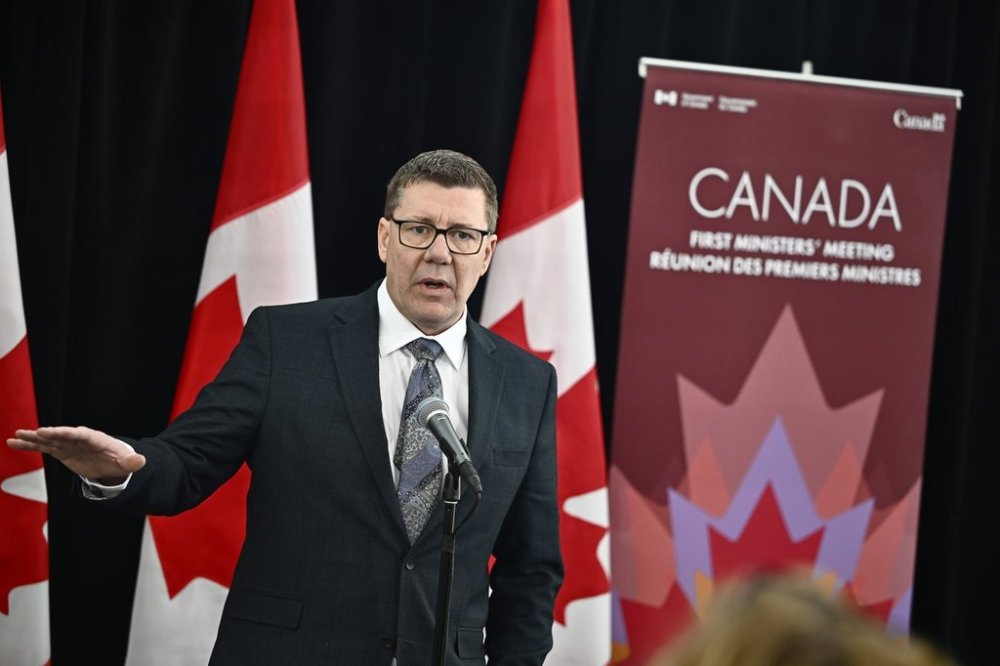
Moe also said he agrees with border security concerns raised by U.S. President Donald Trump and that drugs such as fentanyl must be kept out of communities.
“There is an opportunity for us to look in the mirror as Canadians and as people in the province of Saskatchewan (and ask), ‘Can we do more to keep fentanyl out of our communities?'” he said.
“There’s opportunity for us to take even more action … to remove that poison from our communities.”
Moe is to visit the U.S. capital Sunday to meet with officials before joining other premiers Wednesday for a joint trade mission. He’ll then travel to Mexico to speak with exporters and promote trading.
Trump was set to impose sweeping tariffs on Canadian goods this week but has since paused those plans until March 4. He has demanded that Canada get tougher on its border enforcement.
In response, Prime Minister Justin Trudeau announced the country would beef up border security with new helicopters, technology and nearly 10,000 personnel. There are also plans to appoint a fentanyl czar and list cartels as terrorist organizations, Trudeau said.
With the tariff threat looming, the premiers and Trudeau have also discussed lifting interprovincial trade barriers.
Manitoba Premier Wab Kinew told reporters Friday he thinks the premiers have been united.
“We’re going to take Team Canada down to D.C.,” he said. “We’re going to keep having that warm and hearty friendly Manitoba handshake, but at the same time standing up for ourselves and our values as a province and as a country.”
Meanwhile, Alberta government ministers were in Washington this week for the U.S. National Prayer Breakfast and to discuss the importance of trade.
In a social media post, Premier Danielle Smith said her province has made some inroads.
“It’s all hands on deck to explain to our (American) friends what Alberta and Canada are doing to secure the border and battle fentanyl trafficking, and why a tariff war will hurt both of our countries,” she wrote.
Moe said provinces need to align their regulations to allow goods to flow more easily.
“It’s tedious work, and we need to commit to it as provinces, from coast to coast to coast,” he said.
Energy Minister Jonathan Wilkinson has said provinces should discuss the possibility of an oil pipeline running from western Canada to the East, an idea that’s faced opposition in Quebec.
Moe said he supports such pipeline projects.
“(The federal government is) coming around to our way of thinking when it comes to carbon tax policy and pipeline policy, and we applaud that,” he said.
“It’s better eight years late than never.”
This report by The Canadian Press was first published Feb. 7, 2025.
— With files from Steve Lambert in Winnipeg.