
Manitoba, Nunavut push to ‘unlock Canada’s North’
Advertisement
Read this article for free:
or
Already have an account? Log in here »
We need your support!
Local journalism needs your support!
As we navigate through unprecedented times, our journalists are working harder than ever to bring you the latest local updates to keep you safe and informed.
Now, more than ever, we need your support.
Starting at $15.99 plus taxes every four weeks you can access your Brandon Sun online and full access to all content as it appears on our website.
Subscribe Nowor call circulation directly at (204) 727-0527.
Your pledge helps to ensure we provide the news that matters most to your community!
To continue reading, please subscribe:
Add Brandon Sun access to your Free Press subscription for only an additional
$1 for the first 4 weeks*
*Your next subscription payment will increase by $1.00 and you will be charged $20.00 plus GST for four weeks. After four weeks, your payment will increase to $24.00 plus GST every four weeks.
Read unlimited articles for free today:
or
Already have an account? Log in here »
Hey there, time traveller!
This article was published 17/04/2025 (351 days ago), so information in it may no longer be current.
WINNIPEG — Armed with the indelible ink of black Sharpies, Manitoba Premier Wab Kinew and Nunavut Premier P.J. Akeeagok signed a statement to work together to push for an energy corridor to Canada’s North.
“The reason why we’re here putting pen to paper is because all Canadians know, after what they heard from (U.S. President Donald) Trump for the past few months, that we need to really build up partnerships,” Kinew told reporters Wednesday after a photo opportunity at the Manitoba Legislative Building.
Kinew welcomed the Nunavut premier and his delegation for a meeting after announcing Monday he’s directed Manitoba Hydro to plan to supply Nunavut with 50 megawatts of hydroelectric power that’s no longer being exported to the U.S. — once a federally funded transmission line is built.
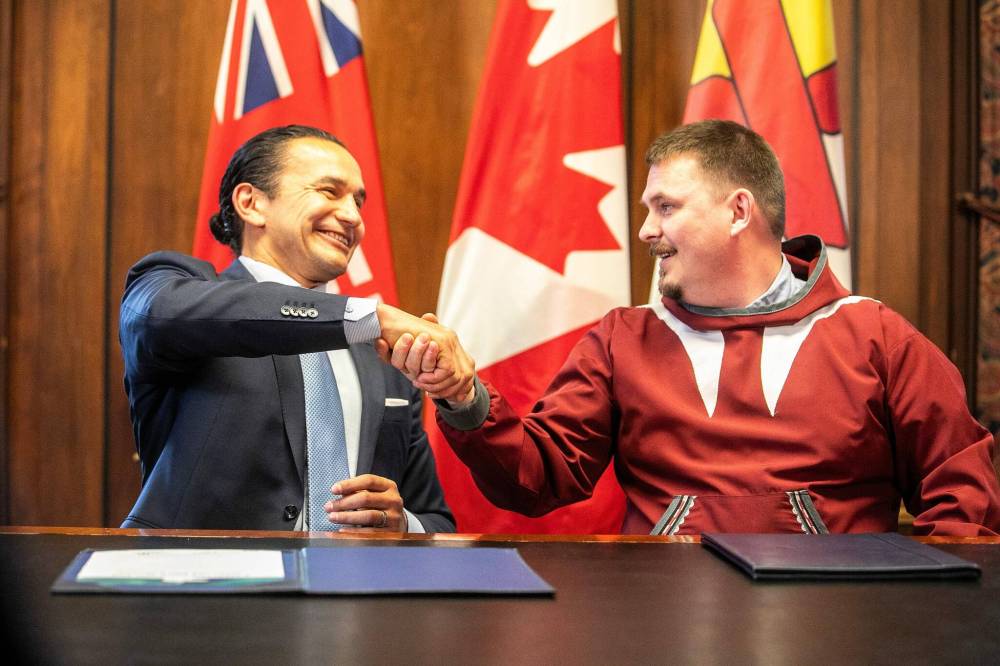
Manitoba Premier Wab Kinew (left) and Nunavut Premier P.J. Akeeagok sign a joint statement regarding an energy corridor between Manitoba and Nunavut at the Manitoba Legislative Building in Winnipeg on Wednesday. (Mikaela MacKenzie/Winnipeg Free Press)
“This has been the vision of many Inuit leaders that wanted to connect southern Canada to the North, and this is nation-building,” said Akeeagok, who’s “excited” to get to work on it with his Manitoba counterpart.
“The urgency comes from what every Canadian has been seeing south the border,” Kinew added.
After taking office in January, Trump launched a trade war, threatening Canada’s economy with tariffs and its sovereignty with annexation.
In Wednesday’s statement, the governments of Manitoba and Nunavut pledged support for a proposal to establish a strategic economic and energy corridor between them.
“The proposed Kivalliq Hydro-Fibre Link has the potential to unlock Canada’s North by advancing reconciliation, spurring economic growth, addressing climate change and investing in our national security,” it says.
The 1,200-kilometre transmission project would connect five Nunavut communities and at least one mine in the Kivalliq region to Manitoba Hydro’s power grid and fibre-optic internet lines.
“We already share many of our common interests in health care to education, among others,” Nunavut’s premier said before he and government and economic development officials met with Kinew and his ministers of finance and Indigenous economic development. “Now, to be able to look at what we could do together, really excites me.”
The statement calls on the federal government to back the Inuit-led energy corridor and associated hydroelectric upgrades. It promises Manitoba and Nunavut will work with First Nations in the region to ensure their support for the project, and to preserve lands and waters for the long-term health of the caribou population for generations of Inuit, Dene, Cree and all Canadians.
A proposed timeline for the Kivalliq Hydro-Fibre Link says construction would start in 2028 and be completed by 2032. The cost of the project hasn’t been spelled out.
“In terms of the price tag, these are things that we’ll sort out with the federal government when they come to the table,” Kinew said. “I’m sure they will because it’s about nation-building, it’s about climate change, it’s about the economy.”
Nunavut is anxious to switch from its reliance on diesel fuel to cleaner sources of energy, Akeeagok said.
“We all want to transition to the green energy. When we talk about climate change, we are the first to see it, we are the first to feel it and there’s no more urgency than the one where we do want to transition to it.”
Manitoba can help, if the next federal government is willing to invest in the North and Arctic sovereignty — as the major party leaders running in the federal election have promised, Kinew said.
“Manitobans have been really smart about investing in a low carbon bridge for the last 50 years,” Kinew said of Manitoba Hydro’s infrastructure.
“Now we can work together with our neighbours to the north, to build up the country. They’re sitting on a wealth of minerals, they’re sitting on a wealth of human potential. When we build an infrastructure project like this, it just unlocks so much more wealth and riches, an opportunity for everybody — Manitobans, people in Nunavut, and all Canadians,” Kinew said.
» Winnipeg Free Press