
AP and the Trump administration argue over presidential access before appeals judges
Advertisement
Read this article for free:
or
Already have an account? Log in here »
We need your support!
Local journalism needs your support!
As we navigate through unprecedented times, our journalists are working harder than ever to bring you the latest local updates to keep you safe and informed.
Now, more than ever, we need your support.
Starting at $15.99 plus taxes every four weeks you can access your Brandon Sun online and full access to all content as it appears on our website.
Subscribe Nowor call circulation directly at (204) 727-0527.
Your pledge helps to ensure we provide the news that matters most to your community!
To continue reading, please subscribe:
Add Brandon Sun access to your Free Press subscription for only an additional
$1 for the first 4 weeks*
*Your next subscription payment will increase by $1.00 and you will be charged $20.00 plus GST for four weeks. After four weeks, your payment will increase to $24.00 plus GST every four weeks.
Read unlimited articles for free today:
or
Already have an account? Log in here »
Hey there, time traveller!
This article was published 17/04/2025 (343 days ago), so information in it may no longer be current.
The Associated Press and the Trump administration returned to a courtroom Thursday — and will be in another on Friday — as part of the high-stakes battle over who can control which journalists are able to question the president.
Lawyers argued before a three-judge panel of the U.S. Court of Appeals about putting in place a lower court order last week that the administration stop excluding AP from covering events in places like the Oval Office and Air Force One. It’s not clear when those judges will make their determination.
On Friday, the two sides will go before the author of last week’s decision, U.S. District Court Judge Trevor N. McFadden. The AP has asked him to enforce his ruling.
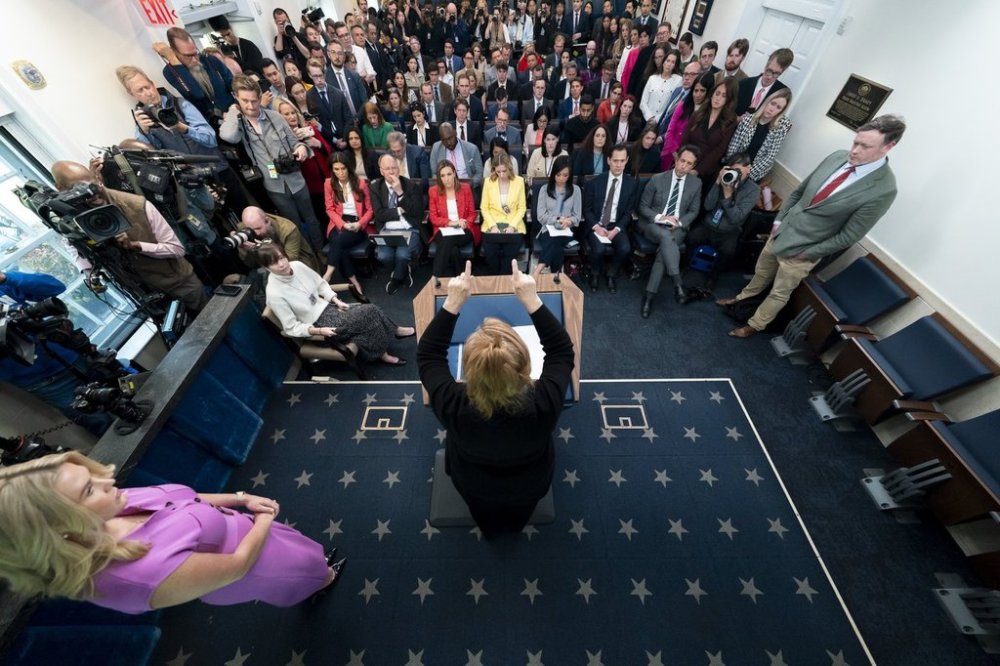
AP reporters and photographers have been blocked since President Trump objected to the outlet’s decision not to rename the Gulf of Mexico. McFadden said last week the AP shouldn’t be excluded just because Trump disagrees with them. Since then, AP says the White House is ignoring the order and continuing to keep its journalists out; Trump’s team says it has put a new rotation system in place for these events, and it hasn’t been AP’s turn yet.
Through Eric McArthur, deputy assistant attorney general, the administration argued that access to the Oval Office is up to the president, just like he can invite Laura Ingraham of Fox News Channel in for a personal interview and not MSNBC’s Rachel Maddow.
Charles Tobin, the AP’s lawyer, said the president can’t be ordered by a court to speak or answer a specific news outlet’s questions. But when he invites reporters to cover him in a public setting covered by a predetermined “pool” of journalists, he can’t discriminate on the basis of viewpoint.
“The White House has conceded this is all about trying to control a message, trying to control the viewpoint of The Associated Press,” he said.
Illustrating a fine line the judges will be asked to walk, Tobin conceded that a president is welcome to invite 20 reporters whose viewpoints he agrees with in for a talk. “Isn’t that awfully close to what is happening here?” asked Judge Gregory Katsas, a Trump appointee.
The difference is in excluding rather than inviting people, Tobin said — a point leaped upon by his opponent.
“President Trump is under no obligation to run the press pool the way his predecessors did or even the way he did during his first term,” McArthur said. “If he can choose 20 people because of viewpoint, he can certainly exclude them because of viewpoint.”
Judges also expressed some worry that courts may be called upon to micromanage what journalists get to cover the president and who can’t.
Tobin returned to the idea put forth in McFadden’s decision that it’s a violation of the First Amendment for Trump to exclude the AP because he disagreed with some of its reporting.
“The president of the United States does not have discretion to violate the U.S. Constitution,” he said.
___
David Bauder writes about media for the AP. Follow him at http://x.com/dbauder and https://bsky.app/profile/dbauder.bsky.social