
Israeli jets strike Beirut’s southern suburbs for the third time since a ceasefire began
Advertisement
Read this article for free:
or
Already have an account? Log in here »
We need your support!
Local journalism needs your support!
As we navigate through unprecedented times, our journalists are working harder than ever to bring you the latest local updates to keep you safe and informed.
Now, more than ever, we need your support.
Starting at $15.99 plus taxes every four weeks you can access your Brandon Sun online and full access to all content as it appears on our website.
Subscribe Nowor call circulation directly at (204) 727-0527.
Your pledge helps to ensure we provide the news that matters most to your community!
To continue reading, please subscribe:
Add Brandon Sun access to your Free Press subscription for only an additional
$1 for the first 4 weeks*
*Your next subscription payment will increase by $1.00 and you will be charged $20.00 plus GST for four weeks. After four weeks, your payment will increase to $24.00 plus GST every four weeks.
Read unlimited articles for free today:
or
Already have an account? Log in here »
Hey there, time traveller!
This article was published 27/04/2025 (342 days ago), so information in it may no longer be current.
BEIRUT (AP) — Israeli jets struck Beirut’s southern suburbs Sunday after issuing a warning about an hour earlier, marking the third Israeli strike on the area since a ceasefire took effect in late November.
In a statement following the strike, the Israeli military said it targeted a precision-guided missile storage facility for the militant Hezbollah group. It added that storing such equipment is a violation of the agreement reached to end the Israel-Hezbollah war.
A huge plume of smoke billowed over the area after the strike, which hit what looked like a metal tent situated between two buildings with three bombs, according to an Associated Press photographer on the ground and footage circulating on social media. The photographer saw two burned and destroyed trucks inside the hangar. There were no immediate reports of casualties.
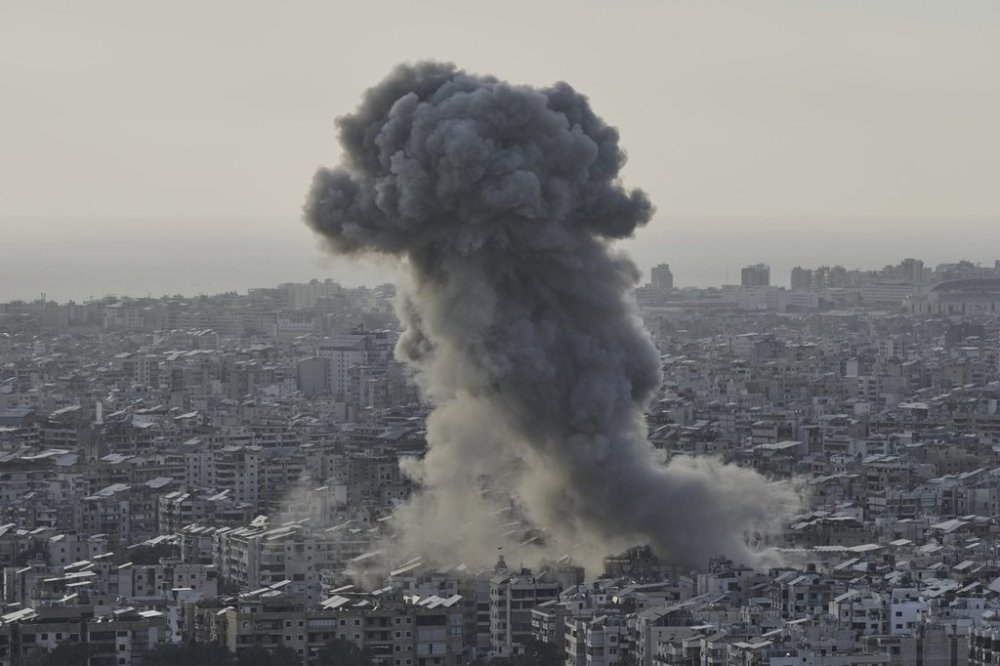
In the warning, the Israeli military said it was targeting Hezbollah facilities in the Hadath area and urged residents to move at least 300 meters from the site before the strike. Two warning strikes followed.
Fighter jets were heard over parts of the Lebanese capital before the strike near the Al-Jamous neighborhood, where gunfire was shot into the air to warn residents and urge them to evacuate, as families fled in panic.
During the last Israel-Hezbollah war, Israeli drones and fighter jets regularly pounded the southern suburbs, where Hezbollah has wide influence and support. Israel views the area, where it has assassinated several of Hezbollah’s top leaders, including chief Hassan Nasrallah, as a militant stronghold and accuses the group of storing weapons there.
President Joseph Aoun condemned the Israeli strike on Beirut’s southern suburbs, calling on the United States and France, as guarantors of the ceasefire, to “assume their responsibilities” and pressure Israel to halt its attacks. He warned that Israel’s continued actions “undermine stability” and risk exposing the region to serious security threats.
U.N. Special Coordinator for Lebanon Jeanine Hennis posted on X that the latest Israeli strike “generated panic and fear of renewed violence among those desperate for a return to normalcy.” She urged all sides to halt any actions that could further undermine the ceasefire understanding and the implementation of the U.N. resolution that ended the war.
Sunday’s strike follows two earlier attacks on the capital’s southern suburbs, the first taking place on March 28, when Israel also issued a warning, and the second on April 1, when an unannounced strike killed four people, including a Hezbollah official.
The leader of Lebanon’s Hezbollah group, Sheikh Naim Kassem, has recently warned that if Israel’s attacks on Lebanon continued and if Lebanon’s government doesn’t act to stop them, the group would eventually resort to other alternatives.
Kassem also said that Hezbollah’s fighters won’t disarm as long as Israeli troops remain in southern Lebanon and the Israeli air force regularly violates Lebanese airspace.
Under the U.S.-brokered ceasefire that ended the 14-month Israel-Hezbollah war, Israeli forces were supposed to withdraw from all Lebanese territory by late January, while Hezbollah had to end its armed presence south of the Litani River along the border with Israel.
Earlier on Sunday, a drone strike killed a man in the southern Lebanese village of Halta, according to the Health Ministry. In a post on X that included footage of the strike, the Israeli military said that it had targeted a Hezbollah member, “where he was working to rebuild Hezbollah’s terrorist capabilities in the area.”
Last week, the Lebanese government said 190 people have been killed and 485 wounded in Lebanon by Israeli strikes since the U.S.-brokered ceasefire went into effect. Israel says it is targeting Hezbollah officials and infrastructure.
The Lebanese military has gradually deployed in the country’s southern region, and Beirut has urged the international community to pressure Israel to stop attacks and withdraw its forces still present on five hilltops in Lebanese territory.
___
Associated Press writer Bassem Mroue contributed to this report.