
Nicolas Cage sells his soul for a house in ‘The Surfer’
Advertisement
Read this article for free:
or
Already have an account? Log in here »
We need your support!
Local journalism needs your support!
As we navigate through unprecedented times, our journalists are working harder than ever to bring you the latest local updates to keep you safe and informed.
Now, more than ever, we need your support.
Starting at $15.99 plus taxes every four weeks you can access your Brandon Sun online and full access to all content as it appears on our website.
Subscribe Nowor call circulation directly at (204) 727-0527.
Your pledge helps to ensure we provide the news that matters most to your community!
To continue reading, please subscribe:
Add Brandon Sun access to your Free Press subscription for only an additional
$1 for the first 4 weeks*
*Your next subscription payment will increase by $1.00 and you will be charged $20.00 plus GST for four weeks. After four weeks, your payment will increase to $24.00 plus GST every four weeks.
Read unlimited articles for free today:
or
Already have an account? Log in here »
Hey there, time traveller!
This article was published 02/05/2025 (329 days ago), so information in it may no longer be current.
LOS ANGELES (AP) — In the Gospel of Mark, Jesus asks his followers a rhetorical question: “What good is it for someone to gain the whole world, yet forfeit their soul?” This is asked of Nicolas Cage’s titular character in “The Surfer.”
For the unnamed protagonist, his heart’s desire — and the thing he thinks will solve his ever-mounting problems — is to purchase his late father’s home, which sits atop an idyllic cliffside along the coast of Australia.
The film’s setting is decidedly modern — Cage pulls up in a Lexus, pays for a coffee with his phone and tries repeatedly to secure funds for the $1.7 million house — which stands in stark contrast to the age-old questions about tribalism, revenge and familial trauma probed in Lorcan Finnegan’s claustrophobic thriller.
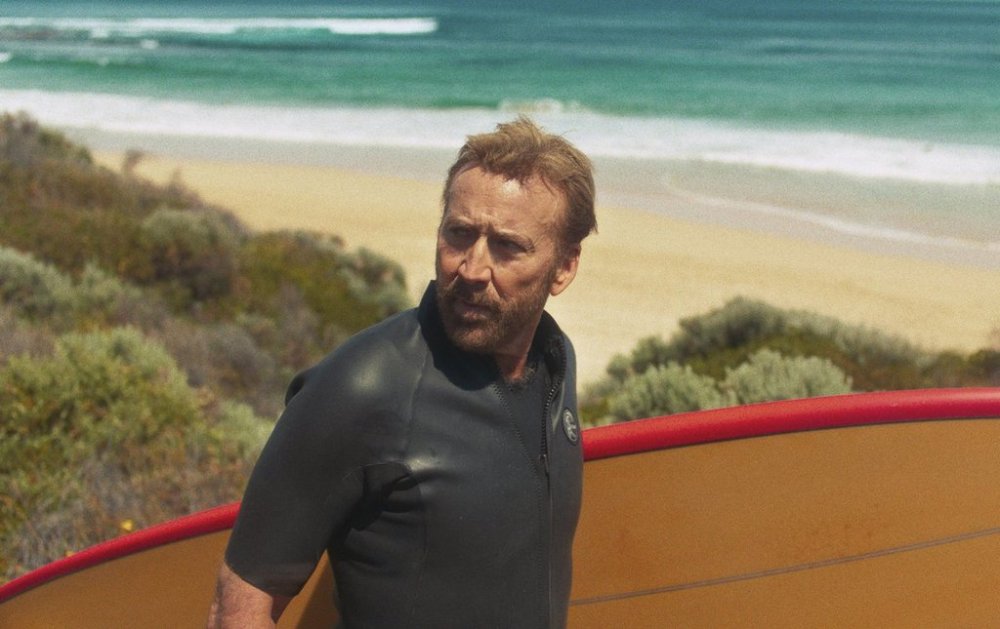
Ahead of the Roadside Attractions release on Friday, Cage and Finnegan spoke with The Associated Press about the film’s surrealism, why violence is “one of the backbones of cinema” and how Humphrey Bogart inspired a scene where Cage shoves a rat in someone’s face. The interview has been edited for clarity and brevity.
AP: Nicolas, last time we spoke, you talked about how Hollywood thinks naturalism is the arbiter of great acting but that you appreciate when you can explore other forms. Where does that impulse stem from?
CAGE: It was a feeling of not wanting to get trapped or calcified in the realm of artwork and thinking that the art that I admired in painters like Francis Bacon or in music, a lot of it was surrealistic. And so in my view, if there’s such a thing as art synthesis, why can’t you do it with acting? You can do it with acting, but it still has to land with the director and with the script in such a way where it moves the story forward and doesn’t become self-indulgent. It has to be a twist and a unique point of expression that evolves the story.
So how do you do that? Well, if the guy’s losing his mind, that’s one way. Then you can get a bit more abstract with facial expressions or voice. Or if the guy is on drugs, that’s one way, like “Bad Lieutenant.” In this case, the surfer is having a bit of a breakdown. It only stands to reason in a natural, authentic way that he would shriek-eat the rat and shove it into some guy’s mouth because it’s been earned. But that’s not to say that the naturalism of the ’70s isn’t great. It is great. And that’s something I enjoy doing as well.
AP: Talk about the film’s exploration of masculinity and tribalism.
FINNEGAN: To me, it wasn’t a film about toxic masculinity. I mean, there was elements of masculinity in crisis, and that’s something that does exist. But to me it was serving the story in a way because Nick’s character had to have this counter in this Scally character (Julian McMahon). Nick’s character lost his father when he was young and he was searching for some sort of belonging and that’s why he was thinking if he buys back this house and this materialistic goal will fix his relationship problems and stuff. So Julian’s character offers up something different. He’s kind of seductive. If you want to be in our gang and you want to be part of this culture, you have to do all of these things.
I think a lot of those figures in the world of toxic masculinity are a bit like that. They’re charming. A lot of the time they have these philosophical ideas and they’re well-read, so they seem very attractive to these guys who are kind of lost. So, I didn’t want the film though to be about that, but it kind of is baked into the whole story.
AP: Nicolas, you’ve done your share of films with violence in them. Is that something you are interested in?
CAGE: As someone who doesn’t like violence and actively tries to avoid violence in my life, I would say that it seems to be something that lends itself to cinema. Whatever gets a person to that point of violence is usually fascinating and compelling drama, and that’s one of the backbones of cinema.
AP: Any scenes stand out as particularly challenging or fun?
FINNEGAN: We discovered some of the humor in the film while making it. When did you think about keeping that rat? I don’t know if you knew exactly what you were planning yet, but it was a mischievous kind of percolation going on in your mind.
CAGE: I went on a Billy Wilder tear before I went to “The Surfer.” I was kind of in bed for a few days, and I was watching movies I wanted to catch up on and I saw “Sabrina.” And in the movie, Bogart pulls an olive out of a martini glass, and he shoves it in his uncle’s mouth and says, “Eat it.” And I couldn’t stop laughing. I thought it was the funniest thing. And I was just tickled pink by myself late at night watching it.
And then it came back to me in Australia. I said, “Well, I can use this rat for something.” And I tucked it in my pocket. Everyone’s looking at me like, what’s Nick doing with the prop rat? I said, “Well, I think it’s funny because the tail is wobbling around. Let’s hold onto it. It’s a good prop. Maybe we can use it.” And sure enough, Bogart and Billy Wilder and “Sabrina” came back and it was like “Eat the rat!” It’s a punk rock version of it, but it’s still inspired by Billy Wilder and Humphrey Bogart.