
Supreme Court tie vote dooms taxpayer funded Catholic charter school in Oklahoma
Advertisement
Read this article for free:
or
Already have an account? Log in here »
We need your support!
Local journalism needs your support!
As we navigate through unprecedented times, our journalists are working harder than ever to bring you the latest local updates to keep you safe and informed.
Now, more than ever, we need your support.
Starting at $15.99 plus taxes every four weeks you can access your Brandon Sun online and full access to all content as it appears on our website.
Subscribe Nowor call circulation directly at (204) 727-0527.
Your pledge helps to ensure we provide the news that matters most to your community!
To continue reading, please subscribe:
Add Brandon Sun access to your Free Press subscription for only an additional
$1 for the first 4 weeks*
*Your next subscription payment will increase by $1.00 and you will be charged $20.00 plus GST for four weeks. After four weeks, your payment will increase to $24.00 plus GST every four weeks.
Read unlimited articles for free today:
or
Already have an account? Log in here »
Hey there, time traveller!
This article was published 22/05/2025 (308 days ago), so information in it may no longer be current.
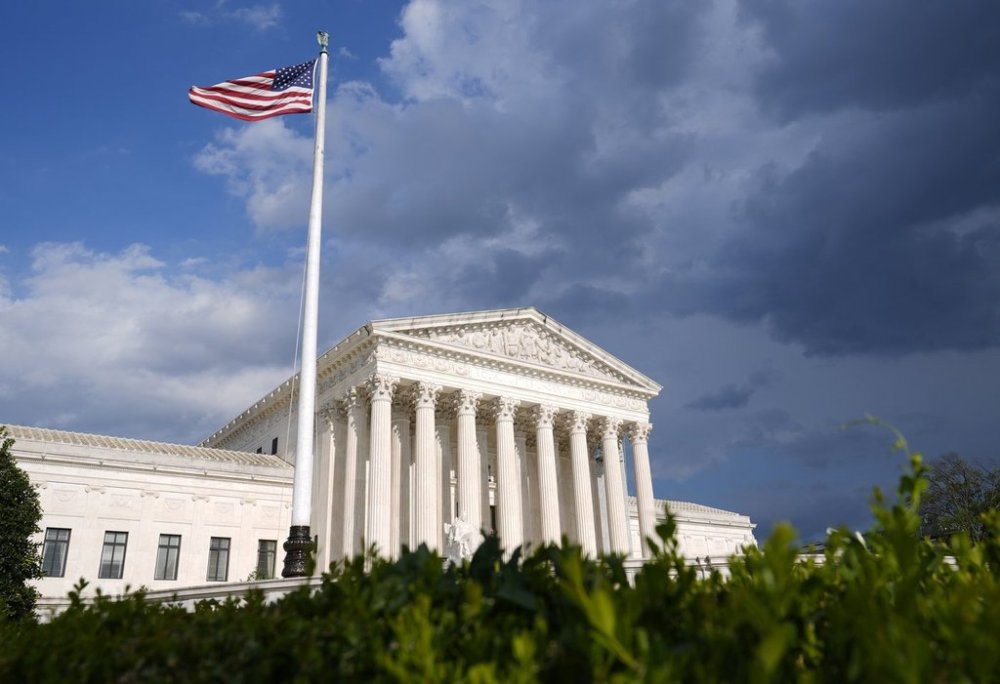
WASHINGTON (AP) — The Supreme Court on Thursday effectively ended a publicly funded Catholic charter school in Oklahoma, dividing 4-4.
The outcome keeps in place an Oklahoma court decision that invalidated a vote by a state charter school board to approve the St. Isidore of Seville Catholic Virtual School, which would have been the nation’s first religious charter school. But it leaves the issue unresolved nationally.
The one-sentence notice from the court provides an unsatisfying end to one of the term’s most closely watched cases.
The Catholic Church in Oklahoma had wanted taxpayers to fund the online charter school “faithful to the teachings of Jesus Christ.” Opponents warned that allowing it would blur the separation between church and state, sap money from public schools and possibly upend the rules governing charter schools in almost every state.
Only eight of the nine justices took part in the case. Justice Amy Coney Barrett didn’t explain her absence, but she is good friends and used to teach with Notre Dame law professor Nicole Garnett, who has been an adviser to the school.
The issue could return to the high court in the future, with the prospect that all nine justices could participate.
The court, following its custom, did not provide a breakdown of the votes. But during arguments last month, four conservative justices seemed likely to side with the school, while the three liberals seemed just as firmly on the other side.
That left Chief Justice John Roberts appearing to hold the key vote, and suggests he went with the liberals to make the outcome 4-4.
The case came to the court amid efforts, mainly in conservative-led states, to insert religion into public schools. Those include a challenged Louisiana requirement that the Ten Commandments be posted in classrooms and a mandate from Oklahoma’s state schools superintendent that the Bible be placed in public school classrooms.
St. Isidore, a K-12 online school, had planned to start classes for its first 200 enrollees last fall, with part of its mission to evangelize its students in the Catholic faith.
A key unresolved issue is whether the school is public or private. Charter schools are deemed public in Oklahoma and the other 45 states and the District of Columbia where they operate. North Dakota recently enacted legislation allowing for charter schools.
They are free and open to all, receive state funding, abide by antidiscrimination laws and submit to oversight of curriculum and testing. But they also are run by independent boards that are not part of local public school systems.
___
Follow the AP’s coverage of the U.S. Supreme Court at https://apnews.com/hub/us-supreme-court.