
Fire destroys buildings in Lynn Lake
Advertisement
Read this article for free:
or
Already have an account? Log in here »
We need your support!
Local journalism needs your support!
As we navigate through unprecedented times, our journalists are working harder than ever to bring you the latest local updates to keep you safe and informed.
Now, more than ever, we need your support.
Starting at $15.99 plus taxes every four weeks you can access your Brandon Sun online and full access to all content as it appears on our website.
Subscribe Nowor call circulation directly at (204) 727-0527.
Your pledge helps to ensure we provide the news that matters most to your community!
To continue reading, please subscribe:
Add Brandon Sun access to your Free Press subscription for only an additional
$1 for the first 4 weeks*
*Your next subscription payment will increase by $1.00 and you will be charged $20.00 plus GST for four weeks. After four weeks, your payment will increase to $24.00 plus GST every four weeks.
Read unlimited articles for free today:
or
Already have an account? Log in here »
Hey there, time traveller!
This article was published 03/06/2025 (296 days ago), so information in it may no longer be current.
WINNIPEG — A wildfire has destroyed several buildings in Lynn Lake and forced the evacuation of all but a dozen people who are fiercely trying to fend off the flames in the northern town.
Ian Bushie, the natural resources minister, confirmed during question period that multiple structures in and around the town had been razed by flames. Most of them were abandoned or considered derelict, the minister said.
Employees of the local government who had stayed behind fled to Leaf Rapids, about 100 kilometres southeast of Lynn Lake, said resident Maggie Braido.
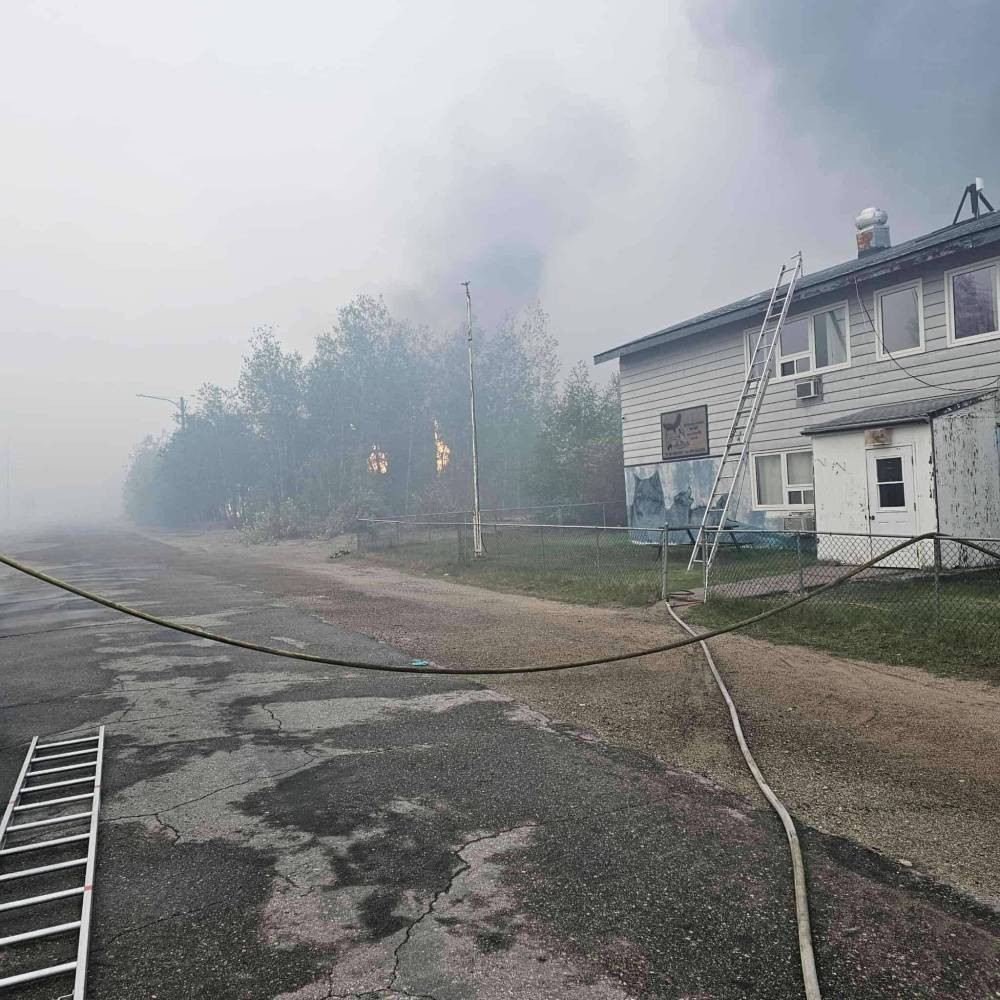
The fire encroached on the town of Lynn Lake Sunday. (Tyler Hunt)
Braido’s fiance, Lynn Lake Mayor Brandon Dulewich, was working on fire suppression around the town and unavailable to do an interview.
“Nobody has slept. They no longer have anyone cooking for first responders,” Braido said.
Braido has been receiving regular updates from Dulewich. She said that as of Monday afternoon, the volunteer fire department was prepping the fire trucks for what’s expected to be another long day of firefighting.
The fire department was about to evacuate along with the remaining town staff but ultimately decided to stay to continue saving homes and infrastructure, Braido said.
“They also just got word that a military Hercules plane will be landing at some point today with an additional fire truck for structures and a crew,” she said.
About 570 residents were ordered to leave May 27; at last count, the blaze had grown to 50,000 hectares.
Military aircraft crews have been evacuating residents of northern communities since the Manitoba government declared a state of emergency May 28. More than 17,000 residents from a handful of communities, have escaped to Winnipeg, The Pas, Brandon and Portage la Prairie.
As of Sunday, the armed forces had evacuated more than 3,200 northerners, the military said Monday.
Flin Flon and the surrounding area, Lynn Lake, Pimicikamak Cree Nation, Mathias Colomb Cree Nation and Tataskweyak Cree Nation have been fully evacuated, Manitoba RCMP said Monday afternoon.
Marcel Colomb First Nation, also known as Black Sturgeon Falls, was still being evacuated Monday.
Mounties, firefighters and emergency medical responders remain in the evacuated communities to keep properties secure and maintain roadblocks, RCMP said.
Amid the mass movement of people being displaced, RCMP detachments in towns and cities hosting evacuees are seeing an increase in calls for service, said spokesman Sgt. Paul Manaigre.
Detachments in Thompson, Dauphin and Portage la Prairie have noticed an uptick.
“A large influx of a population moving into an area produces a lot of stress and anxiety for everyone and people have been calling in to detachments with a lot of questions, which would normally be handled by many more detachments, as opposed to just the few now who are handling the workload,” said Manaigre.
In Flin Flon, structures remained intact and no additional buildings were lost in the Bakers Narrows area, the municipal government said in an update on social media.
“Flin Flon is holding strong and we are continuing to battle the fire,” the update said.
Misipawistik Cree Nation was put on an evacuation notice Sunday after a blaze sparked near Footprint Lake.
The community, 429 kilometres north of Winnipeg, notified residents via Facebook to be ready in case an evacuation order is issued.
In Tataskweyak Cree Nation, a local state of emergency prompted the evacuation of the community to Gillam, where residents were then flown to Thompson, and then Winnipeg.
Only essential staff remain in the community to help fight the 4,000-hectare blaze.
Fires in Mathias Colomb Cree Nation (Pukatawagan) and Sherridon were being held and have not destroyed infrastructure in the communities, Bushie said during his update in the legislature.
In Nopiming Provincial Park, the 189,000-hectare blaze jumped Highway 304 and control lines are being established to better protect Bissett, the minister said.
Currently, the province has 38 firefighters from Alberta, 87 from British Columbia, 19 from Parks Canada, two from Prince Edward Island, 23 from New Brunswick and two AT802 skimmers and one bird dog plane from Minnesota. British Columbia has sent 500 sprinklers.
Firefighters from the U.S. and helicopters from Colombia are expected to arrive in Manitoba in the coming days.
While there is rain in the forecast later this week, it won’t be enough to put a huge dent in the 25 fires across the province.
Christy Climenhaga, a scientist at Environment Canada, said the seasonal forecast is hotter and drier than previous years.
“It’s going to be really hard to tell exactly what we will see precipitation wise … but those forecasts don’t have a lot of confidence,” she said.
Ahead of the first ministers conference in Saskatoon Monday, Premier Wab Kinew said Monday provincial governments must scale up firefighting resources in light of climate change.
“We could use every water bomber we can get our hands on. We’re going to need more water bombers in the future,” he said.
The province put a down payment on five water bombers in April, but they won’t be ready for five years.
“We’re in this challenge of having to respond during an emergency situation by pulling pieces that we have at our disposal. We’re now turning to international sources of assistance,” Kinew said.
Meantime, Winnipeg Centre MP Leah Gazan has forced an emergency debate on wildfires in the House of Commons.
On Monday, Gazan wrote to the Speaker requesting an emergency discussion.
She said the federal government has “repeatedly failed to ensure that remote and northern communities have access to reliable emergency preparedness infrastructure and evacuation support.”
Speaker Francis Scarpaleggia granted the debate, which will take place today.
The Congress of Aboriginal Peoples, too, called on the government to involve Indigenous communities in emergency planning for future disasters.
“Indigenous Peoples living off-reserve including Métis, non-status, and urban Indigenous populations often fall through the cracks in Canada’s emergency management system. Many are not included in emergency planning or infrastructure investment, leaving them more vulnerable to climate-related disasters like wildfires,” the congress said in a news release.
» Winnipeg Free Press, with files from Erik Pindera and Maggie Macintosh