
Men’s mental health under spotlight this week
Advertisement
Read this article for free:
or
Already have an account? Log in here »
We need your support!
Local journalism needs your support!
As we navigate through unprecedented times, our journalists are working harder than ever to bring you the latest local updates to keep you safe and informed.
Now, more than ever, we need your support.
Starting at $15.99 plus taxes every four weeks you can access your Brandon Sun online and full access to all content as it appears on our website.
Subscribe Nowor call circulation directly at (204) 727-0527.
Your pledge helps to ensure we provide the news that matters most to your community!
To continue reading, please subscribe:
Add Brandon Sun access to your Free Press subscription for only an additional
$1 for the first 4 weeks*
- Enjoy unlimited reading on brandonsun.com
- Read the Brandon Sun E-Edition, our digital replica newspaper
*Your next Free Press subscription payment will increase by $1.00 and you will be charged $20.95 plus GST for four weeks. After four weeks, your payment will increase to $24.95 plus GST every four weeks.
Read unlimited articles for free today:
or
Already have an account? Log in here »
Hey there, time traveller!
This article was published 10/06/2025 (444 days ago), so information in it may no longer be current.
This week leading up to Father’s Day is the first-ever Men’s Mental Health Awareness Week in Manitoba.
The milestone is a result of legislation that was introduced by Dawson Trail PC MLA Bob Lagassé, who was struggling with his own mental health.
“If my story can help someone else, then by all means let’s talk about it. Let’s remove the stigma,” he said.
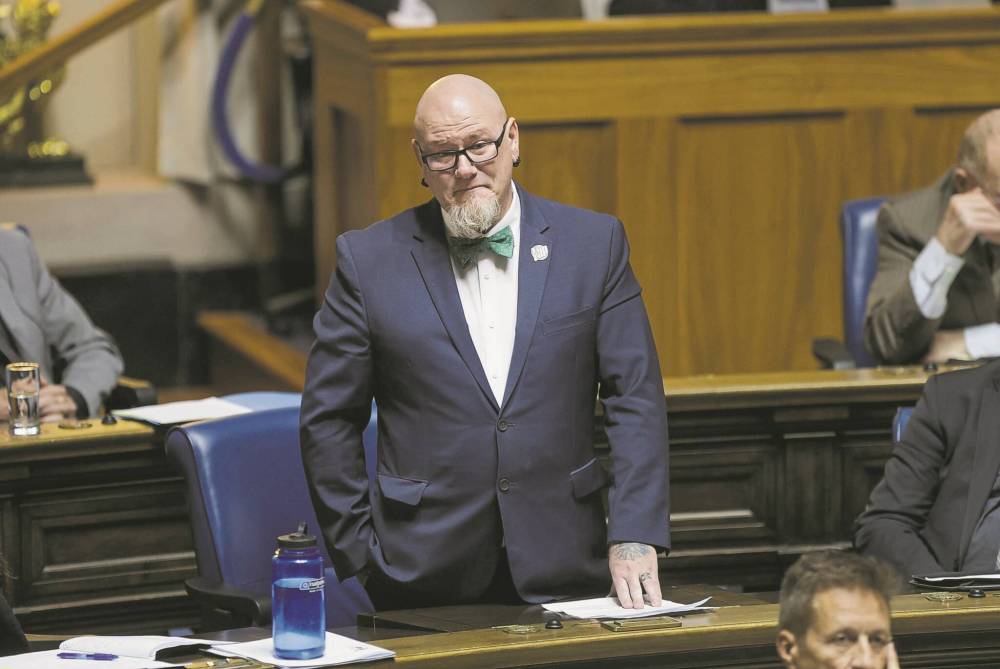
Dawson Trail MLA Bob Lagassé, seen in the Manitoba Legislature in 2023, established a bill for the first-ever Men’s Mental Health Awareness Week in Manitoba, which will be observed each year in the week leading up to Father’s Day. (Ruth Bonneville/Winnipeg Free Press files)
In 2022, Lagassé went public with his mental health struggles during question period in the Manitoba legislature, sharing his experiences with political colleagues on both sides of the aisle.
On Monday, as the bill he introduced came into effect, he shared his story with the Sun.
“In my case, I found myself crying a lot, especially when I was alone. I’d be coming home from work and then break down in tears, and I wouldn’t know really why — it was just there,” Lagassé said.
“Unfortunately there were self-harm thoughts. I had a plan, I knew how I was going to end my life, but thankfully it never happened. It actually led to something good, but it wasn’t intentional.”
Lagassé said his family doctor helped him realize his struggles were caused by several factors, including untreated depression and thought patterns focused on sadness triggered by his deficit hyperactivity disorder.
Medication was able to bring him out of the “darker moments” and back to where he “used to be,” which led to the idea about mental health awareness for men.
Lagassé introduced the bill for the awareness week in May 2024, and it received royal assent on Nov. 7.
“I wanted the week before Father’s Day because that’s when everyone’s thinking about a man in their life, so why not have this conversation?” Lagassé said.
“We men tend to shut down. We don’t scream out for help; we don’t want to be seen as weak. We’ll show higher levels of irritability and anger, talking about wanting to die. In some cases, (men) look for a way to take their own life.”
Manitoba has among the highest mental health needs and the highest rates of suicide of any province. Across Canada, men account for nearly 75 per cent of deaths by suicide, according to Statistics Canada.
Asking for help is a sign of strength not weakness, said Brandon University’s Jonathan Allan, a professor in the Faculty of Arts, editorial board member of Journal of Men’s Studies and former Canada Research Chair.
“Sometimes we are our own worst enemy,” Allan said. “So absolutely, we need to raise the awareness.”
Men are reluctant to talk about mental and physical health, he said, and when they do seek help, it’s usually much later on and much more serious.
“We need men to get their checkups, get their testosterone readings, getting all those sorts of things to know what we’re dealing with,” Allan said.
“Low testosterone often results in some very common mental health issues. You’re fatigued and you lose interest in things. It could be that once we treat the testosterone, the mental health issues may go away, or they’re more manageable.
“We also need to reach men where they are and talk with them in spaces that are comfortable for them,” said Allan.
Men who live in rural areas are at even higher risk for suicide, according to a 2021 survey of Canadian farmers’ mental health conducted by researchers at the University of Guelph.
Suicidal ideation was twice as high among farmers compared to the general population. Additionally, the survey found one in four farmers reported that their life was not worth living, wished they were dead or had thought of taking their own life in the previous 12 months.
It’s data that Gerry Friesen of the Manitoba Farmer Wellness Program said he knows “all too well,” with his past diagnosis of anxiety and depression, and is why he encourages men to share how they’re feeling.
“I started talking publicly about my own journey in 2010 and I’ll tell you, I found out very quickly how talking about it helps,” Friesen said.
“Just telling someone, ‘Hey I’m here for you if you want to talk’ is helpful. It helps people relax, feel comfortable and safe and they’re not going to be judged.”
As Lagassé talked about the new legislation, he insisted it wasn’t a partisan issue, but added the NDP could add more mental health workers.
“Considering the size of the population we have, more can always be done.”
The province has hired 25 new mental health workers and has committed to 100 in the next four years, said Bernadette Smith, the minister of housing, addictions, homelessness and mental health.
“I’m happy that this bill has come forward,” Smith told the Sun. “It’s a part of de-stigmatizing, educating and helping Manitoba men and boys know that they don’t have to suffer in silence, that there are other people you know who experience this.”
Keep checking in on the men in your life and “keep the lines of communication open” are the key messages from Lagassé to loved ones.
“And to the men out there, it’s OK not to be OK. What’s not OK is to go through it alone.”
» mmcdougall@brandonsun.com
» enviromichele.bsky.social