
Building media literacy could help restore trust
Advertisement
Read this article for free:
or
Already have an account? Log in here »
We need your support!
Local journalism needs your support!
As we navigate through unprecedented times, our journalists are working harder than ever to bring you the latest local updates to keep you safe and informed.
Now, more than ever, we need your support.
Starting at $15.99 plus taxes every four weeks you can access your Brandon Sun online and full access to all content as it appears on our website.
Subscribe Nowor call circulation directly at (204) 727-0527.
Your pledge helps to ensure we provide the news that matters most to your community!
To continue reading, please subscribe:
Add Brandon Sun access to your Free Press subscription for only an additional
$1 for the first 4 weeks*
*Your next subscription payment will increase by $1.00 and you will be charged $20.00 plus GST for four weeks. After four weeks, your payment will increase to $24.00 plus GST every four weeks.
Read unlimited articles for free today:
or
Already have an account? Log in here »
Hey there, time traveller!
This article was published 10/07/2025 (259 days ago), so information in it may no longer be current.
“Although many young people express high confidence in detecting false information, many struggle with accurate identification and respond passively — often ignoring misleading content rather than engaging in corrective actions.”
— A 2025 German study on young people and false information in the latest edition of the online journal ScienceDirect
If you’ve spent any amount of time doom-scrolling through the mountains of videos uploaded to social media sites like Facebook or TikTok, you’ve almost certainly watched some form of “faked” news, AI-generated content or vitriolic opinions meant to inflame rather than inform.
While much of this content tends to be seen as a form of entertainment by the masses, it’s when misinformation is passed off as the truth that we find ourselves in danger as a society.
For example, on Thursday, U.S.-based news organization NPR reported that a video has been circulating on TikTok this week falsely stating that the U.S. government is installing incinerators at “Alligator Alcatraz” — the state-run immigration detention facility in the Florida Everglades. The claim — which was repeated on several other social media sites including Facebook, Instagram, Threads, X and Bluesky — is based on a conspiracy theory that the government was constructing Nazi-Gestapo-like furnaces at the site for nefarious purposes.
One of the videos circulating this unproven rumour on TikTok garnered nearly 20 million views, according to the NPR report. But it was another account that seemingly stood out: “a realistic-looking TikTokker giving a direct-to-camera description of the incinerator conspiracy,” wrote NPR.
“The speaker’s image and voice appear to have been created with artificial intelligence tools, according to two forensic media experts NPR consulted,” the NPR report read. “The twist: the words spoken in the video are the exact same as those in another video posted by a different TikTok account days before. The copied version attracted more than 200,000 views on TikTok.”
Deepfake videos are growing more and more sophisticated in recent years, as AI-generated content surges in popularity. But when it comes to an already-controversial real-life story such as the construction of immigrant detention cells in Florida by the Trump administration, the flooding of social media with fake information can prove far more dangerous.
When the public loses the ability to discern what information is real from what is false, the consequences can be deadly, particularly if members of the public choose to act on the lie. Anger, division and even violence is being exacerbated by misinformation on social media.
We already know that unfriendly countries such as Russia, Iran and China have ramped up their use of digital tools for propaganda and misinformation as a means of foreign interference. But the situation on the internet is worsening, and it’s affecting our day-to-day lives.
News media in Canada can sometimes be its own worst enemy, but the widespread rise of misinformation and the creation of information “silos” has only served to further erode the public’s trust in traditional media outlets — not to mention government institutions and other formerly trusted information sources. Unless we start dealing with the problem, the consequences of allowing unchecked misinformation to dominate our media will continue to worsen, particularly among youth, who use social media to excess.
In the most recent edition of the journal ScienceDirect, a broad study from the Ludwig Maximillian University of Munich found that many participating young people struggled to detect false information, with youth confidence often exceeding “actual detection performance.”
The study — which incorporated and built upon dozens of previously held studies on youth and misinformation — also found that false information was responsible for shaping “real-life behaviours and decision-making.” This included deciding not to befriend someone of a different race based on false information about that race, spurning the use of vaccines because of misleading information about a vaccine’s efficacy, or deciding not to vote because of a fear of acting on false information.
The answer, it concluded, was for comprehensive, age-appropriate intervention in the form of educational programs.
“Such programs should not only enhance critical evaluation and digital literacy but also empower young people to counter false information actively. Integrating technological tools and involving educators, parents, and policymakers will equip young people to navigate today’s complex digital landscape and foster a more informed, resilient citizenry.”
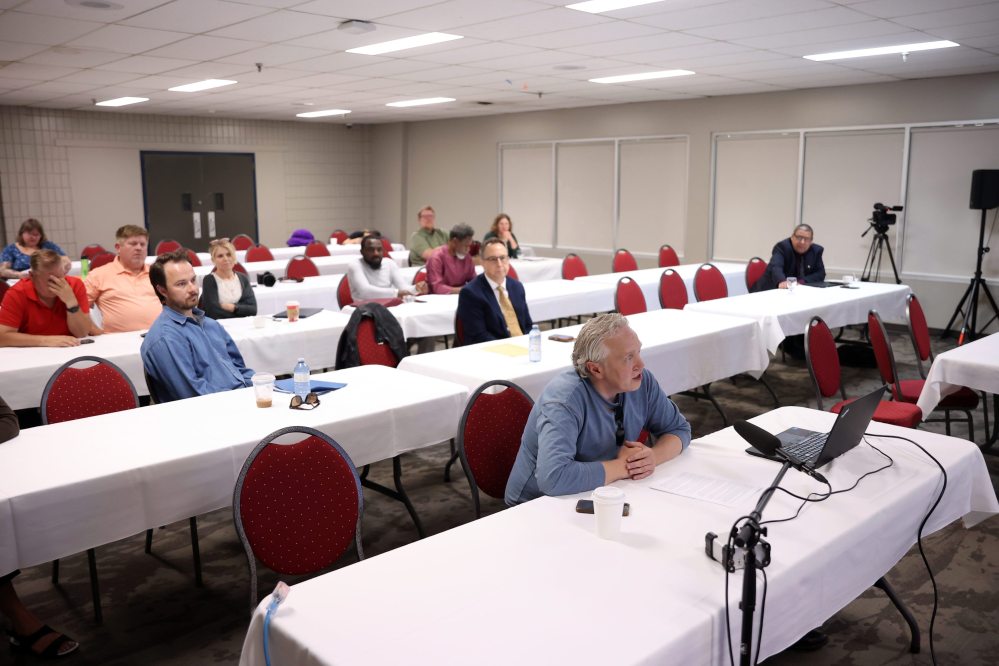
Earlier this week, I had the opportunity to sit before Manitoba’s all-party journalism committee and offer my presentation on how local news media both supports communities and aids democracy. We were also asked to help identify ways that the government could offer support to rural news media.
Local newspaper journalists and editors live and work in the communities in which they publish. We are accountable for the news we print, and the opinions we offer on the editorial pages. And when we get information wrong, which can and does happen, we are honour-bound to correct the record.
While I was satisfied with my presentation, which centred on the importance of local reporting, I believe that one of the most useful things the provincial government could do to support local media — beyond the calls for increased government advertising — is to strengthen the critical thinking skills of students in elementary and high school, and provide better media literacy education in Manitoba schools.
Providing more and better media literacy skills would go a long way to restoring trust in local journalism, particularly as longstanding news sources in Manitoba continue to hold fast to ethical reporting practices.
» Matt Goerzen, editor