
Roman-era mosaic panel with erotic theme that was stolen during World War II returns to Pompeii
Advertisement
Read this article for free:
or
Already have an account? Log in here »
We need your support!
Local journalism needs your support!
As we navigate through unprecedented times, our journalists are working harder than ever to bring you the latest local updates to keep you safe and informed.
Now, more than ever, we need your support.
Starting at $15.99 plus taxes every four weeks you can access your Brandon Sun online and full access to all content as it appears on our website.
Subscribe Nowor call circulation directly at (204) 727-0527.
Your pledge helps to ensure we provide the news that matters most to your community!
To continue reading, please subscribe:
Add Brandon Sun access to your Free Press subscription for only an additional
$1 for the first 4 weeks*
*Your next subscription payment will increase by $1.00 and you will be charged $20.00 plus GST for four weeks. After four weeks, your payment will increase to $24.00 plus GST every four weeks.
Read unlimited articles for free today:
or
Already have an account? Log in here »
Hey there, time traveller!
This article was published 15/07/2025 (256 days ago), so information in it may no longer be current.
POMPEII, Italy (AP) — A mosaic panel on travertine slabs, depicting an erotic theme from the Roman era, was returned to the archaeological park of Pompeii on Tuesday, after being stolen by a Nazi German captain during World War II.
The artwork was repatriated from Germany through diplomatic channels, arranged by the Italian Consulate in Stuttgart, Germany, after having been returned from the heirs of the last owner, a deceased German citizen.
The owner had received the mosaic as a gift from a Wehrmacht captain, assigned to the military supply chain in Italy during the war.
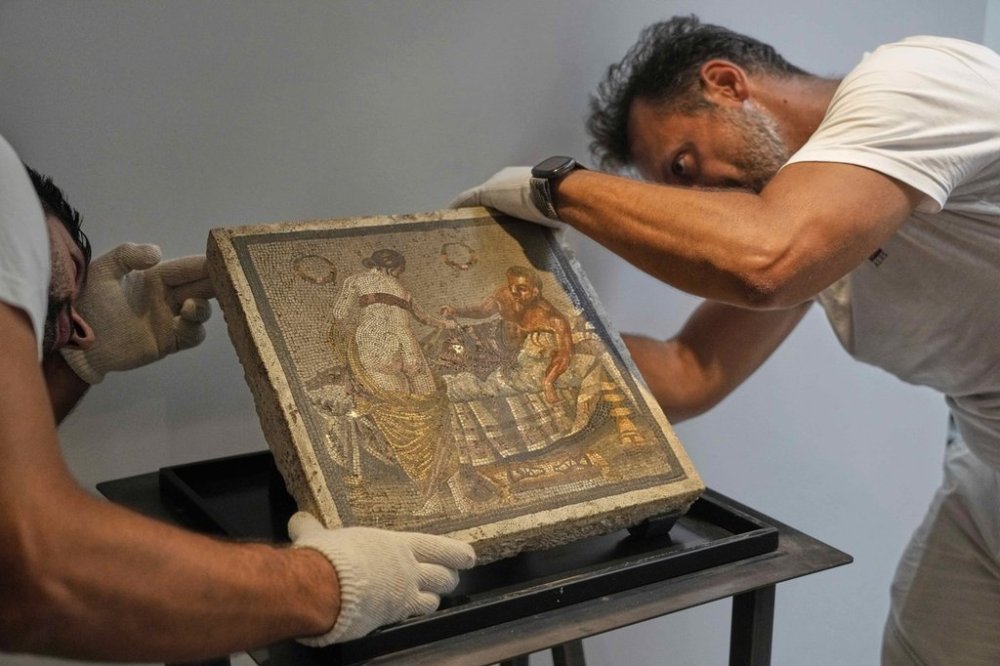
The mosaic — dating between mid- to last century B.C. and the first century — is considered a work of “extraordinary cultural interest,” experts said.
“It is the moment when the theme of domestic love becomes an artistic subject,” said Gabriel Zuchtriegel, director of the Archaeological Park of Pompeii and co-author of an essay dedicated to the returned work. “While the Hellenistic period, from the fourth to the first century B.C., exulted the passion of mythological and heroic figures, now we see a new theme.”
The heirs of the mosaic’s last owner in Germany contacted the Carabinieri unit in Rome that’s dedicated to protecting cultural heritage, which was in charge of the investigation, asking for information on how to return the mosaic to the Italian state. Authorities carried out the necessary checks to establish its authenticity and provenance, and then worked to repatriate the mosaic in September 2023.
The collaboration with the Archaeological Park of Pompeii was also key, as it made it possible to trace it to near the Mount Vesuvius volcano, despite the scarcity of data on the original context of its discovery, the Carabinieri said.
The panel was then assigned to the Archaeological Park of Pompeii where, suitably catalogued, it will be protected and available for educational and research purposes.
“Today’s return is like healing an open wound,” Zuchtriegel said, adding that the mosaic allows to reconstruct the story of that period, the first century A.D., before Pompeii was destroyed by the Vesuvius eruption in A.D. 79.
The park’s director also highlighted how the return by the heirs of its owner signals an important change in “mentality,” as “the sense of possession (of stolen art) becomes a heavy burden.”
“We see that often in the many letters we receive from people who may have stolen just a stone, to bring home a piece of Pompeii,” Zuchtriegel said.
He recalled the so-called “Pompeii curse,” which according to a popular superstition hits whoever steals artifacts in Pompeii.
The world-known legend suggests that those who steal finds from the ancient city of Pompeii will experience bad luck or misfortune. That has been fueled over the years by several tourists who return stolen items, claiming they brought them bad luck and caused tragic events.
___
Zampano reported from Rome.