
Century-old loon hat brought home to Cambridge Bay
Advertisement
Read this article for free:
or
Already have an account? Log in here »
We need your support!
Local journalism needs your support!
As we navigate through unprecedented times, our journalists are working harder than ever to bring you the latest local updates to keep you safe and informed.
Now, more than ever, we need your support.
Starting at $15.99 plus taxes every four weeks you can access your Brandon Sun online and full access to all content as it appears on our website.
Subscribe Nowor call circulation directly at (204) 727-0527.
Your pledge helps to ensure we provide the news that matters most to your community!
To continue reading, please subscribe:
Add Brandon Sun access to your Free Press subscription for only an additional
$1 for the first 4 weeks*
*Your next subscription payment will increase by $1.00 and you will be charged $20.00 plus GST for four weeks. After four weeks, your payment will increase to $24.00 plus GST every four weeks.
Read unlimited articles for free today:
or
Already have an account? Log in here »
Hey there, time traveller!
This article was published 21/08/2025 (217 days ago), so information in it may no longer be current.
CAMBRIDGE BAY, NUNAVUT — After a nearly decade-long repatriation process, a 100-year-old dance hat with loon beak has been returned to Cambridge Bay, which was cause for celebration.
“It brought childhood memories for our elders,” said Emily Angulalik, executive director of Kitikmeot Heritage Society.
The hat, made of caribou hide with a loon beak in its centre, was displayed Aug. 6 during the community celebration to mark its return. More than 200 people came out to commemorate the event.
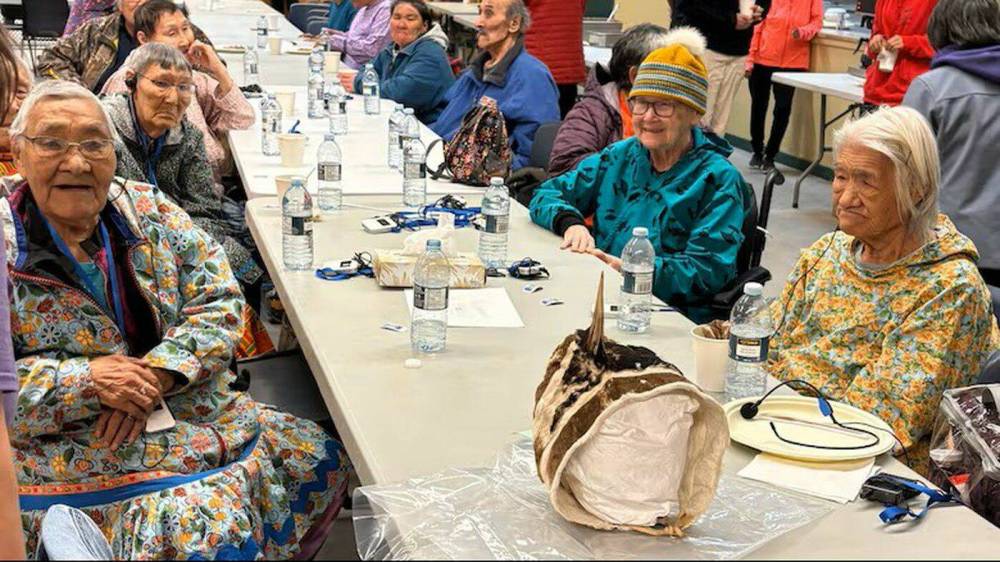
The elders remembered their fathers and grandfathers who used to wear hats like this one while performing Akkuarmiujut, a festive “freestyle” dance that required the dancer to be as quick as an ermine and as loud as a loon when it makes its howling call, Angulalik said.
It’s unclear at what point the hat had left Inuit Nunangat, but it wound up in the collection of Imperial Oil, an oil company based in Calgary.
“A lot of people over the last 150 years have acquired things from Indigenous communities, whether it came through Indian agents or priests, or residential schools, or people doing nursing,” said Joanne Schmidt, curator for Indigenous studies and world cultures for Glenbow Museum in Calgary.
Often, communities would be pressured into selling their ceremonial pieces for financial reasons or because they were discouraged by the government from maintaining their traditional practices.
The hat was brought to Glenbow Museum in 2016 with the goal to give it back to Inuit, Schmidt said. Representatives of the museum worked for years trying to identify the origins of the hat.
“We looked through our collections and reached out to other museums,” Schmidt said.
“It’s researching in books, it’s looking at online articles, checking for photographs of similar things or of people wearing similar things.”
It’s still unclear which community would be the closest descendant of the Inuit who made the loon hat, but researchers identified that it came from the Kitikmeot Region.
The hat will soon be on display at the library of the Kitikmeot Heritage Society — Angulalik is still setting up the right spot for it.
The society also hopes to make a couple of replicas of the hat for their future projects.
“This would really enhance more cultural interest and possibly a way of cultural revitalization,” Angulalik said.
» Nunatsiaq News