
School bus safety pitch falls short of the mark
Advertisement
Read this article for free:
or
Already have an account? Log in here »
We need your support!
Local journalism needs your support!
As we navigate through unprecedented times, our journalists are working harder than ever to bring you the latest local updates to keep you safe and informed.
Now, more than ever, we need your support.
Starting at $15.99 plus taxes every four weeks you can access your Brandon Sun online and full access to all content as it appears on our website.
Subscribe Nowor call circulation directly at (204) 727-0527.
Your pledge helps to ensure we provide the news that matters most to your community!
To continue reading, please subscribe:
Add Brandon Sun access to your Free Press subscription for only an additional
$1 for the first 4 weeks*
*Your next subscription payment will increase by $1.00 and you will be charged $20.00 plus GST for four weeks. After four weeks, your payment will increase to $24.00 plus GST every four weeks.
Read unlimited articles for free today:
or
Already have an account? Log in here »
When it comes to proposed measures within his recently introduced private member’s bills regarding school bus safety, Opposition education critic Wayne Ewasko may have missed the bus with his own legislation.
The Progressive Conservative MLA, who introduced the legislation on Wednesday, according to a CBC report, wants to enhance the safety of Manitoba children riding in school buses by calling for all newly manufactured school buses to be equipped with modern, three-point seatbelts.
“It’s all about student safety,” Ewasko said Wednesday. “Making sure that parents and guardians know that when their child is leaving the home and getting on to a school bus, that they’re getting to school safe and sound.”
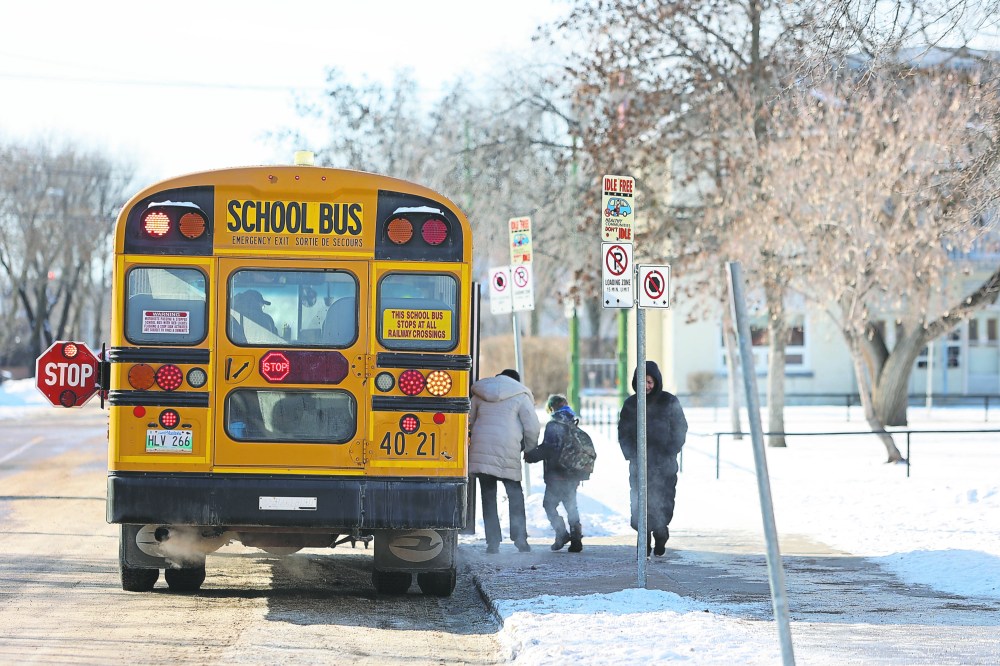
A student boards a school bus at École New Era School in Brandon. (The Brandon Sun files)
Ewasko says he circulated the idea after speaking with a bus driver from Sunrise School Division, where he taught for 17 years.
It’s not the first time this issue has come before public debate. Discussion over school bus safety picked up nationally following the deadly Humboldt Broncos bus crash in Saskatchewan that took the lives of 16 people and seriously injured 13 others in 2018.
In 2019, the Council of Ministers Responsible for Transportation and Highway Safety struck an expert Task Force on School Bus Safety to identify ways to further enhance school bus safety, with a specific emphasis on three-point seatbelts. The task force’s report in 2020 identified a number of operational concerns and risk factors that needed to be addressed before any decision on seatbelts could move forward.
In the wake of that report, the Council of Ministers carried out pilot projects in three school districts between British Columbia and Ontario that involved six school buses equipped with seatbelts. The resulting report in 2024 concluded that, overall, seatbelts had a positive impact on student behaviour by “keeping students seated” and “reducing driver distraction.”
But there were several drawbacks to the idea as well.
“Seatbelt use was impacted by the number of seatbelts installed per seat relative to the student’s physical size,” the report read. “It was difficult for students fourth grade and above to be seated and buckled properly when seated three per seat.”
That means the seating would have to allow Grade 4 to Grade 12 students to be seated two per seat, which would reduce the carrying capacity of a bus.
There were also concerns that during emergency exit simulations, evacuating school buses equipped with seatbelts took between five and 10 minutes longer than on a school bus without them. Furthermore, it remained a challenge for school bus drivers to ensure that seatbelts were always worn properly by all students.
The pilot projects also had notable limitations — they did not examine the costs that would be associated with such an implementation. And that could be substantial.
Back in 2019, the Brandon School Division said it would have to spend upwards of $10,000 per bus to equip school buses with seatbelts. That would have amounted to a $430,000 bill when the division’s fleet was at about 43 buses. No doubt that cost would be far more at today’s prices, even if the number of buses were equal.
With very few incidents within the Brandon School Division having occurred over the last several decades, we can’t see trustees justifying the expense.
On the other hand, Ewasko’s other bill — Bill 221 — would amend the Highway Traffic Act to significantly increase fines for motorists who pass school buses that are stopped while students are getting on or off the vehicle. A first offence would cost a convicted person up to $2,500, with a second and third offence garnering fines of up to $5,000 and $7,500, respectively.
That’s a steep increase over the current $670 fine, which also includes two demerits. But it might be worthwhile.
You can often spot one or two cars that ignore the flashing lights and stop sign on a school bus here in Brandon when it’s stopped to drop off or pick up a student. And that truly is a danger worth guarding against.
But if NDP Education Minister Lisa Naylor is right — and she likely is — there’s no need for a private member’s bill to make such a change. She told CBC the transportation department is reviewing all Highway Traffic Act fines to see if they are high enough, including the penalty for passing stopped school buses.
That’s a good idea.
While well intentioned, Mr. Ewasko’s private member’s bills … may not be.