
Local business leads fight against food waste
Advertisement
Read this article for free:
or
Already have an account? Log in here »
We need your support!
Local journalism needs your support!
As we navigate through unprecedented times, our journalists are working harder than ever to bring you the latest local updates to keep you safe and informed.
Now, more than ever, we need your support.
Starting at $15.99 plus taxes every four weeks you can access your Brandon Sun online and full access to all content as it appears on our website.
Subscribe Nowor call circulation directly at (204) 727-0527.
Your pledge helps to ensure we provide the news that matters most to your community!
To continue reading, please subscribe:
Add Brandon Sun access to your Free Press subscription for only an additional
$1 for the first 4 weeks*
- Enjoy unlimited reading on brandonsun.com
- Read the Brandon Sun E-Edition, our digital replica newspaper
*Your next Free Press subscription payment will increase by $1.00 and you will be charged $20.95 plus GST for four weeks. After four weeks, your payment will increase to $24.95 plus GST every four weeks.
Read unlimited articles for free today:
or
Already have an account? Log in here »
Food delivery fails — whether a truck arrives behind schedule, a seal breaks ahead of time, or an order doubles.
When this happens, it impacts a small per cent of total shipment in Manitoba, but equals a lot of food at the end of the day. The reality of this has become the focus of “food rescue” efforts by a local business in Brandon, and the success has inspired a charity in Winnipeg to replicate ideas and try to spread them across the province.
Think of a truckload of 44,000 pounds of food arriving at a warehouse at the wrong time. Space is limited, and for one reason or another, the warehouse manager can’t take it.
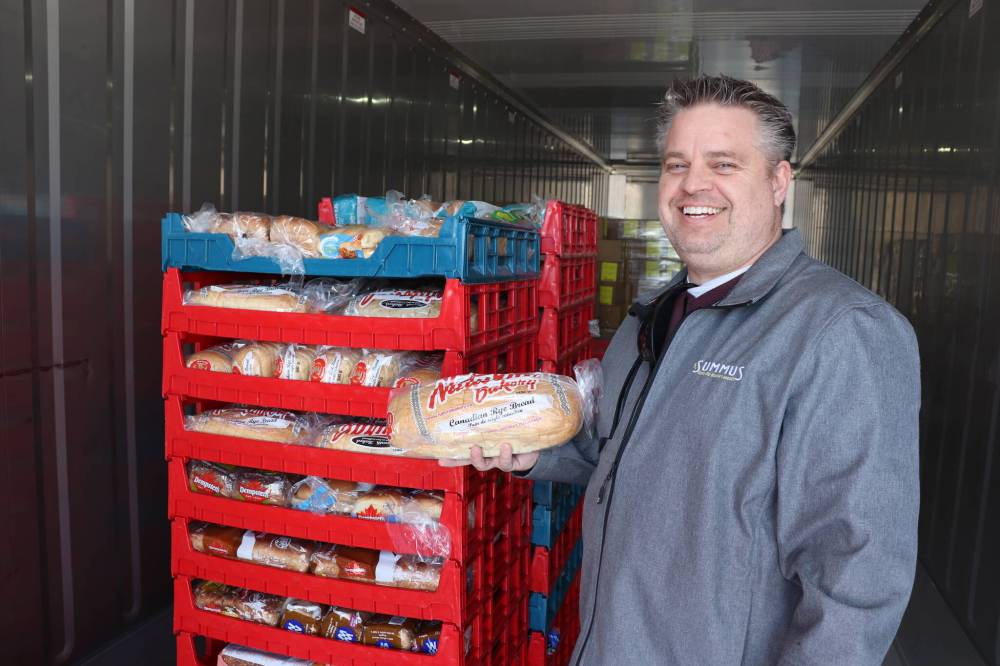
Dzogan holds up a loaf of bread inside one of the Food Rescue Grocery Store’s refrigerated storage units in 2023. The not-for-profit business’s use of shipping containers as refrigerated storage units has spread to Winnipeg under a charity that just installed two. (Kyle Darbyson/The Brandon Sun files)
Where does the food end up?
In many cases, there’s nowhere for the food to go, said Jennifer MacRae, food rescue and emissions reduction project manager at Climate Connections Canada, a project of MakeWay.
“It’s actually cheaper for them to throw it in the garbage, to be honest, than to try and have someone, a manager, spend time trying to go through and get it re-certified,” MacRae told the Sun in a recent interview.
At large scale, errors in the supply chain can lead just one food producer in Manitoba to create a steady two semi loads of food waste per day, she said. The error is acceptable to businesses as a small flaw compared to total production, she said.
“I’ve seen it firsthand … the entire trailer shipment is rejected because one pallet jack went through one box of the pallet load of stuff, and so the whole thing is now needing to be inspected, and is getting rejected, even though the rest of the load is fine, because it’s delayed.”
Food suppliers have to fulfill minimum guarantees to their clients, she said, and so there’s many ways an order could be rejected: the order could be below standard because it is underweight, overweight, blemished, past deadline, misshapen, too salty.
“That’s why you don’t see a lot of products making it to store shelves, because sometimes they can’t meet those expectations,” she said. “It’s factored in already that way. It’s part of their model. Their supply model.”
The question arises of what to do with thousands of pounds of food, and companies can struggle to identify a backup plan, she said. It can be easier to throw the food out, rather than organize a plan that avoids further liabilities for the company, for example.
A trucking business representative in the Winnipeg area told the Sun that they are paid to deliver food to landfills a few times a year. The person shared on the condition of anonymity so as not to risk blowback to the business.
“Usually it’s one or two truck loads,” the representative said in a recent interview. “It only happens maybe three times a year, or four times.”
The typical amount for this one company is about two truck loads, totalling about 88,000 pounds on that shipment, they said. They once had a job of more than 400,000 pounds at once.
“(That) time it was so much that I was, I don’t know, I don’t know if I want to mention that,” they said. “It was like 10 truckloads.”
The issue can be saddening if it involves animals in the food supply, the business representative said.
“It kind of hurts me sometimes when, when I see, well, all these animals, they gave their life just for us, for food, right? And then we just dumped them. That’s just, it’s kind of insane.”
This blip in the supply chain is where a solution can be found, said Ted Dzogan, of the Brandon Food Rescue Store. In his role, he targets these exact moments to “rescue” food. He helps the business find food that is at risk of going to waste, acquire it, and sell it at a discount or share it with food banks in Westman.
A recent example in November saw the store identify 1,500 kilograms of Montreal smoked meat – the weight of five average grizzly bears — to rescue from Winnipeg, he said.
The meat was headed for the landfill, as it was a week from its best-before date, he said. The restaurant that owned the meat expected it could not ship the meat from the warehouse and serve it to customers on time, Dzogan said. So he organized to rescue the meat, drive it to Brandon, extend the shelf life by freezing it, sell it through the Brandon food store at a discount price and donate some to food banks.
It’s one example of a way the store gets food. In other cases, dairy was double-ordered, and the company did not have space to store it, he said. It may be best-before dates, or damaged boxes, or doubled orders, or a lack of space at warehouses, but when food is at risk of becoming waste, the rescue store seeks it. The goal is to sell 60 per cent of the food at a heavy discount, and donate 40 per cent to hungry mouths.
The food rescue operates through the John Howard Society of Brandon, a charity which repairs harm done by crime through restorative justice and providing support.
Dzogan, the chair of the society, said a lot of clients have some ties to crime, and that the affordable food plays a role in helping people in their effort to make reparations.
It’s not the right time to talk with people about healing and making right past wrongs when they are starving, he said.
“That conversation cannot happen on an empty stomach. Period.”
MacRae said that she is pushing to expand one feature of the Brandon store — refrigerated shipping containers that are capable of freezing large quantities of food at a cheap price. She told the Sun that she’s helped with two new shipping containers that have been installed in Winnipeg as of last week, and that she hopes the model will expand to rural and northern Manitoba to address food waste. The project also donated one container to the rescue store in Brandon.
“In Winnipeg, we started expanding it, and already it’s resulted in an extra 315 meals at Chalmers Neighbourhood Renewal Corporation,” she said. “And with Community Helpers Unite, the one trailer that we put in there, instantly was full of food within a couple of hours of it being in operation, thanks to Second Harvest, (a food rescue organization).”
MacRae said she has confidence the Brandon Food Rescue Store model could help solve a lack of infrastructure in Manitoba — where there is not enough space to store rescued food. She said because the containers are inexpensive, her project having purchased at least one at a discounted price of $15,000 on top of permitting, she thinks it will be part of the solution going forward — with an added environmental bonus.
“Our province should be looking at this as an innovative way to increase food rescue, a means to address food insecurity, but also to reduce waste and combat pollution and climate change,” she said.
Food that rots in the landfill releases methane, she pointed out; to keep food waste out of landfills is to stop greenhouse gas emissions.
Environment and Climate Change Minister Mike Moyes said he deeply supports the Brandon Food Rescue Store for leading the way on this rescue model — and that he supports its use in the province.
“Initiatives like the Brandon Food Rescue Store demonstrate the power of community in strengthening food security while also tackling climate change,” he wrote. “This model fits right into our Path to Net-Zero and shows how Manitoba can build resilient food systems that protect our environment while supporting communities across the province. I commend the group for their leadership.”
MacRae said she is looking to expand the idea in many areas in Manitoba beyond Winnipeg.
“We sort of looked into that and realized the feasibility of it and and thought it was a good option, not just for Winnipeg, but could become a very good option for other rural communities and/or smaller municipalities, as well as potentially northern and remote communities.”
» cmcdowell@brandonsun.com