
WHL NOTEBOOK: Video goal judges add extra eyes
Advertisement
Read this article for free:
or
Already have an account? Log in here »
We need your support!
Local journalism needs your support!
As we navigate through unprecedented times, our journalists are working harder than ever to bring you the latest local updates to keep you safe and informed.
Now, more than ever, we need your support.
Starting at $15.99 plus taxes every four weeks you can access your Brandon Sun online and full access to all content as it appears on our website.
Subscribe Nowor call circulation directly at (204) 727-0527.
Your pledge helps to ensure we provide the news that matters most to your community!
To continue reading, please subscribe:
Add Brandon Sun access to your Free Press subscription for only an additional
$1 for the first 4 weeks*
- Enjoy unlimited reading on brandonsun.com
- Read the Brandon Sun E-Edition, our digital replica newspaper
*Your next Free Press subscription payment will increase by $1.00 and you will be charged $20.95 plus GST for four weeks. After four weeks, your payment will increase to $24.95 plus GST every four weeks.
Read unlimited articles for free today:
or
Already have an account? Log in here »
While Jeff Sawchuk, Patrick Gagnon and Maurice Hutlet are no longer on the ice working Western Hockey League games, the longtime officials still have a role, and it’s a big one.
The trio, who are hired and paid by the league, work at Brandon Wheat Kings games as video goal judges.
“It’s a good job,” said Sawchuk, who was an official in the WHL from 1998 to 2007 as both a linesman and later a referee. “As an ex-official, it keeps you involved in the game.”
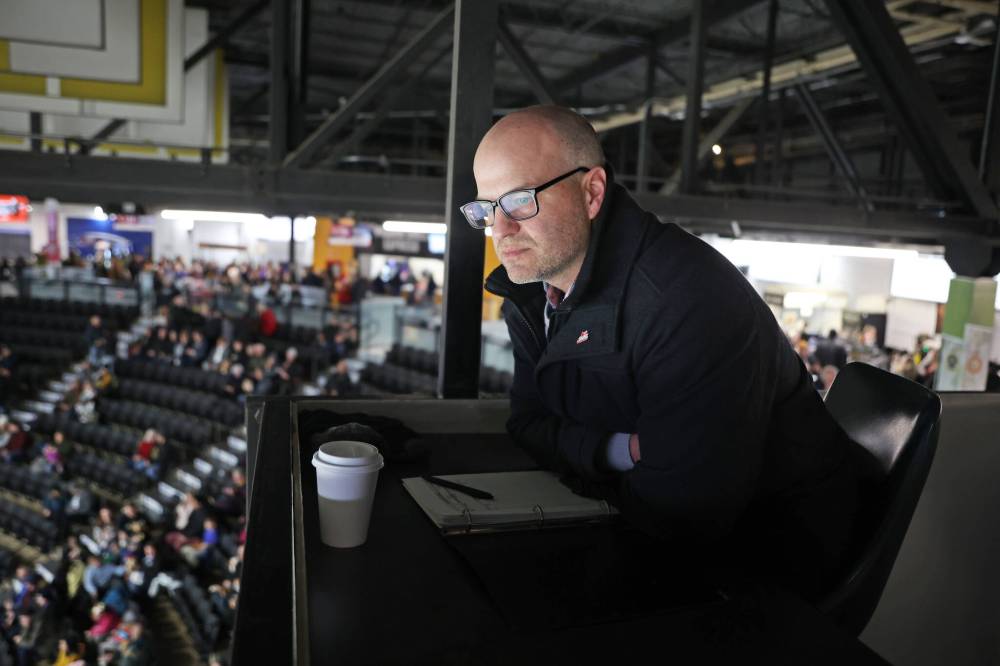
Sawchuk has been there since the program began during the 2009-10 season and handles scheduling for the three.
Hutlet spent three seasons in the WHL as a linesman from 1989 to 1991. He became a video judge 14 or 15 years ago, replacing Chad Cobbe. Gagnon replaced Mike Marshall, so in the history of the program, only five men have done the job in Brandon.
Hutlet said it gives him a chance to contribute to the WHL.
“That’s why I do it,” Hutlet said. “Otherwise, I don’t know if I would ever get out to watch a game. My wife is not interested, so for me it’s an opportunity to go out and watch a game every now and then. I don’t really care for it when it’s 40 below and you have to come out and jump into a cold vehicle, but that’s Manitoba.”
Gagnon reffed his last game on March 2, 2016 after working in the league for seven years beginning in 2009-10. He’s in his third year as a video goal judge, and also serves as the Manitoba Junior Hockey League’s director of officiating.
He took on the WHL job after he was contacted by Kevin Muench, the league’s senior director of officiating and facilities.
While Gagnon is happy to be doing his part for the WHL, a big part of the job for him is before the game when the video goal judge visits the officials room. It also allows him to get a look at some of his MJHL staff who are working WHL games too.
“It’s really nice to catch up with old friends that I used to officiate with who are still in the league,” Gagnon said. “They travel a lot — and that’s part of the reason I can’t do it anymore — but they do come here, and it’s nice to see those guys.
“Not only that, I get to see a lot of my officials in the MJHL as well and see their progress, and a lot of them ask me questions in regard to situations. It’s always nice for them to ask because then I feel like I’m involved still.”
The league introduced video review in the 2008 league final between the Lethbridge Hurricanes and Spokane Chiefs, and more enhanced video replay systems made by Hawk-Eye Innovations were installed in all WHL facilities in time for the start of the 2016-17 season.
But the system is only as good as the people who use it, and when Sawchuk was recruited, it was because the league was looking for ex-referees.
“We knew the rules, so that’s how it all got started,” Sawchuk said. “The majority of the people in each centre were ex-officials.”
Every year, the league holds a conference with its video goal judges to review all the rules, and they send out a manual, power points, videos, and links to situations from the WHL and National Hockey League. They set out the guidelines for all the procedures, what can and can’t be reviewed and what constitutes a good goal.
“Understanding the game and understanding the rules just makes our lives a lot easier at this level,” Gagnon said. “If you go in there without having done it, then you’re really relying on a book and not a feel and understanding. It’s quicker when we understand when we’re needed and what to look for when a play is on.”
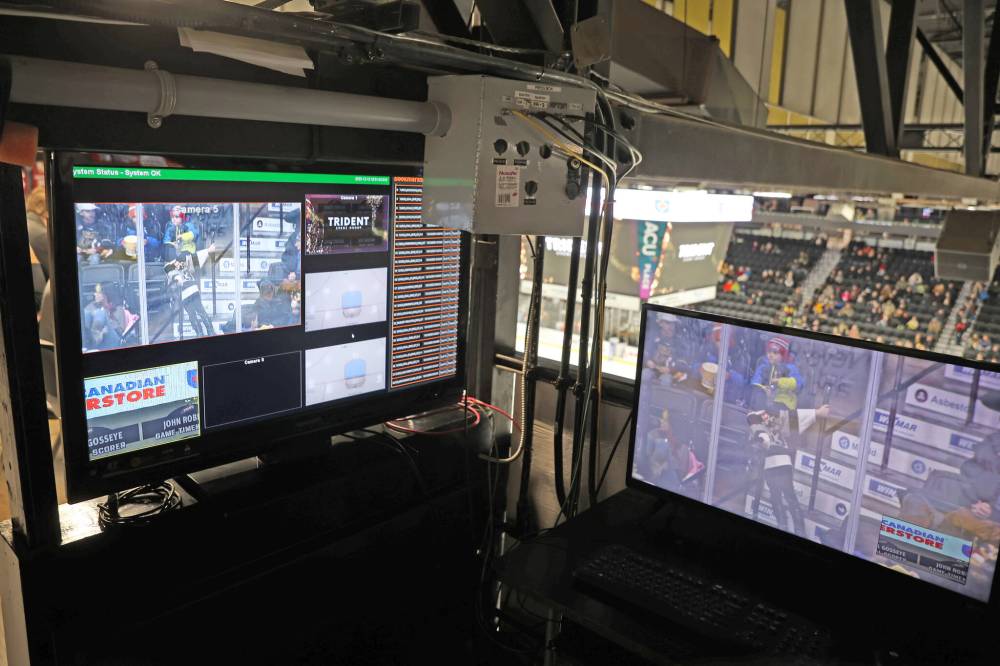
The video booth in Brandon, which is located in the south press box, includes a monitor with six different feeds, and a technician who actually operates the equipment. The video goal judge never touches it.
WHAT’S REVIEWED
Every goal is reviewed, although most times the puck is fairly obviously in the net, and it doesn’t take long. Still, the puck isn’t dropped at centre ice until the referees get that official verification via the timekeepers.
“There’s a lot of nights where there isn’t a lot to do,” Hutlet said. “To keep us alert, we have to record every stoppage of play in case there’s a problem with the clock, we have the last stoppage of play … You watch every goal that’s scored, but if it’s a clean goal, you watch it and give a thumbs up to the guys in the penalty box and then they give the thumbs up to the official, and they drop the puck.
“There are a lot of nights we’re a non-factor in the game.”
This season, Gagnon hasn’t handled a single review on a goal, but he’s also had three in a period before.
There are actually just 12 situations that can be looked at, and that doesn’t include offside, which was taken off the list this season.
“Basically any time there is a review, the majority is to determine the legitimacy of a goal,” Sawchuk said. “It’s did the puck actually cross the goal line? There are situations we can review, like high sticks. Was the puck batted down with a high stick?
“Also, it’s things like, was there a hand pass in the offensive zone that led to a goal in which the officials didn’t call it? We can review that and disallow that goal too.”
Other things include whether the puck hit the netting above the glass before a goal. In addition, the league announced in 2019 that all four-minute high-sticking calls would go to an automatic video review to double-check that it was the offender’s stick that hit the player.
That came into play recently in Brandon when Wheat Kings captain Caleb Hadland was flagged for a four-minute penalty, but the review showed it was actually the stick of a teammate that struck the player and made him bleed, so the penalties were taken off the board.
Even so, majors remain entirely at the discretion of the officials.
The video goal judges are always looking at close plays, even before the referee calls up.

On Friday during a game against the Kelowna Rockets, Wheat Kings forward Brady Turko went in on a breakaway in the third period and rang a wicked shot off the crossbar.
“We quickly bring that up just in case,” Sawchuk said. “Did it go underneath the back bar and come out?” Sawchuk said. “In that situation it clearly rang off the crossbar and came out, and the play went on. “As (the play) goes on, I’m quickly looking to ensure it did in fact hit the crossbar. If it did go in, if I’m looking at it and can 100 per cent confirm it was did go in, I would call down and the timekeepers would buzz the horn and the play would stop.
“I would talk to the referees and say that puck actually went in the net, and then we would revert back to the time when the goal was scored.”
Sawchuk is also able to rely on his training as a referee in that situation, noting a shot off the crossbar makes a sharp “ting” noise, while if it hits the back bar inside the net, it sounds more like a dull thud.
When the referee picks up the phone at the timekeepers bench, he has a direct patch through to the video goal judge.
“What we want to know is what the call on the ice is because essentially we’re looking for supporting evidence to confirm it or overturn it,” Gagnon said. “If we can’t get that 100 per cent clarity, then it’s inconclusive and the call on the ice stands. That’s why it’s important to have that call on the ice.”
Sawchuk has had a similar experience.
“A couple of weeks ago I spoke to the referee when it went off the back bar and came out,” Sawchuk said. “It was a goal, and he signalled it was a goal, and he called upstairs. He said, “I have a good goal on that, but obviously it went into the back of the net and came out very quickly, I’m just considering it was a good goal.’”
The referees may also call up a play like a wrap-around where the goalie’s pad was at the post and the puck went out of sight. But that’s also where the technology can prove inconclusive.
In the NHL, where the video review technology was introduced during the 1991-92 season, there can be nearly as many cameras in one net as there are in an entire WHL rink.
While emotional fans are often able to tell from 300 feet whether a puck was in or not, video goal judges work to more exacting standards.
“With the Western Hockey League, we can’t make mistakes,” Sawchuk said. “At the same time, we’re not the NHL. The Hawk-Eye system is a very good system for the Western Hockey League, but it isn’t the NHL, so we don’t have every single high-def camera and angles that NHL arenas have, but what the Western Hockey League have is very good. There are situations where you have to go with the call on the ice.
“If we can’t 100 per cent confirm, yes, a goal happened, or no, a goal didn’t happen, then you go with the referee’s decision on ice.”
Gagnon agreed.
“It’s frustrating at times,” Gagnon said. “Obviously we can only do what we can with what we have. I think when we were doing off-sides, a lot of that came down to not having the proper angles. Unfortunately, when we were looking down the line, we didn’t have the down-line camera to make a proper call, so a lot of it was inconclusive, so they felt there was no need for it.
“All we can do is do the best we can with what we’ve got, but sometimes if it isn’t a great angle, then it is what it is.”
But that doesn’t mean mistakes never happen. In fact, Gagnon had a technology-related issue in his very first game after he was called on to look at a goal where there might have been an off-side, which could still be reviewed at the time.
“We had a little bit of a glitch going on with the camera and at the time we couldn’t find conclusive evidence of an off-side,” Gagnon said. “Then later on we did watch it when the cameras were better and it was clearly off-side. The first one was a mistake already, which wasn’t a good feeling.”
Naturally, there are more rules involved than the normal fan might realize.
If a puck is hit by a high stick or it strikes the netting above the boards, but the play continues, clears the blue-line, comes back into the end and a goal is scored, then nothing can be done.
“That’s another situation where you can’t review it,” Sawchuk noted.
HIGH STAKES
Like all referees, Sawchuk wishes that some rules were better understood by fans, while noting that coaches usually understand but differ on the interpretation and application.
There are some differences between WHL and NHL rulebooks, like the fact that a player can kick the puck in from outside the crease in major junior.
Gagnon said it would be nice if fans understood how difficult it is to be on the ice and see everything that’s happening. It’s much, much easier to see those things from the press box and the stands.
“Actually being out there on the ice, it’s different angles and different sight lines,” Gagnon said. “Obviously when we’re watching a game from the eagles’ eye, sometimes you see it a lot different than we would see it on the ice.”
In addition, with the evolution of the rules over the years, the law 10 years ago might no longer be in force. Since reading the newest rule book is done by very few people other than officials, confusion invariably abounds.
“It just blows me away how long people who have been around the game don’t understand the rules of the game, at any level of hockey,” Hutlet said. “They think they know and get upset about something but don’t know the rulebook. If you even watch a kids’ hockey game, that’s evident.”
Even with his knowledge of the rules, Sawchuk is acutely aware of how important his decisions can be. A blown call could mean a team misses the playoffs, and that has financial implications.
“There have been lots of situations where we’ve had to overturn calls,” Sawchuk said. “It’s 100 per cent on video. Video doesn’t lie, so that’s what we go off of.”
The names of all game staff are put up on the scoreboard before the puck drops, so they certainly aren’t anonymous.
While their buddies do bring up the job from time to time, Sawchuk, Gagnon, Hutlet, and all the other video goal judges are working under Fight Club rules. As 1990s movie fans will remember, the first rule of Fight Club is not to talk about Fight Club.
“I know a lot of people in Brandon and see my name up there, and they do ask a lot of questions,” Gagnon said. “I’m not supposed to bring up too many details anyway. Sometimes it’s fun when they give you a little bit of heck when you overturn something that didn’t go in their favour.
“They understand the job and a lot of people think it’s pretty cool.”
THIS AND THAT
• QUIZ — In the Internet era, is Brandon more likely to win its first game after Christmas on the road or at home? Which team are the Wheat Kings most likely to play?
• WEEKLY AWARDS — The player of the week is 18-year-old Brandon forward Joby Baumuller of Wilcox, Sask., who scored twice and added an assist in each of his last three games. That included a game-winning shorthanded goal against the Edmonton Oil Kings on Sunday.
The goaltender of the week is 17-year-old Calgary Hitmen netminder Eric Tu of White Rock, B.C., who stopped 46 of the 47 shots he faced last week while posting a pair of victories in his two appearances.
The rookie of the week is 18-year-old Medicine Hat Tigers defenceman Tyson Moss of Port Moody, B.C., who had his first career hat trick and an assist in a 10-2 drubbing of the Swift Current Broncos on Saturday.
• TRADE FRONT — There were two deals on Monday involving teams Brandon will play this week. The Prince George Cougars sent 17-year-old forward Patrick Sopiarz of Edmonton to the Red Deer Rebels for a third-round pick in 2026 and a conditional fourth-round pick in 2029.
Also, the Calgary Hitmen sent third-round picks in 2027 and 2028 to the Regina Pats for 18-year-old forward Julien Maze of Edmonton.
In a big deal last Tuesday, the Saskatoon Blades sent former Wheat Kings overage forward Dominik Petr and a fifth-round pick in 2029 to the Spokane Chiefs for 19-year-old German forward Elias Pul and 17-year-old defenceman Kaden Allan of Hamiota.
• SIN BIN — Some pre-Christmas naughtiness ensued in Wednesday’s game between Swift Current and Kelowna. Both teams were fined $500, with Swift getting nailed for a one-man fight that landed Stepan Kuryachenkov a game misconduct and one-game suspension, and Kelowna paying up for Dawson Gerwing’s role as an instigator in the last five minutes that drew a two-game ban because he is a repeat offender.
• ALUMNI GLANCE — Chad Nychuk, 24, is suiting up with the ECHL’s Atlanta Gladiators, where he’s nearly producing the sort of numbers he did with the Wheat Kings in his final season in 2020-21. The Yellowhead Chiefs graduate, who has played one game with the American Hockey League’s Milwaukee Admirals this season, has three goals and 15 assists in 21 games, and is tied for fourth in league scoring among blue-liners.
The Rossburn Rifle was called up for three games in 2016-17 after signing as an undrafted free agent, and then spent the next four seasons in Brandon, exploding for 21 goals and 71 points in 64 games as an overager. He had 141 points in 206 career regular season games in the WHL.
• THE WEEK AHEAD — In Brandon’s final week before their brief Christmas break, they visit the Red Deer Rebels tonight, the Medicine Hat Tigers on Wednesday, and the Calgary Hitmen on Friday. The break officially begins for the players on Dec. 20, and they have to be back in Brandon on Boxing Day for a visit to the Moose Jaw Warriors on Dec. 27. Their next home game is against the Warriors on Sunday, Dec. 28, at 4 p.m.
• ANSWER — In 28 games since the Internet era began on the WHL website in 1996, Brandon has played 19 games at home and gone 11-5-2-1. On the road, they’ve gone 4-5-0-0. Overall they’re 15-10-2-1 in their first game after Christmas.
They’ve returned on Dec. 27 on 21 occasions, and seven times came back on Dec. 28.
The Pats have been their most frequent post-Christmas opponent with 16 matchups, followed by Saskatoon (3), Swift Current (3), Moose Jaw (2), Winnipeg (2), Red Deer (1), and Calgary (1).
They’ve scored a high of eight goals twice, both against Regina, in an 8-0 win in 2013 and an 8-2 win in 2003.