
Manitoba wildfires, Arctic Ocean storm among Canada’s top weather events for 2025
Advertisement
Read this article for free:
or
Already have an account? Log in here »
We need your support!
Local journalism needs your support!
As we navigate through unprecedented times, our journalists are working harder than ever to bring you the latest local updates to keep you safe and informed.
Now, more than ever, we need your support.
Starting at $15.99 plus taxes every four weeks you can access your Brandon Sun online and full access to all content as it appears on our website.
Subscribe Nowor call circulation directly at (204) 727-0527.
Your pledge helps to ensure we provide the news that matters most to your community!
To continue reading, please subscribe:
Add Brandon Sun access to your Free Press subscription for only an additional
$1 for the first 4 weeks*
*Your next subscription payment will increase by $1.00 and you will be charged $20.00 plus GST for four weeks. After four weeks, your payment will increase to $24.00 plus GST every four weeks.
Read unlimited articles for free today:
or
Already have an account? Log in here »
Behemoth wildfires forced tens of thousands of people to flee their homes across Canada, making it the most impactful weather event in Environment Canada’s top 10 list this year.
An estimated 89,000 square kilometres of land, larger than the size of New Brunswick and Prince Edward Island combined, was burned across Canada in 2025.
Nearly half of that was in Saskatchewan and Manitoba, where both have been victim to prolonged drought.
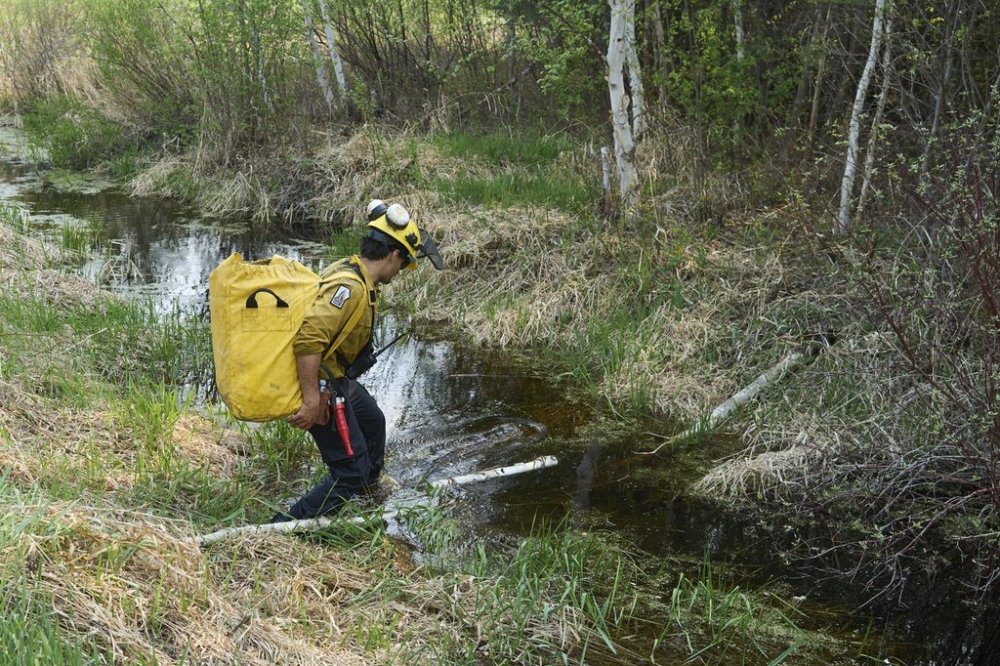
On its own, Manitoba had more than 32,000 residents evacuated from their communities.
In Saskatchewan, half the village of Denare Beach was razed by a wildfire early in the season.
Environment Canada’s list also includes heat waves, thunderstorms and memorable snowstorms — but the breadth of wildfire damage had the most affect on Canadians.
“Canada’s 2025 wildfire year will be remembered as one of the worst on record,” Jennifer Smith, a national warning preparedness meteorologist with Environment and Climate Change Canada, said on Thursday.
The 2025 wildfire year’s total burned land is second to only 2023 when Natural Resources Canada says more than 184,000 square kilometres of land was scorched.
The agency also says 2025 saw drought conditions worsen across much of the country.
Smith pointed to northeastern B.C. where Dawson Creek, a city of 12,000 people, was warned it only had 150 days of stored water remaining. Smith said parts of the St. Lawrence River had fallen so low some boats were “stranded in mudflats.”
“For a nation known for its lakes and rivers, the scale of this dryness was both unusual and unsettling.”
And the year began dry, with fires starting in Alberta in late April. In Manitoba, daytime highs in the province rose above 35 C from May 11 to 13 and parched land across the west became a meal for insatiable fires.
“For some of the events that we’re seeing in this list and across Canada, we can see a clear influence of climate change,” said Nathan Gillett, a researcher with Environment Canada.
“For example, on more hot extremes, the evidence there is very strong.”
Other regions were slammed by snowfall or icy weather.
In late March, Ontario and Quebec were coated in a thick, clear cast of ice after prolonged freezing rain — a major ice storm that made fifth on Environment Canada’s list.
It was beautiful to look at, said Smith, but dangerous in its weight.
Coated trees and blossoms were joined by sagging powerlines. Millions of homes lost power.
Only a month before, the two provinces were among those that were covered in snow through February and a trio of fierce and frosty storms, sixth on the agency’s list.
On Feb. 17, Montreal broke a record set in 1941 for its snowiest four-day streak with 74 centimetres altogether.
“This year had it all,” said Smith.
This report by The Canadian Press was first published Dec. 18, 2025.