
U.S. carbon capture firm says Alberta ticks boxes to get technology off the ground
Advertisement
Read this article for free:
or
Already have an account? Log in here »
We need your support!
Local journalism needs your support!
As we navigate through unprecedented times, our journalists are working harder than ever to bring you the latest local updates to keep you safe and informed.
Now, more than ever, we need your support.
Starting at $15.99 plus taxes every four weeks you can access your Brandon Sun online and full access to all content as it appears on our website.
Subscribe Nowor call circulation directly at (204) 727-0527.
Your pledge helps to ensure we provide the news that matters most to your community!
To continue reading, please subscribe:
Add Brandon Sun access to your Free Press subscription for only an additional
$1 for the first 4 weeks*
*Your next subscription payment will increase by $1.00 and you will be charged $20.00 plus GST for four weeks. After four weeks, your payment will increase to $24.00 plus GST every four weeks.
Read unlimited articles for free today:
or
Already have an account? Log in here »
CALGARY – The chief executive of a U.S.-based carbon capture startup embarking on a project in Alberta’s oilsands says Canada ticks a lot of the boxes needed to bring the emissions-reducing technology into widespread use.
“Alberta specifically is a really great confluence of all the right factors coming together to give Canada a chance to lead in this ecosystem,” said Cameron Halliday, co-founder of Cambridge, Mass.-based Mantel Capture.
“You’ve got the policy support. You’ve got the carrot and the stick.”
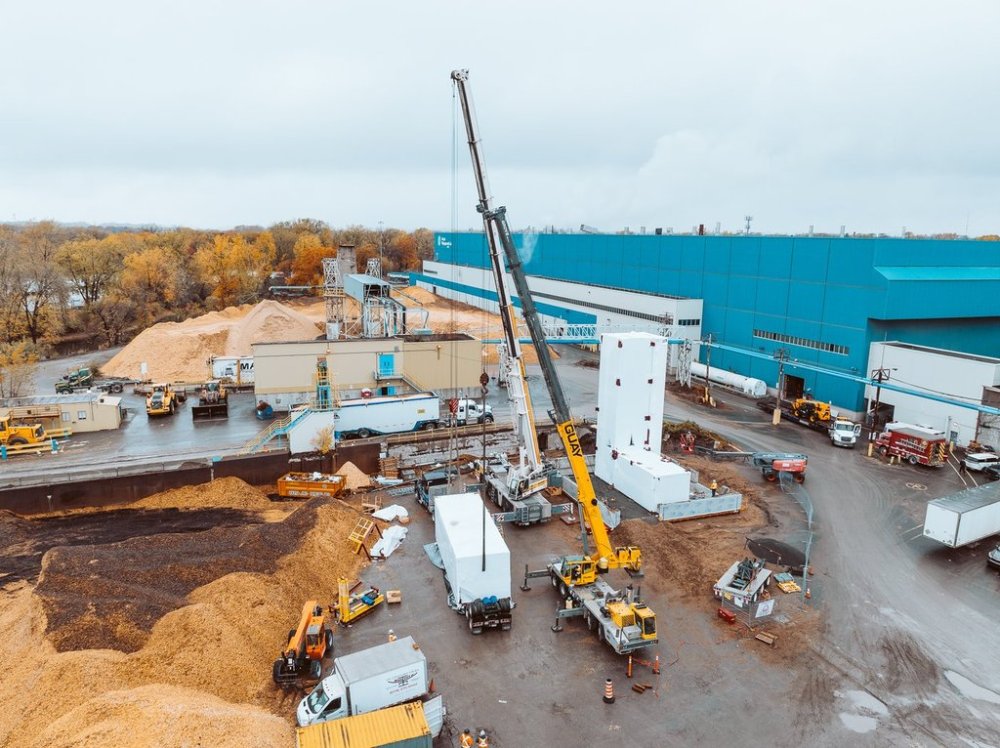
Mantel announced last week that it has begun an early engineering and design study for a commercial-scale project in Alberta’s oilsands. It’s not identifying its partner at this stage, but it’s a producer that uses steam-assisted gravity drainage techniques to extract bitumen from deep underground.
The project is designed to capture 60,000 tonnes of carbon dioxide per year. Usually, carbon capture projects consume a lot of energy, but Mantel’s technology aims to harness what powers its system instead of wasting it, as the 150,000 tonnes of high-pressure steam it generates can be used in its oilsands partner’s operations.
Mantel is not disclosing the cost of the project at this time. It is receiving support from Alberta Innovates, a provincial Crown corporation.
It builds on a demonstration project at Kruger Inc.’s Wayagamack pulp and paper mill in Trois-Rivières, Que., that’s designed to capture 2,000 tonnes of carbon dioxide and generate steam for the mill.
Halliday said Mantel’s modular equipment can be bolted on to many different kinds of industrial plants, like cement, steel, chemicals and power generation.
He called it a “value-additive exercise” on top of the benefit of preventing climate-warming emissions from entering the atmosphere.
“We need a way to do this, frankly, that makes money for the people that are putting their neck out and investing in these things,” he said. “The way to do that is to do it efficiently.”
Alberta is a “sophisticated” player in the carbon capture space with the right policy support with both a price on carbon and tax incentives, Halliday said.
Another thing the province has going for it is the people, as skills in the oil and gas industry mirror many of those needed in the carbon capture business.
“They have a good understanding of the subsurface for sequestration. Even the equipment above ground — it’s chemical-processing type equipment that these guys just understand. It looks familiar to them.”
Mantel is not involved in the Pathways Alliance, a group of some of Canada’s biggest oilsands companies proposing to build what would be one of the world’s largest carbon capture projects, with an estimated cost of $16.5 billion.
Pathways would capture carbon dioxide emissions from more than 20 oilsands facilities in northern Alberta and transport them 400 kilometres away by pipeline to a terminal in the Cold Lake area in eastern Alberta, where they would be stored in an underground hub.
It was a key feature of a memorandum of understanding signed between the Alberta and federal governments late last month. Pathways and a new West Coast bitumen pipeline going ahead are “mutually dependent,” the agreement says.
Halliday said he’s supportive of Pathways, as the carbon pipeline would be a key piece of infrastructure that would make other developments possible.
Halliday said he would like to see carbon capture technology reach the point where it’s an automatic addition to all new industrial plants, like equipment that has long been used to remove sulphur dioxide and other pollutants from flue gases.
“No one thinks about that technology anymore. It’s just deployed on the back of everything. It’s part of how industry operates,” he said.
“And our vision is for our carbon capture technology to be the same.”
This report by The Canadian Press was first published Dec. 22, 2025.