
Trucking association pitches ‘trusted employer’ program
Advertisement
Read this article for free:
or
Already have an account? Log in here »
We need your support!
Local journalism needs your support!
As we navigate through unprecedented times, our journalists are working harder than ever to bring you the latest local updates to keep you safe and informed.
Now, more than ever, we need your support.
Starting at $15.99 plus taxes every four weeks you can access your Brandon Sun online and full access to all content as it appears on our website.
Subscribe Nowor call circulation directly at (204) 727-0527.
Your pledge helps to ensure we provide the news that matters most to your community!
To continue reading, please subscribe:
Add Brandon Sun access to your Free Press subscription for only an additional
$1 for the first 4 weeks*
- Enjoy unlimited reading on brandonsun.com
- Read the Brandon Sun E-Edition, our digital replica newspaper
*Your next Free Press subscription payment will increase by $1.00 and you will be charged $20.95 plus GST for four weeks. After four weeks, your payment will increase to $24.95 plus GST every four weeks.
Read unlimited articles for free today:
or
Already have an account? Log in here »
Hey there, time traveller!
This article was published 23/12/2025 (228 days ago), so information in it may no longer be current.
WINNIPEG — In an effort to prevent worker abuse, the Manitoba Trucking Association is pushing for “trusted employer” certification within Canadian immigration programs.
“It’s not OK to break the law,” said Aaron Dolyniuk, the MTA’s executive director. “It’s not OK to sacrifice workers’ rights for your purpose of profit.”
Dolyniuk met with Manitoba’s deputy minister of labour and immigration earlier this month. During the meeting, the association pitched a new certification process that’s trucking-industry specific, Dolyniuk said.
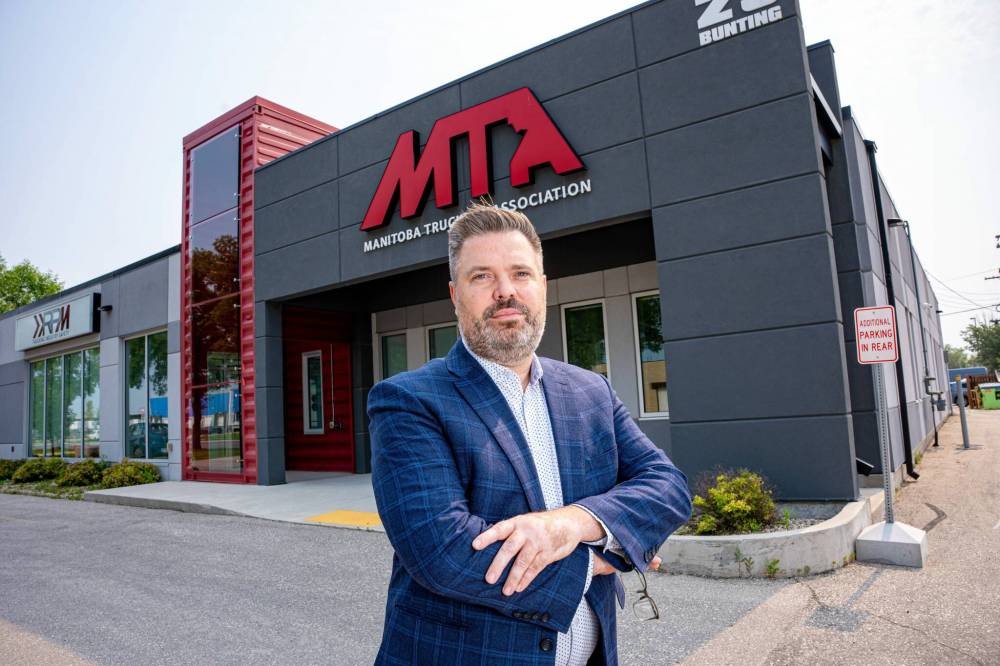
Aaron Dolyniuk, executive director of the Manitoba Trucking Association, plans to pitch the certification to the federal government in the new year. (Nic Adam/Winnipeg Free Press files)
The MTA envisions a program where companies demonstrate their ability to onboard foreign workers, including helping immigrants get a driver’s licence and social insurance number. Firms would need to prove a clean record of labour compliance to an auditor.
Capacity — ensuring a company’s number of trucks aligns with the staff they’re seeking — would be considered. Businesses would show their certification when applying for foreign workers through federal or provincial programs, Dolyniuk said.
Deputy minister Michelle Wallace didn’t address the proposed certification when asked.
“The Manitoba Trucking Association is a valued partner, and we will continue working together to support the sector’s long-term workforce needs,” she wrote in a statement.
Dolyniuk said he intends to meet again with Manitoba’s labour department in 2026. He also plans to pitch the certification to the feds in the new year; he sits on a federal advisory committee covering trucking and immigration.
The Manitoba Trucking Association has been rallying for years against labour trafficking and trucking firms operating illegally.
Recently, it jointly launched an advertising campaign with Winnipeg Crime Stoppers and the Joy Smith Foundation to, in part, elicit tips from people witnessing labour trafficking in the sector.
Billboards, bus exterior ads and digital advertisements have popped up throughout Manitoba since September. Awareness creation through the $276,000 campaign has “exceeded expectations,” said Janet Campbell, president of the Joy Smith Foundation.
Campbell estimates the messaging has been seen more than 52 million times. Signage directs viewers to the campaign’s website (traffickingreport.ca), which lists trafficking signs and shares Joy Smith Foundation and Crime Stoppers contact information.
“We have received calls on a regular basis in our office,” Campbell said, declining to provide exact numbers. “Those numbers continue to increase across the board, with people calling in with concerns or questions.”
Nearly 40 per cent of trucking companies that hired foreign workers through the Labour Market Impact Assessment program in 2019 to 2023 have shuttered, the Joy Smith Foundation said in September. The non-profit works to prevent human trafficking.
In 2024, 13 of 77 trucking companies the Workers Compensation Board of Manitoba audited had under-reported their payrolls, sometimes by millions of dollars. Under-reporting can be linked to worker mistreatment, the Manitoba Trucking Association has said.
“The challenge is, we regulate immigration sort of in one way across industries,” Dolyniuk said. “Different industries have different needs … It needs to be a bit more specific.”
He expects companies would pay to undergo “trusted employer” certification. Government would need to ensure it has capacity for audits, he said.
Reaching foreign workers immigrating to Canada is complicated, noted Lori Wilkinson, a University of Manitoba sociology professor and the Canada Research Chair in migration futures.
“I think people really underestimate the need — it’s a need to migrate,” Wilkinson said. “People will put their lives on hold, and sometimes in danger, just to get here.”
They can also be naïve, Wilkinson continued: migrants might get advice from family and friends telling them Canada is a hard adjustment at first, but you get used to it. The advisers may have arrived via a different stream of immigration.
Employers are vetted by government officials before being approved for foreign workers. A lack of rule enforcement is where problems occur, Wilkinson said.
Ottawa made changes to its temporary foreign worker program last year. Among the moves, companies hiring workers under a low-wage stream would be capped at 10 per cent of their total workforce (instead of 20 per cent previously).
The temporary foreign worker program has seen a halving of applications in the following year, Employment and Social Development Canada reported in October.
» Winnipeg Free Press